


Page 361 - ACCCN's Critical Care Nursing
P. 361
338  P R I N C I P L E S   A N D   P R A C T I C E   O F   C R I T I C A L   C A R E


                                                              A                           B
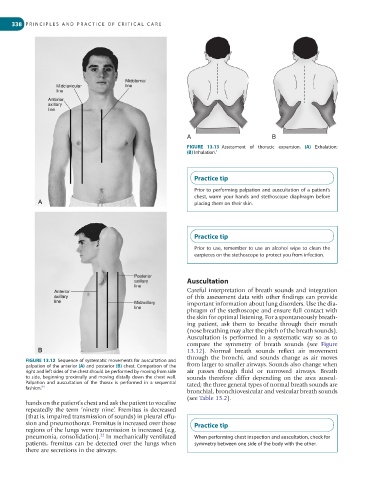
                                                              FIGURE  13.13  Assessment  of  thoracic  expansion.  (A)  Exhalation;
                                                              (B) Inhalation.   1


                                                                 Practice tip
                                                                 Prior  to  performing  palpation  and  auscultation  of  a  patient’s
                                                                 chest,  warm  your  hands  and  stethoscope  diaphragm  before
                                                                 placing them on their skin.


                                                                 Practice tip

                                                                 Prior  to  use,  remember  to  use  an  alcohol  wipe  to  clean  the
                                                                 earpieces on the stethoscope to protect you from infection.


                                                              Auscultation
                                                              Careful interpretation of breath sounds and integration
                                                              of this assessment data with other findings can provide
                                                              important information about lung disorders. Use the dia-
                                                              phragm of the stethoscope and ensure full contact with
                                                              the skin for optimal listening. For a spontaneously breath-
                                                              ing  patient,  ask  them  to  breathe  through  their  mouth
                                                              (nose breathing may alter the pitch of the breath sounds).
                                                              Auscultation  is  performed  in  a  systematic  way  so  as  to
                                                              compare  the  symmetry  of  breath  sounds  (see  Figure
                                                              13.12).  Normal  breath  sounds  reflect  air  movement
                                                              through  the  bronchi,  and  sounds  change  as  air  moves
         FIGURE 13.12  Sequence of systematic movements for auscultation and
         palpation of the anterior (A) and posterior (B) chest. Comparison of the   from larger to smaller airways. Sounds also change when
         right and left sides of the chest should be performed by moving from side   air  passes  though  fluid  or  narrowed  airways.  Breath
         to  side,  beginning  proximally  and  moving  distally  down  the  chest  wall.   sounds  therefore  differ  depending  on  the  area  auscul-
         Palpation  and  auscultation  of  the  thorax  is  performed  in  a  sequential   tated; the three general types of normal breath sounds are
         fashion.
               84
                                                              bronchial, bronchiovesicular and vesicular breath sounds
                                                              (see Table 13.2).
         hands on the patient’s chest and ask the patient to vocalise
         repeatedly the term ‘ninety nine’. Fremitus is decreased
         (that is, impaired transmission of sounds) in pleural effu-
         sion and pneumothorax. Fremitus is increased over those   Practice tip
         regions of the lungs were transmission is increased (e.g.
                                  22
         pneumonia, consolidation).  In mechanically ventilated   When performing chest inspection and auscultation, check for
         patients,  fremitus  can  be  detected  over  the  lungs  when   symmetry between one side of the body with the other.
         there are secretions in the airways.

