


Page 445 - ACCCN's Critical Care Nursing
P. 445
422  P R I N C I P L E S   A N D   P R A C T I C E   O F   C R I T I C A L   C A R E


            TABLE 16.3, Continued

            Division                   Description               Functions
            Medulla oblongata          Between the pons and the spinal   The medulla oblongata contains motor fibres from the brain to
                                         cord.                     the spinal cord and sensory fibres from the spinal cord to the
                                                                   brain. Most of these fibres cross at this level. Cranial nerves
                                                                   IX–XII connect to the brain in the medulla, which has centres
                                                                   for control of vital functions, such as respiration and the heart
                                                                   rate.


            Cerebellum                 Below the posterior portion of the   Coordinates voluntary muscles; maintains balance and muscle
                                         cerebellum. Divided into two   tone; has both excitatory and inhibitory actions. It also
                                         hemispheres.              controls fine movement, balance, position sense and
                                                                   integration of sensory input.


                                                        Central      Primary sensory
                                   Primary motor cortex  sulcus          cortex
                                    (precentral gyrus)              (postcentral gyrus)

                   Somatic motor association
                    area (premotor cortex)                                        PARIETAL LOBE


                                                                                    Parieto-occipital sulcus

                    FRONTAL LOBE                                                                   Somatic sensory
                                                                                                   association area

                Prefrontal cortex                                                             Visual association area
                                                                                                OCCIPITAL LOBE
               Gustatory cortex
                                                                                             Visual cortex

                          Insula                                                           Auditory association area
                       Lateral sulcus
                                                                                 Auditory cortex
                                  Olfactory cortex
                                                                          TEMPORAL LOBE
                            Frontal eye field
        Speech centre                                      A
                                                                                       4
                                                                                    6
                                                                                        1
                                                   General interpretive
                                                          area                            40  39
                                                                                   44  41  42

                                                                                                 16
                                                                                                    17

             Prefrontal
              cortex            B                                                     C
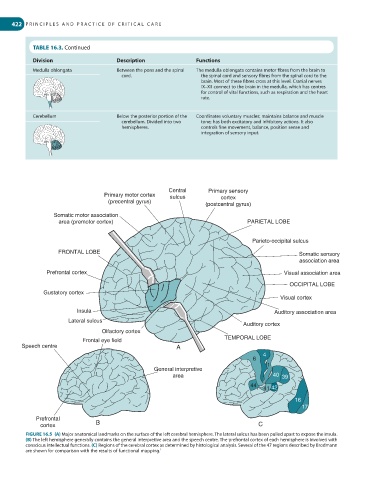
         FIGURE 16.5  (A) Major anatomical landmarks on the surface of the left cerebral hemisphere. The lateral sulcus has been pulled apart to expose the insula.
         (B) The left hemisphere generally contains the general interpretive area and the speech centre. The prefrontal cortex of each hemisphere is involved with
         conscious intellectual functions. (C) Regions of the cerebral cortex as determined by histological analysis. Several of the 47 regions described by Brodmann
         are shown for comparison with the results of functional mapping.   1

