


Page 451 - ACCCN's Critical Care Nursing
P. 451
428  P R I N C I P L E S   A N D   P R A C T I C E   O F   C R I T I C A L   C A R E


                                                                          Parietal emissary
                               Superior sagittal sinus
                             Inferior sagittal sinus
                                                                                 Diploic


                                                                                   Superior ophthalmic

                              Straight sinus                                       Cavernous sinus
                        Superior petrosal sinus

                            Transverse sinus                                           Angular
                                Sigmoid sinus
                               Mastoid emissary
                              Inferior petrosal sinus

                                   Retromandibular
                                                                                   Anterior facial
                                                                          Maxillary

                                                                       Internal jugular
                                        External jugular
                                                       Vertebral
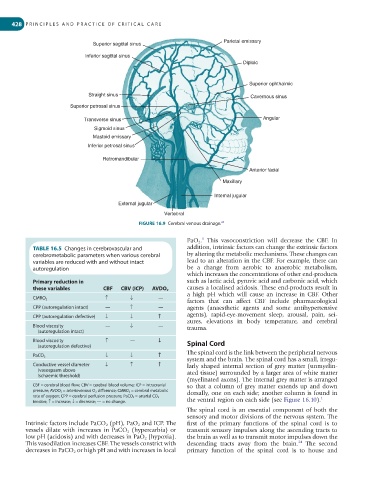
                                              FIGURE 16.9  Cerebral venous drainage.
                                                                         23
                                                                   1
                                                              PaO 2 .   This  vasoconstriction  will  decrease  the  CBF.  In
            TABLE 16.5  Changes in cerebrovascular and        addition, intrinsic factors can change the extrinsic factors
            cerebrometabolic parameters when various cerebral   by altering the metabolic mechanisms. These changes can
            variables are reduced with and without intact     lead to an alteration in the CBF. For example, there can
            autoregulation                                    be  a  change  from  aerobic  to  anaerobic  metabolism,
                                                              which increases the concentrations of other end-products
            Primary reduction in                              such as lactic acid, pyruvic acid and carbonic acid, which
            these variables        CBF   CBV (ICP)  AVDO 2    causes a localised acidosis. These end-products result in
                                                              a  high  pH  which  will  cause  an  increase  in  CBF.  Other
                                   ↑        ↓        —
                                                              factors  that  can  affect  CBF  include  pharmacological
            CMRO 2
            CPP (autoregulation intact)  —  ↑        —        agents  (anaesthetic  agents  and  some  antihypertensive
            CPP (autoregulation defective)  ↓  ↓     ↑        agents),  rapid-eye-movement  sleep,  arousal,  pain,  sei-
                                                              zures,  elevations  in  body  temperature,  and  cerebral
            Blood viscosity        —        ↓        —        trauma.
             (autoregulation intact)
            Blood viscosity        ↑        —        ↓        Spinal Cord
             (autoregulation defective)
                                                              The spinal cord is the link between the peripheral nervous
                                   ↓        ↓        ↑
            PaCO 2
                                                              system and the brain. The spinal cord has a small, irregu-
            Conductive vessel diameter   ↓  ↑        ↑        larly shaped internal section of grey matter (unmyelin-
             (vasospasm above                                 ated tissue) surrounded by a larger area of white matter
             ischaemic threshold)
                                                              (myelinated axons). The internal grey matter is arranged
            CBF = cerebral blood flow; CBV = cerebral blood volume; ICP = intracranial   so  that  a  column  of  grey  matter  extends  up  and  down
            pressure; AVDO 2  = arteriovenous O 2  difference; CMRO 2  = cerebral metabolic   dorsally, one on each side; another column is found in
            rate of oxygen; CPP = cerebral perfusion pressure; PaCO 2  = arterial CO 2                    1
            tension; ↑ = increase; ↓ = decrease; — = no change.  the ventral region on each side (see Figure 16.10).
                                                              The  spinal  cord  is  an  essential  component  of  both  the
                                                              sensory and motor divisions of the nervous system. The
         Intrinsic factors include PaCO 2  (pH), PaO 2  and ICP. The   first  of  the  primary  functions  of  the  spinal  cord  is  to
         vessels  dilate  with  increases  in  PaCO 2   (hypercarbia)  or   transmit sensory impulses along the ascending tracts to
         low pH (acidosis) and with decreases in PaO 2  (hypoxia).   the brain as well as to transmit motor impulses down the
                                                                                                   24
         This vasodilation increases CBF. The vessels constrict with   descending  tracts  away  from  the  brain.   The  second
         decreases in PaCO 2  or high pH and with increases in local   primary  function  of  the  spinal  cord  is  to  house  and

