


Page 448 - ACCCN's Critical Care Nursing
P. 448
Neurological Assessment and Monitoring 425


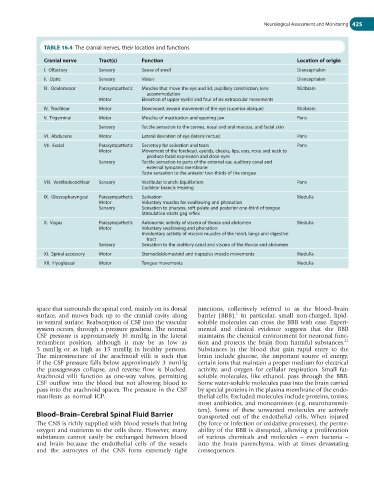
               TABLE 16.4  The cranial nerves, their location and functions

               Cranial nerve     Tract(s)      Function                                           Location of origin
               I.  Olfactory     Sensory       Sense of smell                                     Diencephalon
               II.  Optic        Sensory       Vision                                             Diencephalon
               III.  Oculomotor  Parasympathetic  Muscles that move the eye and lid, pupillary constriction, lens   Midbrain
                                                 accommodation
                                 Motor         Elevation of upper eyelid and four of six extraocular movements
               IV.  Trochlear    Motor         Downward, inward movement of the eye (superior oblique)  Midbrain
               V.  Trigeminal    Motor         Muscles of mastication and opening jaw             Pons
                                 Sensory       Tactile sensation to the cornea, nasal and oral mucosa, and facial skin
               VI.  Abducens     Motor         Lateral deviation of eye (lateral rectus)          Pons
               VII.  Facial      Parasympathetic  Secretory for salivation and tears              Pons
                                 Motor         Movement of the forehead, eyelids, cheeks, lips, ears, nose and neck to
                                                 produce facial expression and close eyes
                                 Sensory       Tactile sensation to parts of the external ear, auditory canal and
                                                 external tympanic membrane
                                               Taste sensation to the anterior two-thirds of the tongue
               VIII.  Vestibulocochlear  Sensory  Vestibular branch: Equilibrium                  Pons
                                               Cochlear branch: Hearing
               IX.  Glossopharyngeal  Parasympathetic  Salivation                                 Medulla
                                 Motor         Voluntary muscles for swallowing and phonation
                                 Sensory       Sensation to pharynx, soft palate and posterior one-third of tongue
                                               Stimulation elicits gag reflex
               X.  Vagus         Parasympathetic  Autonomic activity of viscera of thorax and abdomen  Medulla
                                 Motor         Voluntary swallowing and phonation
                                               Involuntary activity of visceral muscles of the heart, lungs and digestive
                                                 tract
                                 Sensory       Sensation to the auditory canal and viscera of the thorax and abdomen
               XI.  Spinal accessory  Motor    Sternocleidomastoid and trapezius muscle movements  Medulla
               XII.  Hyoglossal  Motor         Tongue movements                                   Medulla


             space that surrounds the spinal cord, mainly on its dorsal   junctions,  collectively  referred  to  as  the  blood–brain
                                                                              1
             surface,  and  moves  back  up  to  the  cranial  cavity  along   barrier  (BBB).   In  particular,  small  non-charged,  lipid-
             its ventral surface. Reabsorption of CSF into the vascular   soluble  molecules  can  cross  the  BBB  with  ease.  Experi-
             system occurs, through a pressure gradient. The normal   mental  and  clinical  evidence  suggests  that  the  BBB
             CSF  pressure  is  approximately  10  mmHg  in  the  lateral   maintains the chemical environment for neuronal func-
                                                                                                                  22
             recumbent  position,  although  it  may  be  as  low  as   tion  and  protects  the  brain  from  harmful  substances.
             5  mmHg  or  as  high  as  15  mmHg  in  healthy  persons.   Substances  in  the  blood  that  gain  rapid  entry  to  the
             The  microstructure  of  the  arachnoid  villi  is  such  that    brain  include  glucose,  the  important  source  of  energy,
             if the CSF pressure falls below approximately 3  mmHg   certain ions that maintain a proper medium for electrical
             the  passageways  collapse,  and  reverse  flow  is  blocked.   activity,  and  oxygen  for  cellular  respiration.  Small  fat-
             Arachnoid  villi  function  as  one-way  valves,  permitting   soluble  molecules,  like  ethanol,  pass  through  the  BBB.
             CSF outflow into the blood but not allowing blood to   Some water-soluble molecules pass into the brain carried
             pass into the arachnoid spaces. The pressure in the CSF   by special proteins in the plasma membrane of the endo-
             manifests  as  normal  ICP.                          thelial cells. Excluded molecules include proteins, toxins,
                                                                  most antibiotics, and monoamines (e.g. neurotransmit-
                                                                  ters).  Some  of  these  unwanted  molecules  are  actively
             Blood–Brain–Cerebral Spinal Fluid Barrier            transported  out  of  the  endothelial  cells.  When  injured
             The CNS is richly supplied with blood vessels that bring   (by force or infection or oxidative processes), the perme-
             oxygen and nutrients to the cells there. However, many   ability of the BBB is disrupted, allowing a proliferation
             substances  cannot  easily  be  exchanged  between  blood   of  various  chemicals  and  molecules  –  even  bacteria  –
             and  brain  because  the  endothelial  cells  of  the  vessels   into  the  brain  parenchyma,  with  at  times  devastating
             and  the  astrocytes  of  the  CNS  form  extremely  tight   consequences.

