


Page 450 - ACCCN's Critical Care Nursing
P. 450
Neurological Assessment and Monitoring 427

                                                                                              Anterior
                   Anterior                                                                   cerebral artery
                   cerebral
                   artery
                                                               Middle
                                                               cerebral
                                                               artery
                   Internal
                   carotid                                     Portion of
                   artery                                      temporal
                                                               lobe
                                                               removed
                   Basilar
                   artery                                      Posterior
                                                               inferior                          Middle
                   Anterior                                    cerebellar                        cerebral
                   inferior                                    artery   Posterior                artery
                   cerebellar                                           cerebral artery
                   artery                                      Vertebral  B
                                                               artery


                       Anterior
                       communicating                    Posterior
                       artery
                                                        communicating
                                                        artery
                       Posterior
                       cerebral artery                                                                 Anterior
                       (to midbrain)                                                                   cerebral
                                                                        C    Posterior                 artery
                                                        Basilar artery       cerebral
                                                        (to pons)            artery

                       A
                                                                Lenticulostriate
                                                                arteries


                                                                                                  Anterior
                                                                                                  cerebral
                                                                                                  artery


                                                                     Middle
                                                                     cerebral
                                                                     artery                     Anterior
                                                                                  Internal      communicating
                                                                                  carotid       artery
                                                                        D         artery
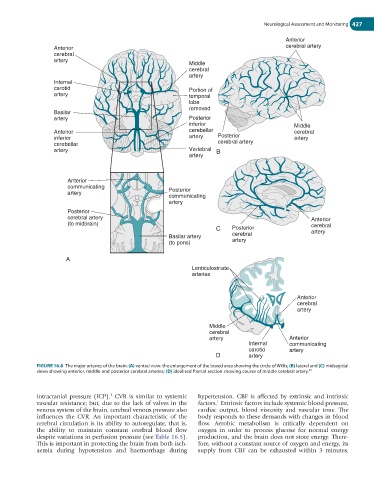
             FIGURE 16.8  The major arteries of the brain: (A) ventral view: the enlargement of the boxed area showing the circle of Willis; (B) lateral and (C) midsagittal
                                                                                                      82
             views showing anterior, middle and posterior cerebral arteries; (D) idealised frontal section showing course of middle cerebral artery.


                                     1
             intracranial  pressure  (ICP).   CVR  is  similar  to  systemic   hypertension.  CBF  is  affected  by  extrinsic  and  intrinsic
                                                                        1
             vascular resistance; but, due to the lack of valves in the   factors.  Extrinsic factors include systemic blood pressure,
             venous system of the brain, cerebral venous pressure also   cardiac  output,  blood  viscosity  and  vascular  tone.  The
             influences  the  CVR.  An  important  characteristic  of  the   body responds to these demands with changes in blood
             cerebral circulation is its ability to autoregulate, that is,   flow.  Aerobic  metabolism  is  critically  dependent  on
             the  ability  to  maintain  constant  cerebral  blood  flow   oxygen  in  order  to  process  glucose  for  normal  energy
             despite variations in perfusion pressure (see Table 16.5).   production, and the brain does not store energy. There-
             This is important in protecting the brain from both isch-  fore, without a constant source of oxygen and energy, its
             aemia  during  hypotension  and  haemorrhage  during   supply  from  CBF  can  be  exhausted  within  3  minutes.

