


Page 447 - ACCCN's Critical Care Nursing
P. 447
424  P R I N C I P L E S   A N D   P R A C T I C E   O F   C R I T I C A L   C A R E


                                                                Knee  Hip  Trunk  Shoulder  Arm

                                                          Leg
                                                                                Elbow  Wrist  Hand  Fingers
                                         Head
                                                     Hip
                                              Neck
                                                  Trunk
                                        Arm
                                    Elbow
                              Forearm
                                                                                                Thumb
                            Hand
                        Fingers
                                                                                                 Neck
                       Thumb
                      Eye                                                                           Brow
                                                                                                      Eye
                    Nose
                                                                                                       Face
                  Face
                Lips                                       Midline      Toes                             Lips
                                           Genitals
               Teeth                                                                                     Jaw
              Gums
              Jaw                                                                                       Tongue

           Tongue                                                                                  Pharynx
               Pharynx                                                                            Larynx
                Abdomen


                      Somatosensory cortex                                        Motor cortex


                                                   Left          Right
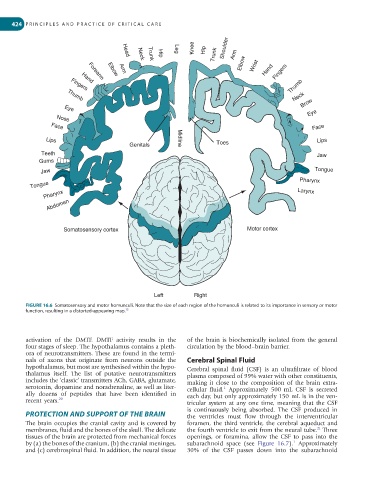
         FIGURE 16.6  Somatosensory and motor homunculi. Note that the size of each region of the homunculi is related to its importance in sensory or motor
                                          15
         function, resulting in a distorted-appearing map.


         activation  of  the  DMTF.  DMTF  activity  results  in  the   of the brain is biochemically isolated from the general
         four stages of sleep. The hypothalamus contains a pleth-  circulation by the blood–brain barrier.
         ora of neurotransmitters. These are found in the termi-
         nals  of  axons  that  originate  from  neurons  outside  the   Cerebral Spinal Fluid
         hypothalamus, but most are synthesised within the hypo-  Cerebral  spinal  fluid  (CSF)  is  an  ultrafiltrate  of  blood
         thalamus  itself.  The  list  of  putative  neurotransmitters   plasma composed of 99% water with other constituents,
         includes the ‘classic’ transmitters ACh, GABA, glutamate,   making  it  close  to  the  composition  of  the  brain  extra-
         serotonin, dopamine and noradrenaline, as well as liter-  cellular  fluid.   Approximately  500  mL  CSF  is  secreted
                                                                          1
         ally  dozens  of  peptides  that  have  been  identified  in   each day, but only approximately 150  mL is in the ven-
         recent  years. 20                                    tricular  system  at  any  one  time,  meaning  that  the  CSF
                                                              is  continuously  being  absorbed.  The  CSF  produced  in
         PROTECTION AND SUPPORT OF THE BRAIN                  the  ventricles  must  flow  through  the  interventricular
         The brain occupies the cranial cavity and is covered by   foramen,  the  third  ventricle,  the  cerebral  aqueduct  and
                                                                                                         21
         membranes, fluid and the bones of the skull. The delicate   the fourth ventricle to exit from the neural tube.  Three
         tissues of the brain are protected from mechanical forces   openings,  or  foramina,  allow  the  CSF  to  pass  into  the
                                                                                                 1
         by (a) the bones of the cranium, (b) the cranial meninges,   subarachnoid  space  (see  Figure  16.7).   Approximately
         and (c) cerebrospinal fluid. In addition, the neural tissue   30%  of  the  CSF  passes  down  into  the  subarachnoid

