


Page 515 - ACCCN's Critical Care Nursing
P. 515
492  P R I N C I P L E S   A N D   P R A C T I C E   O F   C R I T I C A L   C A R E


                                               Replacement
            CVVH
            CVVH
                                               fluids
                                                                          R.O       K +
                                  Blood                         Tap
                                  Pump                                                 –
                                                                water             HCO 3
                                                                                  Membrane           Blood
                                                                                                     pump
                   Pre & Post

                                                                 Waste = Qdf + UF


                Filtrate                            Heater
                                                                                       IHD

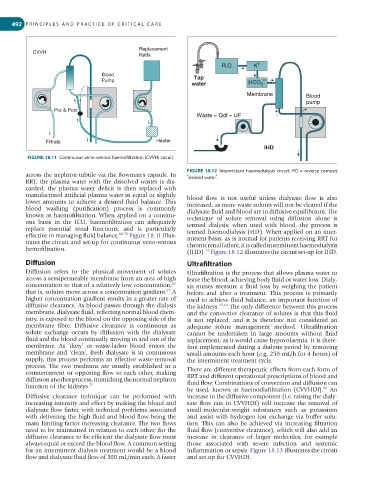
          FIGURE 18.11  Continuous veno-venous haemofiltration (CVVH) circuit.
                                                              FIGURE 18.12  Intermittent haemodialysis circuit. RO =  reverse  osmosis
         across the nephron tubule via the Bowman’s capsule. In
         RRT, the plasma water with the dissolved wastes is dis-  ‘treated water’.
         carded;  the  plasma  water  deficit  is  then  replaced  with
         manufactured artificial plasma water in equal or slightly   blood  flow  is  not  useful  unless  dialysate  flow  is  also
         lower  amounts  to  achieve  a  desired  fluid  balance.  This   increased, as more waste solutes will not be cleared if the
         blood  washing  (purification)  process  is  commonly   dialysate fluid and blood are in diffusive equilibrium. The
         known as haemofiltration. When applied on a continu-  technique  of  solute  removal  using  diffusion  alone  is
         ous  basis  in  the  ICU,  haemofiltration  can  adequately   termed  dialysis;  when  used  with  blood,  the  process  is
         replace  essential  renal  functions,  and  is  particularly     termed haemodialysis (HD). When applied on an inter-
         effective in managing fluid balance. 66-70  Figure 18.11 illus-  mittent basis, as is normal for patients receiving RRT for
         trates the circuit and set-up for continuous veno-venous   chronic renal failure, it is called intermittent haemodialysis
         hemofiltration.
                                                                    72
                                                              (IHD).  Figure 18.12 illustrates the circuit set-up for IHD.
         Diffusion                                            Ultrafiltration
         Diffusion  refers  to  the  physical  movement  of  solutes   Ultrafiltration is the process that allows plasma water to
         across a semipermeable membrane from an area of high   leave the blood, achieving body fluid or water loss. Dialy-
         concentration to that of a relatively low concentration;    sis nurses measure a fluid loss by weighing the patient
                                                         66
                                                        71
         that is, solutes move across a concentration gradient.  A   before  and  after  a  treatment.  This  process  is  primarily
         higher concentration gradient results in a greater rate of   used to achieve fluid balance, an important function of
         diffusive clearance. As blood passes through the dialysis   the kidneys. 33,66  The only difference between this process
         membrane, dialysate fluid, reflecting normal blood chem-  and the convective clearance of solutes is that this fluid
         istry, is exposed to the blood on the opposing side of the   is  not  replaced,  and  it  is  therefore  not  considered  an
         membrane  fibre.  Diffusive  clearance  is  continuous  as   adequate  solute  management  method.  Ultrafiltration
         solute  exchange  occurs  by  diffusion  with  the  dialysate   cannot  be  undertaken  in  large  amounts  without  fluid
         fluid and the blood continually moving in and out of the   replacement, as it would cause hypovolaemia. It is there-
         membrane.  As  ‘dirty’  or  waste-laden  blood  enters  the   fore implemented during a dialysis period by removing
         membrane  and  ‘clean’,  fresh  dialysate  is  in  continuous   small amounts each hour (e.g. 250 mL/h for 4 hours) of
         supply, this process performs an effective waste-removal   the intermittent treatment cycle.
         process.  The  two  mediums  are  usually  established  in  a
         countercurrent or opposing flow to each other, making   There are different therapeutic effects from each form of
         diffusion another process, mimicking the normal nephron   RRT and different operational prescriptions of blood and
         function of the kidneys. 71                          fluid flow. Combinations of convection and diffusion can
                                                                                                           66
                                                              be  used,  known  as  haemodiafiltration  (CVVHDf).   An
         Diffusive  clearance  technique  can  be  performed  with   increase in the diffusive component (i.e. raising the dialy-
         increasing intensity and effect by making the blood and   sate flow rate in CVVHDf) will increase the removal of
         dialysate flow faster, with technical problems associated   small-molecular-weight  substances  such  as  potassium
         with delivering the high fluid and blood flow being the   and assist with hydrogen ion exchange via buffer solu-
         main limiting factor increasing clearance. The two flows   tion.  This  can  also  be  achieved  via  increasing  filtration
         need to be maintained in relation to each other; for the   fluid flow (convective clearance), which will also add an
         diffusive clearance to be efficient the dialysate flow must   increase  in  clearance  of  larger  molecules,  for  example
         always equal or exceed the blood flow. A common setting   those  associated  with  severe  infection  and  systemic
         for an intermittent dialysis treatment would be a blood   inflammation or sepsis. Figure 18.13 illustrates the circuit
         flow and dialysate fluid flow of 300 mL/min each. A faster   and set-up for CVVHDf.

