


Page 514 - ACCCN's Critical Care Nursing
P. 514
Support of Renal Function 491

             outside the ICU. In North America, CRRT is not always   ●  a surgical joining of an artery and vein (usually in the
             the preferred choice for supporting ARF in ICU, and inter-  forearm), making a large vessel that is punctured with
                                            54
             mittent  dialysis  techniques  prevail.   As  a  result  of  this   needles to both draw and return the blood (AV fistula)
             mixed  application  of  techniques,  there  have  been  a   ●  a catheter with two lumens to draw and return blood
                                                                                             63
             number of publications highlighting the success, utility   via  a  large  central  vein   (veno-venous  access
             and methods for CRRT in the ICU setting, 47,55,56  with a   catheter).
             smaller number of publications either making compari-  In  the  acute  renal  failure  setting  and  where  temporary
             sons between approaches or continuing to support inter-  treatment  is  anticipated,  the  two-lumen  catheter  is
             mittent techniques using dialysis in the ICU. 57-60
                                                                  recommended. 8,64
             While  this  application  of  both  CRRT  and  intermittent
             haemodialysis (IHD) has prevailed for the management   HAEMODIALYSIS, HAEMOFILTRATION AND
             of  ARF,  new  ‘hybrid’  approaches  have  evolved  that   HAEMODIAFILTRATION
             combine some benefits of both CRRT and IHD, but also
             do suffer from the compromise nature of the approach.   There are numerous approaches to the delivery of RRT.
             These are daily, limited time frame treatments, with one   Haemodialysis,  haemofiltration  and  haemodiafiltration
             variant  of  the  approach  termed  EDDf  (extended  daily   are  three  common  techniques  used  to  achieve  artificial
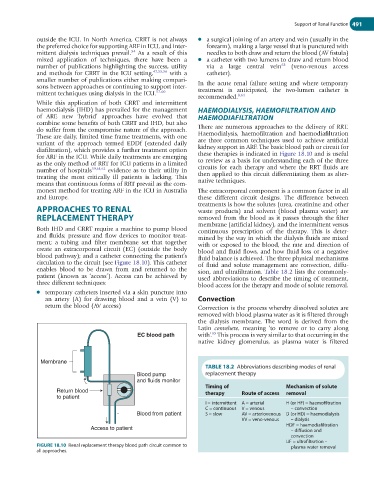
             diafiltration), which provides a further treatment option   kidney support in ARF. The basic blood path or circuit for
             for ARF in the ICU. While daily treatments are emerging   these therapies is indicated in Figure 18.10 and is useful
             as the only method of RRT for ICU patients in a limited   to review as a basis for understanding each of the three
             number of hospitals 59,61,62  evidence as to their utility in   circuits  for  each  therapy  and  where  the  RRT  fluids  are
             treating  the  most  critically  ill  patients  is  lacking.  This   then applied to this circuit differentiating them as alter-
             means that continuous forms of RRT prevail as the com-  native techniques.
             monest method for treating ARF in the ICU in Australia   The extracorporeal component is a common factor in all
             and Europe.                                          these  different  circuit  designs.  The  difference  between
             APPROACHES TO RENAL                                  treatments is how the solutes (urea, creatinine and other
                                                                  waste  products)  and  solvent  (blood  plasma  water)  are
             REPLACEMENT THERAPY                                  removed  from  the  blood  as  it  passes  through  the  filter
                                                                  membrane (artificial kidney), and the intermittent versus
             Both IHD and CRRT require a machine to pump blood    continuous  prescription  of  the  therapy.  This  is  deter-
             and  fluids;  pressure  and  flow  devices  to  monitor  treat-  mined by the way in which the dialysis fluids are mixed
             ment;  a  tubing  and  filter  membrane  set  that  together   with or exposed to the blood, the rate and direction of
             create  an  extracorporeal  circuit  (EC)  (outside  the  body   blood and fluid flows, and how fluid loss or a negative
             blood pathway); and a catheter connecting the patient’s   fluid balance is achieved. The three physical mechanisms
             circulation to the circuit (see Figure 18.10). This catheter   of  fluid  and  solute  management  are  convection,  diffu-
             enables  blood  to  be  drawn  from  and  returned  to  the   sion, and ultrafiltration. Table 18.2 lists the commonly-
             patient  (known  as  ‘access’).  Access  can  be  achieved  by   used abbreviations to describe the timing of treatment,
             three different techniques:                          blood access for the therapy and mode of solute removal.
             ●  temporary catheters inserted via a skin puncture into
                an  artery  (A)  for  drawing  blood  and  a  vein  (V)  to   Convection
                return the blood (AV access)                      Convection is the process whereby dissolved solutes are
                                                                  removed with blood plasma water as it is filtered through
                                                                  the  dialysis  membrane.  The  word  is  derived  from  the
                                                                  Latin  convehere,  meaning  ‘to  remove  or  to  carry  along
                                                                      65
                                              EC blood path       with’.  This process is very similar to that occurring in the
                                                                  native  kidney  glomerulus,  as  plasma  water  is  filtered

              Membrane
                                                                    TABLE 18.2  Abbreviations describing modes of renal
                                              Blood pump            replacement therapy
                                              and fluids monitor
                                                                    Timing of                  Mechanism of solute
                    Return blood                                    therapy     Route of access  removal
                    to patient
                                                                    I = intermittent  A = arterial  H (or HF) = haemofiltration
                                                                    C = continuous  V = venous  – convection
                                              Blood from patient    S = slow    AV = arteriovenous  D (or HD) = haemodialysis
                                                                                VV = veno-venous  – dialysis
                                                                                               HDF = haemodiafiltration
                               Access to patient                                                – diffusion and
                                                                                                convection
                                                                                               UF = ultrafiltration –
             FIGURE 18.10  Renal replacement therapy blood path circuit common to               plasma water removal
             all approaches.

