


Page 743 - ACCCN's Critical Care Nursing
P. 743
720  S P E C I A LT Y   P R A C T I C E   I N   C R I T I C A L   C A R E

         Prevention of eclampsia
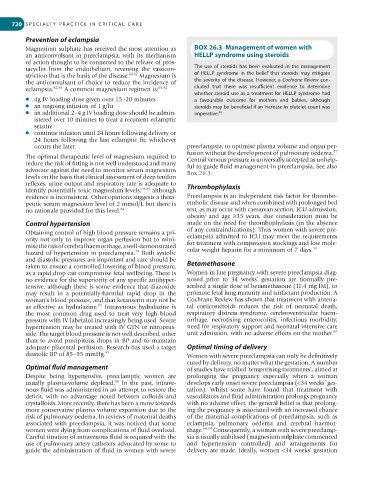
         Magnesium sulphate has received the most attention as   BOX 26.3  Management of women with
         an anticonvulsant in preeclampsia, with its mechanism   HELLP syndrome using steroids
         of action thought to be connected to the release of pros-
         tacyclin  from  the  endothelium,  reversing  the  vasocon-  The  use  of  steroids  has  been  evaluated  in  the  management
         striction that is the basis of the disease. 80,81  Magnesium is   of  HELLP  syndrome  in  the  belief  that  steroids  may  mitigate
         the anticonvulsant of choice to reduce the incidence of   the severity of the disease. However, a Cochrane Review con-
         eclampsia. 82,83  A common magnesium regimen is: 68,82  cluded  that  there  was  insufficient  evidence  to  determine
                                                                 whether steroid use as a treatment for HELLP syndrome had
         l  4g IV loading dose given over 15–20 minutes          a  favourable  outcome  for  mothers  and  babies,  although
         l  an ongoing infusion of 1 g/hr                        steroids may be beneficial if an increase in platelet count was
         l  an additional 2–4 g IV loading dose should be admin-  imperative. 88
            istered over 10 minutes to treat a recurrent eclamptic
            seizure
         l  continue infusion until 24 hours following delivery or
            24  hours  following  the  last  eclamptic  fit;  whichever
            occurs the later.                                 preeclampsia, to optimise plasma volume and organ per-
                                                                                                              87
                                                              fusion without the development of pulmonary oedema.
         The optimal therapeutic level of magnesium required to   Central venous pressure is universally accepted as unhelp-
         reduce the risk of fitting is not well understood and many   ful to guide fluid management in preeclampsia. See also
         advocate against the need to monitor serum magnesium   Box 26.3.
         levels on the basis that clinical assessment of deep tendon
         reflexes, urine output and respiratory rate is adequate to   Thrombophylaxis
         identify potentially toxic magnesium levels, 68,82  although
         evidence is inconsistent. Other opinions suggests a thera-  Preeclampsia is an independent risk factor for thrombo-
         peutic serum magnesium level of 2 mmol/L but there is   embolic disease and when combined with prolonged bed
         no rationale provided for this level. 84             rest, as may occur with caesarean section, ICU admission,
                                                              obesity  and  age  ≥35  years,  due  consideration  must  be
         Control hypertension                                 made on the need for thrombophylaxis (in the absence
         Obtaining control of high blood pressure remains a pri-  of any contraindications). Thus women with severe pre-
         ority not only to improve organ perfusion but to mini-  eclampsia admitted to ICU may meet the requirements
         mise the risk of cerebral haemorrhage, a well-demonstrated   for treatment with compression stockings and low mole-
                                                                                                       30
                                             24
         hazard of hypertension in preeclampsia.  Both systolic   cular weight heparin for a minimum of 7 days.
         and diastolic pressures are important and care should be
         taken to ensure a controlled lowering of blood pressure,   Betamethasone
         as a rapid drop can compromise fetal wellbeing. There is   Women in late pregnancy with severe preeclampsia diag-
         no evidence for the superiority of any specific antihyper-  nosed  prior  to  34  weeks’  gestation  are  normally  pre-
         tensive, although there is some evidence that diazoxide   scribed a single dose of betamethasone (11.4 mg IM), to
         may  result  in  a  potentially-harmful  rapid  drop  in  the   promote fetal lung maturity and surfactant production. A
         woman’s blood pressure, and that ketanserin may not be   Cochrane Review has shown that treatment with antena-
                                 83
         as  effective  as  hydralazine.   Intravenous  hydralazine  is   tal  corti costeroids  reduces  the  risk  of  neonatal  death,
         the  most  common  drug  used  to  treat  very  high  blood   respiratory  distress  syndrome,  cerebroventricular  haem-
         pressure with IV labetalol increasingly being used. Severe   orrhage,  necrotising  enterocolitis,  infectious  morbidity,
         hypertension may be treated with IV GTN or nitroprus-  need for respiratory support and neonatal intensive care
         side. The target blood pressure is not well described, other   unit admission, with no adverse effects on the mother. 89
         than to avoid precipitous drops in BP and to maintain
         adequate placental perfusion. Research has used a target   Optimal timing of delivery
         diastolic BP of 85–95 mmHg. 85                       Women with severe preeclampsia can only be definitively
                                                              cured by delivery, no matter what the gestation. A number
         Optimal fluid management                             of studies have trialled ‘temporising treatments’, aimed at
         Despite  being  hypertensive,  preeclamptic  women  are   prolonging  the  pregnancy  especially  when  a  woman
                                       86
         usually  plasma-volume  depleted.   In  the  past,  intrave-  develops early onset severe preeclampsia (<34 weeks’ ges-
         nous fluid was administered in an attempt to restore the   tation).  Whilst  some  have  found  that  treatment  with
         deficit,  with  no  advantage  noted  between  colloids  and   vasodilators and fluid administration prolongs pregnancy
         crystalloids. More recently, there has been a move towards   with no adverse effect, the general belief is that prolong-
         more conservative plasma volume expansion due to the   ing the pregnancy is associated with an increased chance
         risk of pulmonary oedema. In reviews of maternal deaths   of the maternal complications of preeclampsia, such as
         associated with  preeclampsia,  it  was  noticed  that some   eclampsia,  pulmonary  oedema  and  cerebral  haemor-
         women were dying from complications of fluid overload.   rhage. 68,90  Consequently, a woman with severe preeclamp-
         Careful titration of intravenous fluid is required with the   sia is usually stabilised (magnesium sulphate commenced
         use of pulmonary artery catheters advocated by some to   and  hypertension  controlled)  and  arrangements  for
         guide the administration of fluid in women with severe   delivery are made. Ideally, women <34 weeks’ gestation

