


Page 489 - Concise Pathology for Exam Preparation ( PDFDrive )
P. 489
474    SECTION II  Diseases of Organ Systems

                     Clinical Features
                     •  Affects children and adults.
                     •  Occurs after mucosal (respiratory, gastrointestinal or urinary tract) infections (increased
                       IgA synthesis in response to viruses, bacteria, food allergens, etc.).
                     •  Presents with gross or microscopic haematuria and/or proteinuria.
                     •  Five to ten percent present as acute nephritic syndrome.
                     •  Course  of  disease  variable;  many  individuals  maintain  normal  renal  function  for
                       decades.
                     •  Chronic renal failure (CRF) may occur in as many as 50% cases.
                     •  Henoch–Schönlein purpura (a systemic disorder characterized by purpura, abdominal
                       pain and arthritis) has many similarities with IgA nephropathy.

                     Morphology
                     •  Mesangial widening and segmental inflammation confined to certain glomeruli (focal
                       proliferative GN) or overt crescent formation (crescentic GN) or diffuse mesangial pro-
                       liferation (mesangioproliferative GN) may be seen.
                     •  Mesangium shows electron-dense deposits.
                     •  IF shows mesangial deposition of IgA, C3, properdin and small amounts of IgG/IgM.
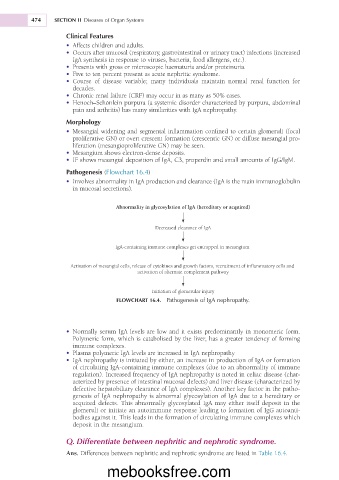
                     Pathogenesis (Flowchart 16.4)
                     •  Involves abnormality in IgA production and clearance (IgA is the main immunoglobulin
                       in mucosal secretions).

                                     Abnormality in glycosylation of IgA (hereditary or acquired)


                                                 Decreased clearance of IgA


                                     IgA-containing immune complexes get entrapped in mesangium


                       Activation of mesangial cells, release of cytokines and growth factors, recruitment of inflammatory cells and
                                           activation of alternate complement pathway


                                                Initiation of glomerular injury
                                     FLOWCHART 16.4.  Pathogenesis of IgA nephropathy.


                     •  Normally serum IgA levels are low and it exists predominantly in monomeric form.
                       Polymeric form, which is catabolised by the liver, has a greater tendency of forming
                       immune complexes.
                     •  Plasma polymeric IgA levels are increased in IgA nephropathy
                     •  IgA nephropathy is initiated by either, an increase in production of IgA or formation
                       of circulating IgA-containing immune complexes (due to an abnormality of immune
                       regulation). Increased frequency of IgA nephropathy is noted in celiac disease (char-
                       acterized by presence of intestinal mucosal defects) and liver disease (characterized by
                       defective hepatobiliary clearance of IgA complexes). Another key factor in the patho-
                       genesis of IgA nephropathy is abnormal glycosylation of IgA due to a hereditary or
                       acquired defects. This abnormally glycosylated IgA may either itself deposit in the
                       glomeruli or initiate an autoimmune response leading to formation of IgG autoanti-
                       bodies against it. This leads in the formation of circulating immune complexes which
                       deposit in the mesangium.

                     Q. Differentiate between nephritic and nephrotic syndrome.
                     Ans. Differences between nephritic and nephrotic syndrome are listed in Table 16.4.


                                  mebooksfree.com

