


Page 491 - Concise Pathology for Exam Preparation ( PDFDrive )
P. 491
476    SECTION II  Diseases of Organ Systems


                     Routes of spread of bacteria to kidneys:
                       1.  Haematogenous: Seen in septicaemia or infective endocarditis and is less common.
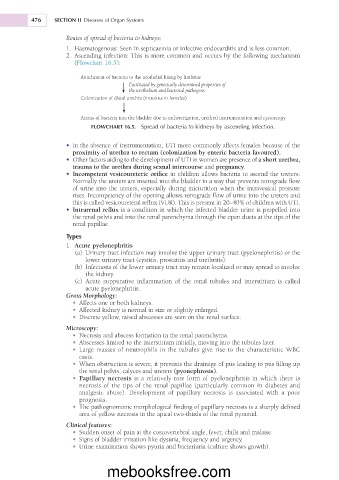
                       2.  Ascending infection: This is more common and occurs by the following mechanism
                        (Flowchart 16.5):

                          Attachment of bacteria to the urothelial lining by fimbriae
                                         Facilitated by genetically determined properties of
                                         the urothelium and bacterial pathogens
                          Colonization of distal urethra (introitus in females)


                          Access of bacteria into the bladder due to catheterization, urethral instrumentation and cystoscopy
                             FLOWCHART 16.5.  Spread of bacteria to kidneys by ascending infection.

                     •  In the absence of instrumentation, UTI more commonly affects females because of the
                       proximity of urethra to rectum (colonization by enteric bacteria favoured).
                     •  Other factors aiding to the development of UTI in women are presence of a short urethra,
                       trauma to the urethra during sexual intercourse and pregnancy.
                     •  Incompetent vesicoureteric orifice in children allows bacteria to ascend the ureters.
                       Normally the ureters are inserted into the bladder in a way that prevents retrograde flow
                       of urine into the ureters, especially during micturition when the intravesical pressure
                       rises. Incompetency of the opening allows retrograde flow of urine into the ureters and
                       this is called vesicoureteral reflux (VUR). This is present in 20–40% of children with UTI.
                     •  Intrarenal reflux is a condition in which the infected bladder urine is propelled into
                       the renal pelvis and into the renal parenchyma through the open ducts at the tips of the
                       renal papillae.

                     Types
                       1.  Acute pyelonephritis
                         (a)  Urinary tract infection may involve the upper urinary tract (pyelonephritis) or the
                           lower urinary tract (cystitis, prostatitis and urethritis).
                         (b)  Infections of the lower urinary tract may remain localized or may spread to involve
                           the kidney.
                         (c)  Acute  suppurative  inflammation  of  the  renal  tubules  and  interstitium  is  called
                           acute pyelonephritis.
                     Gross Morphology:
                       •  Affects one or both kidneys.
                       •  Affected kidney is normal in size or slightly enlarged.
                       •  Discrete yellow, raised abscesses are seen on the renal surface.
                     Microscopy:
                       •  Necrosis and abscess formation in the renal parenchyma.
                       •  Abscesses limited to the interstitium initially, moving into the tubules later.
                       •  Large  masses  of  neutrophils  in  the  tubules  give  rise  to  the  characteristic  WBC
                         casts.
                       •  When obstruction is severe, it prevents the drainage of pus leading to pus filling up
                         the renal pelvis, calyces and ureters (pyonephrosis).
                       •  Papillary necrosis is a relatively rare form of pyelonephritis in which there is
                         necrosis of the tips of the renal papillae (particularly common in diabetes and
                         analgesic  abuse).  Development  of  papillary  necrosis  is  associated  with  a  poor
                         prognosis.
                       •  The pathognomonic morphological finding of papillary necrosis is a sharply defined
                         area of yellow necrosis in the apical two-thirds of the renal pyramid.
                     Clinical features:
                       •  Sudden onset of pain at the costovertebral angle, fever, chills and malaise.
                       •  Signs of bladder irritation like dysuria, frequency and urgency.
                       •  Urine examination shows pyuria and bacteriuria (culture shows growth).


                                  mebooksfree.com

