


Page 490 - Concise Pathology for Exam Preparation ( PDFDrive )
P. 490
16  Diseases of the Kidney and Lower Urinary Tract  475


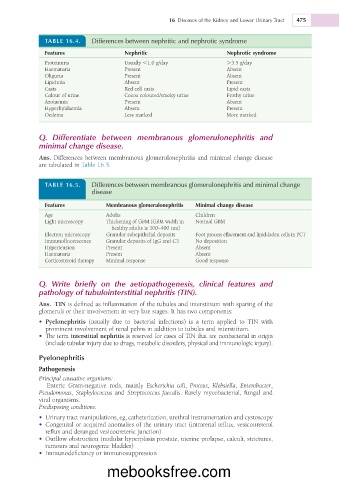
               TABLE 16.4.   Differences between nephritic and nephrotic syndrome

               Features                Nephritic                       Nephrotic syndrome
               Proteinuria             Usually ,1.0 g/day              .3.5 g/day
               Haematuria              Present                         Absent
               Oliguria                Present                         Absent
               Lipiduria               Absent                          Present
               Casts                   Red cell casts                  Lipid casts
               Colour of urine         Cocoa coloured/smoky urine      Frothy urine
               Azotaemia               Present                         Absent
               Hyperlipidaemia         Absent                          Present
               Oedema                  Less marked                     More marked


             Q.  Differentiate  between  membranous  glomerulonephritis  and
             minimal change disease.

             Ans. Differences between membranous glomerulonephritis and minimal change disease
             are tabulated in Table 16.5.


               TABLE 16.5.   Differences between membranous glomerulonephritis and minimal change
                             disease

               Features           Membranous glomerulonephritis   Minimal change disease
               Age                Adults                     Children
               Light microscopy   Thickening of GBM (GBM width in   Normal GBM
                                   healthy adults is 300–400 nm)
               Electron microscopy  Granular subepithelial deposits  Foot process effacement and lipid-laden cells in PCT
               Immunofluorescence   Granular deposits of IgG and C3  No deposition
               Hypertension       Present                    Absent
               Haematuria         Present                    Absent
               Corticosteroid therapy  Minimal response      Good response


             Q.  Write  briefly  on  the  aetiopathogenesis,  clinical  features  and
             pathology of tubulointerstitial nephritis (TIN).

             Ans.  TIN is defined as inflammation of the tubules and interstitium with sparing of the
             glomeruli or their involvement in very late stages. It has two components:
             •  Pyelonephritis  (usually  due  to  bacterial  infections)  is  a  term  applied  to  TIN  with
               prominent involvement of renal pelvis in addition to tubules and interstitium.
             •  The term interstitial nephritis is reserved for cases of TIN that are nonbacterial in origin
               (include tubular injury due to drugs, metabolic disorders, physical and immunologic injury).

             Pyelonephritis
             Pathogenesis
             Principal causative organisms:
               Enteric  Gram-negative  rods,  mainly  Escherichia  coli,  Proteus,  Klebsiella,  Enterobacter,
             Pseudomonas,  Staphylococcus  and  Streptococcus faecalis.  Rarely  mycobacterial,  fungal  and
             viral organisms.
             Predisposing conditions:
             •  Urinary tract manipulations, eg, catheterization, urethral instrumentation and cystoscopy
             •  Congenital or acquired anomalies of the urinary tract (intrarenal reflux, vesicoureteral
               reflux and deranged vesicoureteric junction)
             •  Outflow obstruction (nodular hyperplasia prostate, uterine prolapse, calculi, strictures,
               tumours and neurogenic bladder)
             •  Immunodeficiency or immunosuppression


                                  mebooksfree.com

