


Page 50 - Concise Pathology for Exam Preparation ( PDFDrive )
P. 50
2  Acute and Chronic Inflammation  35


                 (b)  Transmigration across the endothelium (emigration or diapedesis): emigration
                   is facilitated by focal dissolution of the exposed basement membrane by leukocyte-
                   derived collagenase
                 (c)  Migration in interstitial tissue towards a chemotactic stimulus (chemotaxis)

             Q. What are leukocyte adhesion molecules (LAMs)?
             Ans.  LAMs  are  molecules  on  the  leukocytes  and  endothelial  surfaces,  which  regulate
             leukocyte adhesion and transmigration.
             •  Chemical mediators affect the process of adhesion and transmigration by modulating
               the surface expression and avidity of adhesion molecules.
             •  LAMs are synthesized by endothelial cells and leukocytes.
             •  LAMs belong to four molecular families—selections, immunoglobulin super family,
               integrins and mucin-like glycoproteins.
             •  There are three types of selectins—L-selectins (expressed on leukocytes); E-selectins
               (expressed on endothelial cells) and P-selectins (expressed on platelets and endothe-
               lium).  The  ligands  for  selectins  are  sialylated  oligosaccharides  bound  to  mucin-like
               glycoproteins. TNF and IL1 increase endothelial expression of ligands for integrins like
               VCAM-1 (vascular cell adhesion molecule-1) which is the ligand for b1 integrin VLA-4
               and ICAM-1 (intercellular adhesion molecule-1) which is the ligand for b2 integrins like
               LFA-1 and MAC-1.
             •  Corticosteroids  inhibit  adhesion  molecule  synthesis,  thereby  decreasing  neutrophil
               adhesion and increasing the circulating absolute neutrophil count.
             •  Endotoxins enhance neutrophil adhesion, leading to a reduction in peripheral blood
               absolute neutrophil count.
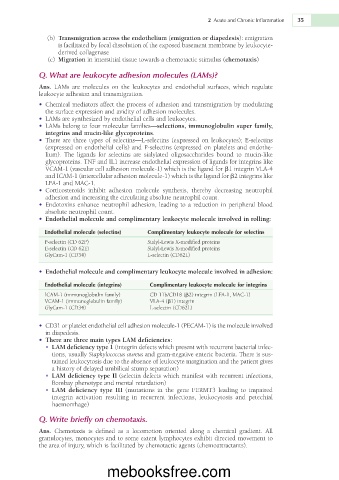
             •  Endothelial molecule and complimentary leukocyte molecule involved in rolling:

               Endothelial molecule (selectins)  Complimentary leukocyte molecule for selectins
               P-selectin (CD 62P)            Sialyl-Lewis X-modified proteins
               E-selectin (CD 62E)            Sialyl-Lewis X-modified proteins
               GlyCam-1 (CD34)                L-selectin (CD62L)


             •  Endothelial molecule and complimentary leukocyte molecule involved in adhesion:
               Endothelial molecule (integrins)  Complimentary leukocyte molecule for integrins
               ICAM-1 (immunoglobulin family)  CD 11b/CD18 (b2) integrin (LFA-1, MAC-1)
               VCAM-1 (immunoglobulin family)  VLA-4 (b1) integrin
               GlyCam-1 (CD34)                 L-selectin (CD62L)


             •  CD31 or platelet endothelial cell adhesion molecule-1 (PECAM-1) is the molecule involved
               in diapedesis.
             •  There are three main types LAM deficiencies:
               •  LAM deficiency type 1 (integrin defects which present with recurrent bacterial infec-
                 tions, usually Staphylococcus aureus and gram-negative enteric bacteria. There is sus-
                 tained leukocytosis due to the absence of leukocyte margination and the patient gives
                 a history of delayed umbilical stump separation)
               •  LAM deficiency type II (selectin defects which manifest with recurrent infections,
                 Bombay phenotype and mental retardation)
               •  LAM  deficiency  type  III  (mutations  in  the  gene  FERMT3  leading  to  impaired
                 integrin  activation  resulting  in  recurrent  infections,  leukocytosis  and  petechial
                 haemorrhage)

             Q. Write briefly on chemotaxis.
             Ans.  Chemotaxis  is  defined  as  a  locomotion  oriented  along  a  chemical  gradient.  All
             granulocytes, monocytes and to some extent lymphocytes exhibit directed movement to
             the area of injury, which is facilitated by chemotactic agents (chemoattractants).


                                  mebooksfree.com

