


Page 590 - Concise Pathology for Exam Preparation ( PDFDrive )
P. 590
21  Musculoskeletal System  575

             Gross	Morphology
             •	 Sessile, round to oval and bosselated
             •	 Project from subperiosteal/endosteal surface of cortex
             •	 Multiple  osteomas,  may  present  with  intestinal  polyposis  and  soft  tissue  tumours
               (Gardner	syndrome)
             Microscopy
             Composed of dense and mature lamellar bone.

             Osteoid Osteoma
             Skeletal	Distribution
             •	 Long bones (femur and tibia)
             •	 Usually intracortical; less frequently arise from medullary cavity
             Clinical	Features
             •	 Common in the age group between 10 and 30 years.
             •	 Presents  with  intense  pain  which  increases  during  night  and  is  relieved  by  aspirin
               (pain is attributed to excessive PGE2 produced by proliferating osteoblasts). It may be
               accompanied by localized swelling and tenderness.

             X-ray
             Shows a central nidus smaller than 1.5 cm that is surrounded by sclerotic bone. The nidus
               may be difficult to see on plain X-ray. CT is modality of choice to identify it.
             Gross	Morphology
             Appears as a well-defined, round-to-oval mass of gritty tissue with a size less than 2 cm
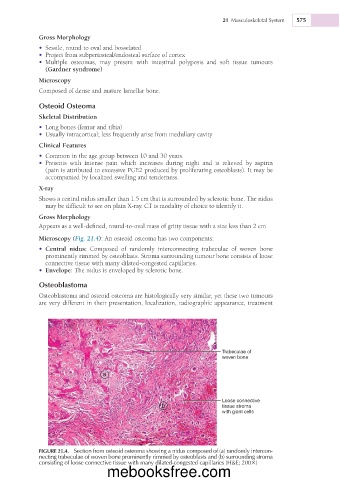
             Microscopy (Fig. 21.4): An osteoid osteoma has two components:
             •	 Central	 nidus:  Composed  of  randomly  interconnecting  trabeculae  of  woven  bone
               prominently rimmed by osteoblasts. Stroma surrounding tumour bone consists of loose
               connective tissue with many dilated-congested capillaries.
             •	 Envelope: The nidus is enveloped by sclerotic bone.

             Osteoblastoma
             Osteoblastoma and osteoid osteoma are histologically very similar, yet these two tumours
             are very different in their presentation, localization, radiographic appearance, treatment


                                                                     Trabeculae of
                                                                     woven bone

                                 a


                                                                     Loose connective
                                                   b                 tissue stroma
                                                                     with giant cells


             FIGURE 21.4.  Section from osteoid osteoma showing a nidus composed of (a) randomly intercon-
             necting trabeculae of woven bone prominently rimmed by osteoblasts and (b) surrounding stroma
             consisting of loose connective tissue with many dilated-congested capillaries (H&E; 2003)
                                  mebooksfree.com

