


Page 589 - Concise Pathology for Exam Preparation ( PDFDrive )
P. 589
574    SECTION II  Diseases of Organ Systems


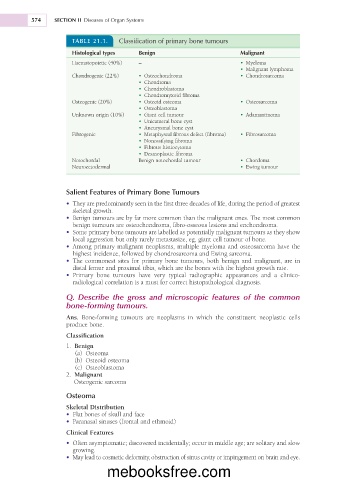
                       TABLE 21.1.    Classification of primary bone tumours

                       Histological types   Benign                         Malignant
                       Haematopoietic (40%)  –                             •  Myeloma
                                                                           •  Malignant lymphoma
                       Chondrogenic (22%)   •  Osteochondroma              •  Chondrosarcoma
                                            •  Chondroma
                                            •  Chondroblastoma
                                            •  Chondromyxoid fibroma
                       Osteogenic (20%)     •  Osteoid osteoma             •  Osteosarcoma
                                            •  Osteoblastoma
                       Unknown origin (10%)  •  Giant cell tumour          •  Adamantinoma
                                            •  Unicameral bone cyst
                                            •  Aneurysmal bone cyst
                       Fibrogenic           •  Metaphyseal fibrous defect (fibroma)  •  Fibrosarcoma
                                            •  Nonossifying fibroma
                                            •  Fibrous histiocytoma
                                            •  Desmoplastic fibroma
                       Notochordal          Benign notochordal tumour      •  Chordoma
                       Neuroectodermal                                     •  Ewing tumour


                     Salient Features of Primary Bone Tumours
                     •	 They are predominantly seen in the first three decades of life, during the period of greatest
                       skeletal growth.
                     •	 Benign tumours are by far more common than the malignant ones. The most common
                       benign tumours are osteochondroma, fibro-osseous lesions and enchondroma.
                     •	 Some primary bone tumours are labelled as potentially malignant tumours as they show
                       local aggression but only rarely metastasize, eg, giant cell tumour of bone.
                     •	 Among primary malignant neoplasms, multiple myeloma and osteosarcoma have the
                       highest incidence, followed by chondrosarcoma and Ewing sarcoma.
                     •	 The commonest sites for primary bone tumours, both benign and malignant, are in
                       distal femur and proximal tibia, which are the bones with the highest growth rate.
                     •	 Primary  bone  tumours  have  very  typical  radiographic  appearances  and  a  clinico-
                       radiological correlation is a must for correct histopathological diagnosis.
                     Q.  Describe  the  gross  and  microscopic  features  of  the  common
                     bone-forming tumours.
                     Ans.  Bone-forming  tumours  are  neoplasms  in  which  the  constituent  neoplastic  cells
                     produce bone.
                     Classification
                       1.  Benign
                         (a)  Osteoma
                         (b)  Osteoid osteoma
                         (c)  Osteoblastoma
                       2.  Malignant
                        Osteogenic sarcoma
                     Osteoma

                     Skeletal	Distribution
                     •	 Flat bones of skull and face
                     •	 Paranasal sinuses (frontal and ethmoid)
                     Clinical	Features
                     •	 Often asymptomatic; discovered incidentally; occur in middle age; are solitary and slow
                       growing.
                     •	 May lead to cosmetic deformity, obstruction of sinus cavity or impingement on brain and eye.

                                  mebooksfree.com

