


Page 594 - Concise Pathology for Exam Preparation ( PDFDrive )
P. 594
21  Musculoskeletal System  579

             Skeletal Distribution
             Metaphysis of lower femur, upper tibia and upper humerus.
             Clinical Features
             •	 Solitary osteochondromas are diagnosed in later life as compared to multiple osteochon-
               dromas which usually manifest in childhood itself.
             •	 Osteochondromas are mostly asymptomatic but may present with pain and deformity.
               They sometimes interfere with the functioning of regional tendons and blood vessels.
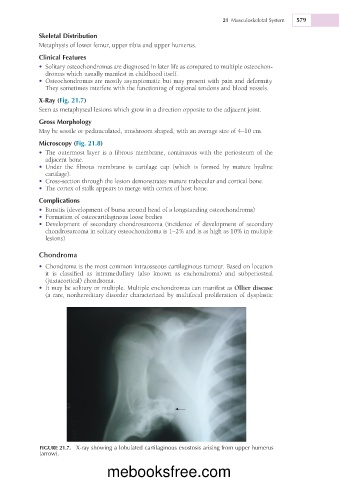
             X-Ray (Fig. 21.7)
             Seen as metaphyseal lesions which grow in a direction opposite to the adjacent joint.

             Gross Morphology
             May be sessile or pedunculated, mushroom shaped, with an average size of 4–10 cm.

             Microscopy (Fig. 21.8)
             •	 The  outermost  layer  is  a  fibrous  membrane,  continuous  with  the  periosteum  of  the
               adjacent bone.
             •	 Under  the  fibrous  membrane  is  cartilage  cap  (which  is  formed  by  mature  hyaline
               cartilage).
             •	 Cross-section through the lesion demonstrates mature trabecular and cortical bone.
             •	 The cortex of stalk appears to merge with cortex of host bone.
             Complications
             •	 Bursitis (development of bursa around head of a longstanding osteochondroma)
             •	 Formation of osteocartilaginous loose bodies
             •	 Development of secondary chondrosarcoma (incidence of development of secondary
               chondrosarcoma in solitary osteochondroma is 1–2% and is as high as 10% in multiple
               lesions)

             Chondroma
             •	 Chondroma is the most common intraosseous cartilaginous tumour. Based on location
               it  is  classified  as  intramedullary  (also  known  as  enchondroma)  and  subperiosteal
               (juxtacortical) chondroma.
             •	 It may be solitary or multiple. Multiple enchondromas can manifest as Ollier	disease
               (a rare, nonhereditary disorder characterized by multifocal proliferation of dysplastic


             FIGURE 21.7.  X-ray showing a lobulated cartilaginous exostosis arising from upper humerus
             (arrow).


                                  mebooksfree.com

