


Page 598 - Concise Pathology for Exam Preparation ( PDFDrive )
P. 598
21  Musculoskeletal System  583


                 (b)  Secondary  chondrosarcoma:  Arises  from  benign  cartilage  defects  such  as
                   osteochondroma or enchondroma
               2.  Based	on	topography:
                 (a)  Conventional  intramedullary:  Arises  from  the  medullary  cavity  of  long  bones,
                   pelvis, costochondral junction of ribs and shoulders and presents as a lytic lesion
                   with blotchy calcification.
                 (b)  Juxtacortical (peripheral): Arises in the shaft of a long bone.
               3.  Based	on	morphology:
                 (a)  Conventional (which is further subtyped as hyaline or myxoid)
                 (b)  Clear cell
                 (c)  Dedifferentiated
                  (d)  Mesenchymal
             Gross Morphology
             Grey-white, lobulated, bulky, translucent masses with a gelatinous consistency. Erosion/
             destruction of cortex is frequently seen. Calcification and ossification are not uncommon.

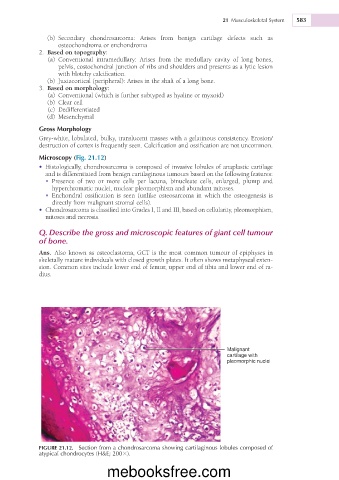
             Microscopy (Fig. 21.12)
             •	 Histologically, chondrosarcoma is composed of invasive lobules of anaplastic cartilage
               and is differentiated from benign cartilaginous tumours based on the following features:
               •	 Presence  of  two  or  more  cells  per  lacuna,  binucleate  cells,  enlarged,  plump  and
                 hyperchromatic nuclei, nuclear pleomorphism and abundant mitoses.
               •	 Enchondral  ossification  is  seen  (unlike  osteosarcoma  in  which  the  osteogenesis  is
                 directly from malignant stromal cells).
             •	 Chondrosarcoma is classified into Grades I, II and III, based on cellularity, pleomorphism,
               mitoses and necrosis.

             Q. Describe the gross and microscopic features of giant cell tumour
             of bone.

             Ans.  Also known as osteoclastoma, GCT is the most common tumour of epiphyses in
             skeletally mature individuals with closed growth plates. It often shows metaphyseal exten-
             sion. Common sites include lower end of femur, upper end of tibia and lower end of ra-
             dius.


                                                                       Malignant
                                                                       cartilage with
                                                                       pleomorphic nuclei


             FIGURE 21.12.  Section from a chondrosarcoma showing cartilaginous lobules composed of
             atypical chondrocytes (H&E; 2003).


                                  mebooksfree.com

