


Page 597 - Concise Pathology for Exam Preparation ( PDFDrive )
P. 597
582    SECTION II  Diseases of Organ Systems


                     •	 Mitoses and necrosis are frequent; scattered osteoclastic giant cells may also be seen.
                     •	 Scant amount of lace-like hyaline matrix may be laid down, which calcifies to produce
                       a characteristic chicken-wire	calcification.

                     Chondromyxoid Fibroma (CMF)

                     Clinical Features
                     Affects  young  adults  and  presents  with  localized  dull  aching  pain  and  swelling  in  the
                     affected region.
                     X-Ray
                     Large, lobulated, sharply defined, eccentric, lytic, metaphyseal lesion surrounded by a rim
                     of sclerosis.

                     Gross Morphology
                     Average size is 3–8 cm; cut surface appears solid, glistening and tan-grey.

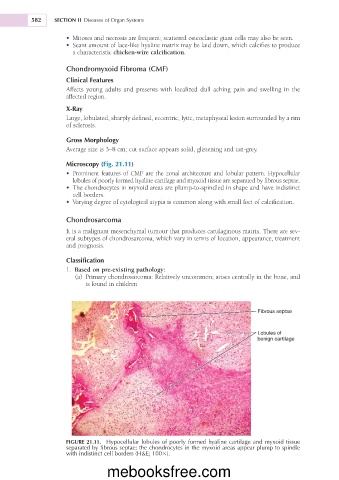
                     Microscopy (Fig. 21.11)
                     •	 Prominent features of CMF are the zonal architecture and lobular pattern. Hypocellular
                       lobules of poorly formed hyaline cartilage and myxoid tissue are separated by fibrous septae.
                     •	 The chondrocytes in myxoid areas are plump-to-spindled in shape and have indistinct
                       cell borders.
                     •	 Varying degree of cytological atypia is common along with small foci of calcification.

                     Chondrosarcoma

                     It is a malignant mesenchymal tumour that produces cartilaginous matrix. There are sev-
                     eral subtypes of chondrosarcoma, which vary in terms of location, appearance, treatment
                     and prognosis.

                     Classification
                       1.  Based	on	pre-existing	pathology:
                         (a)  Primary chondrosarcoma: Relatively uncommon; arises centrally in the bone, and
                           is found in children


                                                                                Fibrous septae


                                                                                Lobules of
                                                                                benign cartilage


                     FIGURE 21.11.  Hypocellular lobules of poorly formed hyaline cartilage and myxoid tissue
                     separated by fibrous septae; the chondrocytes in the myxoid areas appear plump to spindle
                     with indistinct cell borders (H&E; 1003).


                                  mebooksfree.com

