


Page 1342 - Hematology_ Basic Principles and Practice ( PDFDrive )
P. 1342
1188   Part VII  Hematologic Malignancies


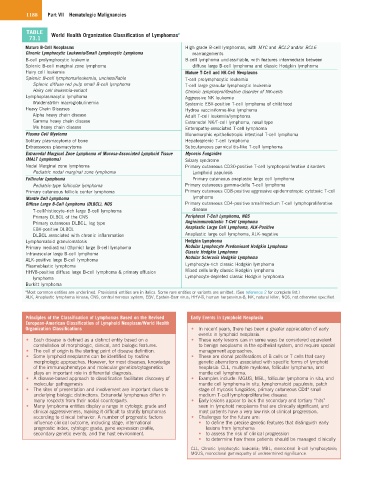
          TABLE   World Health Organization Classification of Lymphomas a
          73.1
         Mature B-Cell Neoplasms                              High grade B-cell lymphomas, with MYC and BCL2 and/or BCL6
         Chronic Lymphocytic Leukemia/Small Lymphocytic Lymphoma  rearrangements
         B-cell prolymphocytic leukemia                       B-cell lymphoma unclassifiable, with features intermediate between
         Splenic B-cell marginal zone lymphoma                  diffuse large B-cell lymphoma and classic Hodgkin lymphoma
         Hairy cell leukemia                                  Mature T-Cell and NK-Cell Neoplasms
         Splenic B-cell lymphoma/leukemia, unclassifiable     T-cell prolymphocytic leukemia
            Splenic diffuse red pulp small B-cell lymphoma    T-cell large granular lymphocytic leukemia
            Hairy cell leukemia-variant                       Chronic lymphoproliferative disorder of NK-cells
         Lymphoplasmacytic lymphoma                           Aggressive NK leukemia
            Waldenström macroglobulinemia                     Systemic EBV-positive T-cell lymphoma of childhood
         Heavy Chain Diseases                                 Hydroa vacciniforme-like lymphoma
            Alpha heavy chain disease                         Adult T-cell leukemia/lymphoma
            Gamma heavy chain disease                         Extranodal NK/T-cell lymphoma, nasal type
            Mu heavy chain disease                            Enteropathy-associated T-cell lymphoma
         Plasma Cell Myeloma                                  Monomorphic epitheliotropic intestinal T-cell lymphoma
         Solitary plasmacytoma of bone                        Hepatosplenic T-cell lymphoma
         Extraosseous plasmacytoma                            Subcutaneous panniculitis-like T-cell lymphoma
         Extranodal Marginal Zone Lymphoma of Mucosa-Associated Lymphoid Tissue   Mycosis Fungoides
         (MALT Lymphoma)                                      Sézary syndrome
         Nodal Marginal zone lymphoma                         Primary cutaneous CD30-positive T-cell lymphoproliferative disorders
            Pediatric nodal marginal zone lymphoma              Lymphoid papulosis
         Follicular Lymphoma                                    Primary cutaneous anaplastic large cell lymphoma
            Pediatric-type follicular lymphoma                Primary cutaneous gamma-delta T-cell lymphoma
         Primary cutaneous follicle center lymphoma           Primary cutaneous CD8-positive aggressive epidermotropic cytotoxic T-cell
         Mantle Cell Lymphoma                                   lymphoma
         Diffuse Large B-Cell Lymphoma (DLBCL), NOS           Primary cutaneous CD4-positive small/medium T-cell lymphoproliferative
            T-cell/histiocyte–rich large B-cell lymphoma        disease
            Primary DLBCL of the CNS                          Peripheral T-Cell Lymphoma, NOS
            Primary cutaneous DLBCL, leg type                 Angioimmunoblastic T-Cell Lymphoma
            EBV-positive DLBCL                                Anaplastic Large Cell Lymphoma, ALK-Positive
            DLBCL associated with chronic inflammation        Anaplastic large cell lymphoma, ALK-negative
         Lymphomatoid granulomatosis                          Hodgkin Lymphoma
         Primary mediastinal (thymic) large B-cell lymphoma   Nodular Lymphocyte Predominant Hodgkin Lymphoma
         Intravascular large B-cell lymphoma                  Classic Hodgkin Lymphoma
         ALK-positive large B-cell lymphoma                   Nodular Sclerosis Hodgkin Lymphoma
         Plasmablastic lymphoma                               Lymphocyte-rich classic Hodgkin lymphoma
         HHV8-positive diffuse large B-cell lymphoma & primary effusion   Mixed cellularity classic Hodgkin lymphoma
            lymphoma                                          Lymphocyte-depleted classic Hodgkin lymphoma
         Burkitt lymphoma
         a Most common entities are underlined. Provisional entities are in italics. Some rare entities or variants are omitted. (See reference 2 for complete list.)
         ALK, Anaplastic lymphoma kinase; CNS, central nervous system; EBV, Epstein-Barr virus; HHV-8, human herpesvirus-8; NK, natural killer; NOS, not otherwise specified.


         Principles of the Classification of Lymphomas Based on the Revised   Early Events in Lymphoid Neoplasia
         European-American Classification of Lymphoid Neoplasm/World Health
         Organization Classifications                           •  In recent years, there has been a greater appreciation of early
                                                                  events in lymphoid neoplasia.
          •  Each disease is defined as a distinct entity based on a   •  These early lesions can in some ways be considered equivalent
            constellation of morphologic, clinical, and biologic features.  to benign neoplasms in the epithelial system, and require special
          •  The cell of origin is the starting point of disease definition.  management approaches.
          •  Some lymphoid neoplasms can be identified by routine   •  These are clonal proliferations of B cells or T cells that carry
            morphologic approaches. However, for most diseases, knowledge   genetic aberrations associated with specific forms of lymphoid
            of the immunophenotype and molecular genetics/cytogenetics   neoplasia: CLL, multiple myeloma, follicular lymphoma, and
            plays an important role in differential diagnosis.    mantle cell lymphoma.
          •  A disease-based approach to classification facilitates discovery of   •  Examples include: MGUS, MBL, follicular lymphoma in situ, and
            molecular pathogenesis                                mantle cell lymphoma in situ; lymphomatoid papulosis, patch
                                                                                                      +
          •  The sites of presentation and involvement are important clues to   stage of mycosis fungoides, primary cutaneous CD4  small
            underlying biologic distinctions. Extranodal lymphomas differ in   medium T-cell lymphoproliferative disease.
            many respects from their nodal counterparts.        •  Early lesions appear to lack the secondary and tertiary “hits”
          •  Many lymphoma entities display a range in cytologic grade and   seen in lymphoid neoplasms that are clinically significant, and
            clinical aggressiveness, making it difficult to stratify lymphomas   most patients have a very low risk of clinical progression.
            according to clinical behavior. A number of prognostic factors   •  Challenges for the future are:
            influence clinical outcome, including stage, international   •  to define the precise genetic features that distinguish early
            prognostic index, cytologic grade, gene expression profile,   lesions from lymphoma
            secondary genetic events, and the host environment.   •  to assess the risk of clinical progression
                                                                  •  to determine how these patients should be managed clinically
                                                               CLL,  Chronic  lymphocytic  leukemia;  MBL,  monoclonal  B-cell  lymphocytosis;
                                                               MGUS, monoclonal gammopathy of undetermined significance.

