


Page 1346 - Hematology_ Basic Principles and Practice ( PDFDrive )
P. 1346
1192   Part VII  Hematologic Malignancies


                       A A                             B B                 CC

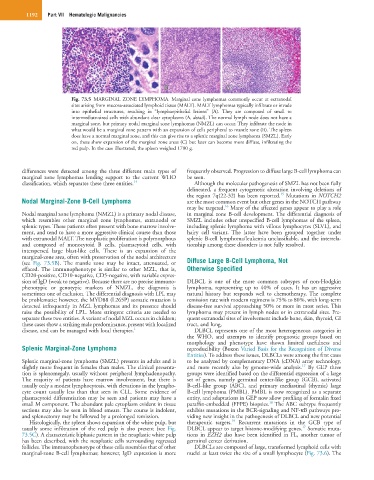
                        Fig. 73.5  MARGINAL ZONE LYMPHOMA. Marginal zone lymphomas commonly occur at extranodal
                        sites arising from mucosa-associated lymphoid tissue (MALT). MALT lymphomas typically infiltrate or invade
                        into  epithelial  structures,  resulting  in  “lymphoepithelial  lesions”  (A).  They  are  composed  of  small  to
                        intermediate-sized cells with abundant clear cytoplasms (A, detail). The normal lymph node does not have a
                        marginal zone, but primary nodal marginal zone lymphomas (NMZL) can occur. They infiltrate the node in
                        what would be a marginal zone pattern with an expansion of cells peripheral to mantle zone (B). The spleen
                        does have a normal marginal zone, and this can give rise to a splenic marginal zone lymphoma (SMZL). Early
                        on, these show expansion of the marginal zone areas (C) but later can become more diffuse, infiltrating the
                        red pulp. In the case illustrated, the spleen weighed 1700 g.


        differences  were  detected  among  the  three  different  main  types  of   frequently observed. Progression to diffuse large B-cell lymphoma can
        marginal  zone  lymphomas  lending  support  to  the  current  WHO   be seen.
        classification, which separates these three entities. 14  Although the molecular pathogenesis of SMZL has not been fully
                                                              delineated,  a  frequent  cytogenetic  alteration  involving  deletions  of
                                                                                             15
                                                              the region 7q(22-32) has been reported.  Mutations in NOTCH2
        Nodal Marginal-Zone B-Cell Lymphoma                   are the most common event but other genes in the NOTCH pathway
                                                                           16
                                                              may be targeted.  Many of the affected genes appear to play a role
        Nodal marginal zone lymphoma (NMZL) is a primary nodal disease,   in marginal zone B-cell development. The differential diagnosis of
        which  resembles  other  marginal  zone  lymphomas,  extranodal  or   SMZL includes other unspecified B-cell lymphomas of the spleen,
        splenic types. These patients often present with bone marrow involve-  including splenic lymphoma with villous lymphocytes (SLVL), and
        ment, and tend to have a more aggressive clinical course than those   hairy  cell  variant.  The  latter  have  been  grouped  together  under
        with extranodal MALT. The neoplastic proliferation is polymorphous   splenic B-cell lymphoma/leukemia unclassifiable, and the interrela-
        and  composed  of  monocytoid  B  cells,  plasmacytoid  cells,  with   tionship among these disorders is not fully resolved.
        interspersed  large  blast-like  cells.  There  is  an  expansion  of  the
        marginal-zone area, often with preservation of the nodal architecture
        (see  Fig.  73.5B).  The  mantle  zone  may  be  intact,  attenuated,  or   Diffuse Large B-Cell Lymphoma, Not
        effaced. The  immunophenotype  is  similar  to  other  MZL,  that  is,   Otherwise Specified
        CD20-positive, CD10-negative, CD5-negative, with variable expres-
        sion of IgD (weak to negative). Because there are no precise immuno-  DLBCL  is  one  of  the  more  common  subtypes  of  non-Hodgkin
        phenotypic  or  genotypic  markers  of  NMZL,  the  diagnosis  is   lymphoma,  representing  up  to  40%  of  cases.  It  has  an  aggressive
        sometimes one of exclusion. The differential diagnosis with LPL may   natural  history  but  responds  well  to  chemotherapy. The  complete
        be problematic; however, the MYD88 (L265P) somatic mutation is   remission rate with modern regimens is 75% to 80%, with long-term
        detected infrequently in MZL lymphomas and its presence should   disease-free survival approaching 50% or more in most series. This
        raise  the  possibility  of  LPL.  More  stringent  criteria  are  needed  to   lymphoma may present in lymph nodes or in extranodal sites. Fre-
        separate these two entities. A variant of nodal MZL occurs in children;   quent extranodal sites of involvement include bone, skin, thyroid, GI
        these cases show a striking male predominance, present with localized   tract, and lung.
        disease, and can be managed with local therapies. 1      DLBCL represents one of the most heterogeneous categories in
                                                              the  WHO,  and  attempts  to  identify  prognostic  groups  based  on
                                                              morphology  and  phenotype  have  shown  limited  usefulness  and
        Splenic Marginal-Zone Lymphoma                        reproducibility (Boxon Varied Basis for the Recognition of Diverse
                                                              Entities). To address these issues, DLBCLs were among the first cases
        Splenic marginal-zone lymphoma (SMZL) presents in adults and is   to be analyzed by complementary DNA (cDNA) array technology,
                                                                                                    17
        slightly more frequent in females than males. The clinical presenta-  and  more  recently  also  by  genome-wide  analysis.   By  GEP  three
        tion is splenomegaly, usually without peripheral lymphadenopathy.   groups were identified based on the differential expression of a large
        The  majority  of  patients  have  marrow  involvement,  but  there  is   set  of  genes,  namely  germinal  center-like  group  (GCB),  activated
        usually only a modest lymphocytosis, with elevations in the lympho-  B-cell–like  group  (ABC),  and  primary  mediastinal  (thymic)  large
        cyte  count  usually  less  than  that  seen  in  CLL.  Some  evidence  of   B-cell lymphoma (PMBL). PMBL is now recognized as a separate
        plasmacytoid differentiation may be seen and patients may have a   entity, and adaptations in GEP now allow profiling of formalin fixed
                                                                                         18
        small M component. The abundant pale cytoplasm evident in tissue   paraffin-embedded (FFPE) biopsies.  The ABC subtype frequently
        sections may also be seen in blood smears. The course is indolent,   exhibits mutations in the BCR-signaling and NF-κB pathways pro-
        and splenectomy may be followed by a prolonged remission.  viding new insight in the pathogenesis of DLBCL and new potential
                                                                             19
           Histologically, the spleen shows expansion of the white pulp, but   therapeutic  targets.   Recurrent  mutations  in  the  GCB  type  of
                                                                                                    17
        usually  some  infiltration  of  the  red  pulp  is  also  present  (see  Fig.   DLBCL appear to target histone-modifying genes.  Somatic muta-
        73.5C). A characteristic biphasic pattern in the neoplastic white pulp   tions  in  EZH2  also  have  been  identified  in  FL,  another  tumor  of
        has been described, with the neoplastic cells surrounding regressed   germinal center derivation.
        follicles. The immunophenotype of these cells resembles that of other   DLBCLs are composed of large, transformed lymphoid cells with
        marginal-zone B-cell lymphomas; however, IgD expression is more   nuclei at least twice the size of a small lymphocyte (Fig. 73.6). The

