


Page 1343 - Hematology_ Basic Principles and Practice ( PDFDrive )
P. 1343
Chapter 73  The Pathologic Basis for the Classification of Non-Hodgkin and Hodgkin Lymphomas  1189


                          A                 BB                  CC           D D          E

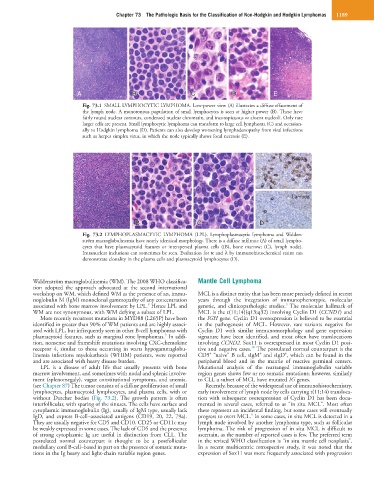
                            Fig. 73.1  SMALL LYMPHOCYTIC LYMPHOMA. Low-power view (A) illustrates a diffuse effacement of
                            the lymph node. A monotonous population of small lymphocytes is seen at higher power (B). These have
                            fairly round nuclear contours, condensed nuclear chromatin, and inconspicuous or absent nucleoli. Only rare
                            larger cells are present. Small lymphocytic lymphoma can transform to large cell lymphoma (C) and occasion-
                            ally to Hodgkin lymphoma (D). Patients can also develop worsening lymphadenopathy from viral infections
                            such as herpes simplex virus, in which the node typically shows focal necrosis (E).


                                                                                                 Kappa


                                                                                                 Lambda


                          A A                BB                   C C                 D D
                            Fig.  73.2  LYMPHOPLASMACYTIC  LYMPHOMA  (LPL).  Lymphoplasmacytic  lymphoma  and Walden-
                            ström macroglobulinemia have nearly identical morphology. There is a diffuse infiltrate (A) of small lympho-
                            cytes  that  have  plasmacytoid  features  or  interspersed  plasma  cells  ((B),  bone  marrow;  (C),  lymph  node).
                            Intranuclear inclusions can sometimes be seen. Evaluation for κ and λ by immunohistochemical stains can
                            demonstrate clonality in the plasma cells and plasmacytoid lymphocytes (D).


            Waldenström macroglobulinemia (WM). The 2008 WHO classifica-  Mantle Cell Lymphoma
            tion  adopted  the  approach  advocated  at  the  second  international
            workshop on WM, which defined WM as the presence of an, immu-  MCL is a distinct entity that has been more precisely defined in recent
            noglobulin M (IgM) monoclonal gammopathy of any concentration   years  through  the  integration  of  immunophenotypic,  molecular
                                                                                               3
                                                 8
            associated with bone marrow involvement by LPL.  Hence LPL and   genetic, and clinicopathologic studies.  The molecular hallmark of
            WM are not synonymous, with WM defying a subset of LPL.  MCL is the t(11;14)(q13;q32) involving Cyclin D1 (CCND1) and
              More recently recurrent mutations in MYD88 (L265P) have been   the IGH gene. Cyclin D1 overexpression is believed to be essential
            identified in greater than 90% of WM patients and are highly associ-  in  the  pathogenesis  of  MCL.  However,  rare  variants  negative  for
            ated with LPL, but infrequently seen in other B-cell lymphomas with   Cyclin  D1  with  similar  immunomorphology  and  gene  expression
                                                       9
            plasmacytoid features, such as marginal zone lymphomas.  In addi-  signature have been identified, and most often have translocations
            tion, nonsense and frameshift mutations involving CXC-chemokine   involving CCND2. Sox11 is overexpressed in most Cyclin D1 posi-
                                                                                   10
            receptor  4,  similar  to  those  occurring  in  warts  hypogammaglobu-  tive and negative cases.  The postulated normal counterpart is the
                                                                      +
                                                                                      +
                                                                                              +
            linemia  infections  myelokathexis  (WHIM)  patients,  were  reported   CD5  “naive” B cell, sIgM  and sIgD , which can be found in the
            and are associated with heavy disease burden.         peripheral  blood  and  in  the  mantle  of  reactive  germinal  centers.
              LPL  is  a  disease  of  adult  life  that  usually  presents  with  bone   Mutational  analysis  of  the  rearranged  immunoglobulin  variable
            marrow involvement, and sometimes with nodal and splenic involve-  region genes shows few or no somatic mutations; however, similarly
            ment (splenomegaly), vague constitutional symptoms, and anemia.   to CLL a subset of MCL have mutated IG genes.
            (see Chapter 87) The tumor consists of a diffuse proliferation of small   Recently, because of the widespread use of immunohistochemistry,
            lymphocytes, plasmacytoid lymphocytes, and plasma cells, with or   early involvement of lymph node by cells carrying t(11;14) transloca-
            without  Dutcher  bodies  (Fig.  73.2).  The  growth  pattern  is  often   tion with subsequent overexpression of Cyclin D1 has been docu-
            interfollicular, with sparing of the sinuses. The cells have surface and   mented in several cases, referred to as “in situ MCL”. Most often
            cytoplasmic immunoglobulin (Ig), usually of IgM type, usually lack   these represent an incidental finding, but some cases will eventually
                                                                                   5
            IgD,  and  express  B-cell–associated  antigens  (CD19,  20,  22,  79a).   progress to overt MCL.  In some cases, in situ MCL is detected in a
            They are usually negative for CD5 and CD10. CD25 or CD11c may   lymph node involved by another lymphoma type, such as follicular
            be weakly expressed in some cases. The lack of CD5 and the presence   lymphoma. The  risk  of  progression  of  in  situ  MCL  is  difficult  to
            of  strong  cytoplasmic  Ig  are  useful  in  distinction  from  CLL. The   ascertain, as the number of reported cases is few. The preferred term
            postulated  normal  counterpart  is  thought  to  be  a  postfollicular   in the revised WHO classification is “in situ mantle cell neoplasia”.
            medullary cord B-cell–based in part on the presence of somatic muta-  In  a  recent  multicentric  retrospective  study,  it  was  noted  that  the
            tions in the Ig heavy and light-chain variable region genes.  expression of Sox11 was more frequently associated with progression

