


Page 1344 - Hematology_ Basic Principles and Practice ( PDFDrive )
P. 1344
1190   Part VII  Hematologic Malignancies


                       A A               BB                 CC            D             EE
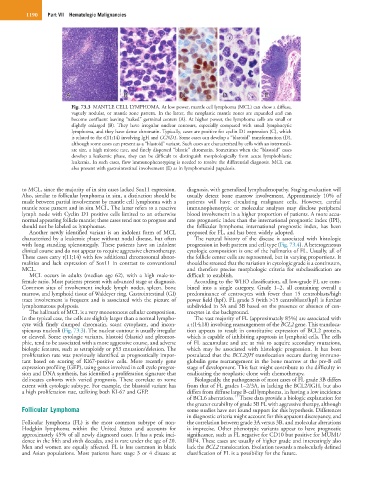
                        Fig. 73.3  MANTLE CELL LYMPHOMA. At low power, mantle cell lymphoma (MCL) can show a diffuse,
                        vaguely nodular, or mantle zone pattern. In the latter, the neoplastic mantle zones are expanded and can
                        become confluent leaving “naked” germinal centers (A). At higher power, the lymphoma cells are small or
                        slightly  enlarged  (B).  They  have  irregular  nuclear  contours,  especially  compared  with  small  lymphocytic
                        lymphoma, and they have dense chromatin. Typically, cases are positive for cyclin D1 expression (C), which
                        is related to the t(11;14) involving IgH and CCND1. Some cases can develop a “blastoid” transformation (D),
                        although some cases can present as a “blastoid” variant. Such cases are characterized by cells with an intermedi-
                        ate size, a high mitotic rate, and finely dispersed “blastic” chromatin. Sometimes when the “blastoid” cases
                        develop  a  leukemic  phase,  they  can  be  difficult  to  distinguish  morphologically  from  acute  lymphoblastic
                        leukemia. In such cases, flow immunophenotyping is needed to resolve the differential diagnosis. MCL can
                        also present with gastrointestinal involvement (E) as in lymphomatoid papulosis.


        to MCL, since the majority of in situ cases lacked Sox11 expression.   diagnosis, with generalized lymphadenopathy. Staging evaluation will
        Also, similar to follicular lymphoma in situ, a distinction should be   usually  detect  bone  marrow  involvement.  Approximately  10%  of
        made between partial involvement by mantle cell lymphoma with a   patients  will  have  circulating  malignant  cells.  However,  careful
        mantle zone pattern and in situ MCL. The latter refers to a reactive   immunophenotypic  or  molecular  analyses  may  disclose  peripheral
        lymph node with Cyclin D1 positive cells limited to an otherwise   blood involvement in a higher proportion of patients. A more accu-
        normal appearing follicle mantle; these cases tend not to progress and   rate prognostic index than the international prognostic index (IPI),
        should not be labeled as lymphomas.                   the  follicular  lymphoma  international  prognostic  index,  has  been
           Another  newly  identified  variant  is  an  indolent  form  of  MCL   proposed for FL, and has been widely adopted.
        characterized by a leukemic phase without nodal disease, but often   The  natural  history  of  the  disease  is  associated  with  histologic
        with  long  standing  splenomegaly. These  patients  have  an  indolent   progression in both pattern and cell type (Fig. 73.4). A heterogeneous
        clinical course and do not appear to require aggressive chemotherapy.   cytologic composition is one of the hallmarks of FL. Usually, all of
        These cases carry t(11;14) with few additional chromosomal abnor-  the follicle center cells are represented, but in varying proportions. It
        malities  and  lack  expression  of  Sox11  in  contrast  to  conventional   should be stressed that the variation in cytologic grade is a continuum,
        MCL.                                                  and  therefore  precise  morphologic  criteria  for  subclassification  are
           MCL  occurs  in  adults  (median  age  62),  with  a  high  male-to-  difficult to establish.
        female ratio. Most patients present with advanced stage at diagnosis.   According to the WHO classification, all low-grade FL are com-
        Common  sites  of  involvement  include  lymph  nodes,  spleen,  bone   bined  into  a  single  category,  Grade  1–2,  all  containing  overall  a
        marrow, and lymphoid tissue of Waldeyer ring. Gastrointestinal (GI)   predominance of centrocytes with fewer than 15 centroblasts/high
        tract involvement is frequent and is associated with the picture of   power field (hpf). FL grade 3 (with >15 centroblasts/hpf) is further
        lymphomatous polyposis.                               subdivided in 3A and 3B based on the presence or absence of cen-
           The hallmark of MCL is a very monotonous cellular composition.   trocytes in the background.
        In the typical case, the cells are slightly larger than a normal lympho-  The vast majority of FL (approximately 85%) are associated with
        cyte  with  finely  clumped  chromatin,  scant  cytoplasm,  and  incon-  a t(14;18) involving rearrangement of the BCL2 gene. This transloca-
        spicuous nucleoli (Fig. 73.3). The nuclear contour is usually irregular   tion  appears  to  result  in  constitutive  expression  of  BCL2  protein,
        or cleaved. Some cytologic variants, blastoid (blastic) and pleomor-  which is capable of inhibiting apoptosis in lymphoid cells. The cells
        phic, tend to be associated with a more aggressive course, and adverse   of  FL  accumulate  and  are  at  risk  to  acquire  secondary  mutations,
        biologic features, such as tetraploidy or p53 mutation/deletion. The   which  may  be  associated  with  histologic  progression.  It  has  been
        proliferation rate was previously identified as prognostically impor-  postulated that the BCL2/JH translocation occurs during immuno-
        tant  based  on  scoring  of  Ki67-positive  cells.  More  recently  gene   globulin gene rearrangement in the bone marrow at the pre-B cell
        expression profiling (GEP), using genes involved in cell cycle progres-  stage of development. This fact might contribute to the difficulty in
        sion and DNA synthesis, has identified a proliferation signature that   eradicating the neoplastic clone with chemotherapy.
        delineates  cohorts  with  varied  prognosis.  These  correlate  to  some   Biologically, the pathogenesis of most cases of FL grade 3B differs
        extent with cytologic subtype. For example, the blastoid variant has   from that of FL grades 1–2/3A, in lacking the BCL2/IGH, but also
        a high proliferation rate, utilizing both KI-67 and GEP.  differs from diffuse large B-cell lymphoma, in having a low incidence
                                                                              11
                                                              of BCL6 aberrations.  These data provide a biologic explanation for
                                                              the greater curability of grade 3B FL with aggressive therapy, although
        Follicular Lymphoma                                   some studies have not found support for this hypothesis. Differences
                                                              in diagnostic criteria might account for this apparent discrepancy, and
        Follicular  lymphoma  (FL)  is  the  most  common  subtype  of  non-  the correlation between grade 3A versus 3B, and molecular alterations
        Hodgkin  lymphoma  within  the  United  States  and  accounts  for   is  imprecise.  Other  phenotypic  variants  appear  to  have  prognostic
        approximately 45% of all newly diagnosed cases. It has a peak inci-  significance, such as FL negative for CD10 but positive for MUM1/
        dence in the fifth and sixth decades, and is rare under the age of 20.   IRF4. These cases are usually of higher grade and interestingly also
        Men and women are equally affected. FL is less common in black   lack the BCL2 translocation. Evolution towards a molecularly defined
        and Asian populations. Most patients have stage 3 or 4 disease at   classification of FL is a possibility for the future.

