


Page 1347 - Hematology_ Basic Principles and Practice ( PDFDrive )
P. 1347
Chapter 73  The Pathologic Basis for the Classification of Non-Hodgkin and Hodgkin Lymphomas  1193


                                                                                CD10             BCL6


                                              B B                     C C               D D

                                                                                MUM1             CD138


                          A A                 E E                     F F               G G

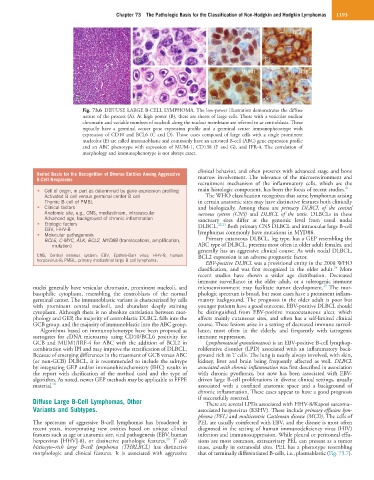
                            Fig. 73.6  DIFFUSE LARGE B-CELL LYMPHOMA. The low-power illustration demonstrates the diffuse
                            nature of the process (A). At high power (B), there are sheets of large cells. Those with a vesicular nuclear
                            chromatin and variable numbers of nucleoli along the nuclear membrane are referred to as centroblasts. These
                            typically  have  a  germinal  center  gene  expression  profile  and  a  germinal  center  immunophenotype  with
                            expression  of  CD10 and  BCL6  (C and D). Those cases composed  of large  cells  with a single  prominent
                            nucleolus (E) are called immunoblastic and commonly have an activated B-cell (ABC) gene expression profile
                            and  an  ABC  phenotype  with  expression  of  MUM-1,  CD138  (F  and  G),  and  IFR-4. The  correlation  of
                            morphology and immunophenotype is not always exact.

                                                                  clinical behavior, and often presents with advanced stage and bone
             Varied Basis for the Recognition of Diverse Entities Among Aggressive
             B-Cell Neoplasms                                     marrow  involvement. The  relevance  of  the  microenvironment  and
                                                                  recruitment  mechanism  of  the  inflammatory  cells,  which  are  the
             •  Cell of origin, in part as determined by gene expression profiling  main histologic component, has been the focus of recent studies. 21
                Activated B cell versus germinal center B cell      The WHO classification recognizes that some lymphomas arising
                Thymic B cell of PMBL                             in certain anatomic sites may have distinctive features both clinically
             •  Clinical factors                                  and  biologically.  Among  these  are  primary  DLBCL  of  the  central
                Anatomic site, e.g., CNS, mediastinum, intravascular  nervous  system  (CNS)  and  DLBCL  of  the  testis.  DLBCLs  in  these
                Advanced age, background of chronic inflammation  sanctuary  sites  differ  at  the  genomic  level  from  usual  nodal
             •  Etiologic factors                                 DLBCL. 22,23  Both primary CNS DLBCL and intraocular large B-cell
                EBV, HHV-8
             •  Molecular pathogenesis                            lymphomas commonly have mutations in MYD88.
                BCL6, C-MYC, ALK, BCL2, MYD88 (translocations, amplification,   Primary cutaneous DLBCL, leg type, has a GEP resembling the
                  mutation)                                       ABC type of DLBCL, presents most often in older adult females, and
                                                                  generally has an aggressive clinical course. As with nodal DLBCL,
             CNS,  Central  nervous  system;  EBV,  Epstein-Barr  virus;  HHV-8,  human   BCL2 expression is an adverse prognostic factor.
             herpesvirus-8; PMBL, primary mediastinal large B cell lymphoma;
                                                                    EBV-positive DLBCL was a provisional entity in the 2008 WHO
                                                                                                              24
                                                                  classification,  and  was  first  recognized  in  the  older  adult.   More
                                                                  recent  studies  have  shown  a  wider  age  distribution.  Decreased
                                                                  immune  surveillance  in  the  older  adult,  or  a  tolerogenic  immune
                                                                                                           25
            nuclei generally have vesicular chromatin, prominent nucleoli, and   microenvironment  may  facilitate  tumor  development.   The  mor-
            basophilic  cytoplasm,  resembling  the  centroblasts  of  the  normal   phologic spectrum is broad, but most cases have a prominent inflam-
            germinal center. The immunoblastic variant is characterized by cells   matory  background. The  prognosis  in  the  older  adult  is  poor  but
            with  prominent  central  nucleoli,  and  abundant  deeply  staining   younger patients have a good outcome. EBV-positive DLBCL should
            cytoplasm. Although there is no absolute correlation between mor-  be  distinguished  from  EBV-positive  mucocutaneous  ulcer,  which
            phology and GEP, the majority of centroblastic DLBCL falls into the   affects mainly cutaneous sites, and often has a self-limited clinical
            GCB group, and the majority of immunoblastic into the ABC group.  course. These lesions arise in a setting of decreased immune surveil-
              Algorithms based on immunophenotype have been proposed as   lance,  most  often  in  the  elderly,  and  frequently  with  iatrogenic
            surrogates  for  cDNA  microarray  using  CD10/BCL6  positivity  for   immune suppression.
            GCB  and  MUM1/IRF-4  for  ABC  with  the  addition  of  BCL2  in   Lymphomatoid granulomatosis is an EBV-positive B-cell lymphop-
            combination with IPI and may improve the stratification of DLBCL.   roliferative  disorder  (LPD)  associated  with  an  inflammatory  back-
            Because of emerging differences in the treatment of GCB versus ABC   ground rich in T cells. The lung is nearly always involved, with skin,
            (or non-GCB) DLBCL, it is recommended to include the subtype   kidney,  liver  and  brain  being  frequently  affected  as  well.  DLBCL
            by integrating GEP and/or immunohistochemistry (IHC) results in   associated with chronic inflammation was first described in association
            the  report  with  clarification  of  the  method  used  and  the  type  of   with  chronic  pyothorax,  but  now  has  been  associated  with  EBV-
            algorithm. As noted, newer GEP methods may be applicable to FFPE   driven large B-cell proliferations in diverse clinical settings, usually
            material. 18                                          associated  with  a  confined  anatomic  space  and  a  background  of
                                                                  chronic inflammation. These cases appear to have a good prognosis
            Diffuse Large B-Cell Lymphomas, Other                 if successfully resected.
                                                                    There are several LPDs associated with HHV-8/Kaposi sarcoma–
            Variants and Subtypes.                                associated herpesvirus (KSHV). These include primary effusion lym-
                                                                  phoma (PEL) and multicentric Castleman disease (MCD). The cells of
            The  spectrum  of  aggressive  B-cell  lymphomas  has  broadened  in   PEL are usually coinfected with EBV, and the disease is most often
            recent  years,  incorporating  new  entities  based  on  unique  clinical   diagnosed in the setting of human immunodeficiency virus (HIV)
            features such as age or anatomic site, viral pathogenesis (EBV, human   infection and immunosuppression. While pleural or peritoneal effu-
                                                       20
            herpesvirus  [HHV]-8),  or  distinctive  pathologic  features.   T  cell/  sions are most common, extracavitary PEL can present as a tumor
            histiocyte–rich  large  B-cell  lymphoma  (THRLBCL)  has  distinctive   mass, usually in extranodal sites. PEL has a phenotype resembling
            morphologic  and  clinical  features.  It  is  associated  with  aggressive   that of terminally differentiated B-cells, i.e., plasmablastic (Fig. 73.7).

