


Page 1345 - Hematology_ Basic Principles and Practice ( PDFDrive )
P. 1345
Chapter 73  The Pathologic Basis for the Classification of Non-Hodgkin and Hodgkin Lymphomas  1191


                                                                 C C           D D          E E


                          A A                B B                 F F
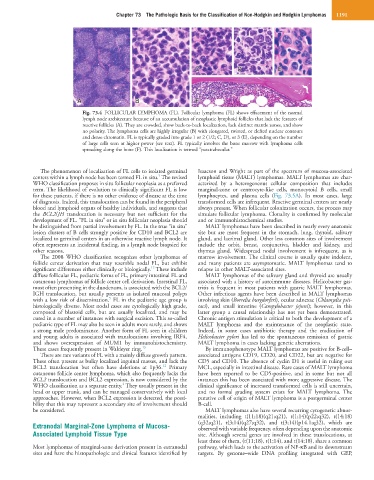
                            Fig. 73.4  FOLLICULAR LYMPHOMA (FL). Follicular lymphoma (FL) shows effacement of the normal
                            lymph node architecture because of an accumulation of neoplastic lymphoid follicles that lack the features of
                            reactive follicles (A). They are crowded, show back-to-back localization, lack distinct mantle zones, and show
                            no polarity. The lymphoma cells are highly irregular (B) with elongated, twisted, or clefted nuclear contours
                            and dense chromatin. FL is typically graded into grade 1 or 2 (1/2; C, D), or 3 (E), depending on the number
                            of large cells seen at higher power (see text). FL typically involves the bone marrow with lymphoma cells
                            spreading along the bone (F). This localization is termed “paratrabecular.”


              The phenomenon of localization of FL cells to isolated germinal   Isaacson and Wright as part of the spectrum of mucosa-associated
                                                     5
            centers within a lymph node has been termed FL in situ.  The revised   lymphoid tissue (MALT) lymphomas. MALT lymphomas are char-
            WHO classification proposes in situ follicular neoplasia as a preferred   acterized  by  a  heterogeneous  cellular  composition  that  includes
            term. The likelihood of evolution to clinically significant FL is low   marginal-zone  or  centrocyte-like  cells,  monocytoid  B  cells,  small
            for these patients, if there is no other evidence of disease at the time   lymphocytes,  and  plasma  cells  (Fig.  73.5A).  In  most  cases,  large
            of diagnosis. Indeed, this translocation can be found in the peripheral   transformed cells are infrequent. Reactive germinal centers are nearly
            blood and lymphoid organs of healthy individuals, and suggests that   always present. When follicular colonization occurs, the process may
            the  BCL2/JH  translocation  is  necessary  but  not  sufficient  for  the   simulate follicular lymphoma. Clonality is confirmed by molecular
            development of FL. “FL in situ” or in situ follicular neoplasia should   and or immunohistochemical studies.
            be distinguished from partial involvement by FL. In the true “in situ”   MALT lymphomas have been described in nearly every anatomic
            lesion clusters of B cells strongly positive for CD10 and BCL2 are   site  but  are  most  frequent  in  the  stomach,  lung,  thyroid,  salivary
            localized to germinal centers in an otherwise reactive lymph node. It   gland, and lacrimal gland. Other less common sites of involvement
            often represents an incidental finding, in a lymph node biopsied for   include  the  orbit,  breast,  conjunctiva,  bladder  and  kidney,  and
            other reasons.                                        thymus  gland.  Widespread  nodal  involvement  is  infrequent,  as  is
              The  2008  WHO  classification  recognizes  other  lymphomas  of   marrow involvement. The clinical course is usually quite indolent,
            follicle  center  derivation  that  may  resemble  nodal  FL,  but  exhibit   and  many  patients  are  asymptomatic.  MALT  lymphomas  tend  to
                                                  12
            significant differences either clinically or biologically.  These include   relapse in other MALT-associated sites.
            diffuse follicular FL, pediatric forms of FL, primary intestinal FL and   MALT lymphomas of the salivary gland and thyroid are usually
            cutaneous lymphomas of follicle center cell derivation. Intestinal FL,   associated with a history of autoimmune diseases. Helicobacter gas-
            most often presenting in the duodenum, is associated with the BCL2/  tritis  is  frequent  in  most  patients  with  gastric  MALT  lymphomas.
            IGH translocation, but usually presents as isolated mucosal polyps   Other infectious agents have been described in MALT lymphomas
                                     5
            with a low risk of dissemination.  FL in the pediatric age group is   involving skin (Borrelia burgdorferi), ocular adnexae (Chlamydia psit-
            histologically diverse. Most nodal cases are cytologically high grade,   taci),  and  small  intestine  (Campylobacter  jejuni);  however,  in  this
            composed  of  blastoid  cells,  but  are  usually  localized,  and  may  be   latter  group  a  causal  relationship  has  not  yet  been  demonstrated.
            cured in a number of instances with surgical excision. This so-called   Chronic antigen stimulation is critical to both the development of a
            pediatric type of FL may also be seen in adults more rarely, and shows   MALT  lymphoma  and  the  maintenance  of  the  neoplastic  state.
            a strong male predominance. Another form of FL seen in children   Indeed,  in  some  cases  antibiotic  therapy  and  the  eradication  of
            and young adults is associated with translocations involving IRF4,   Helicobacter  pylori  has  led  to  the  spontaneous  remission  of  gastric
            and  shows  overexpression  of  MUM1  by  immunohistochemistry.   MALT lymphoma in cases lacking genetic aberrations.
            These cases frequently present in Waldeyer ring. 13     By immunophenotype MALT lymphomas are positive for B-cell–
              There are rare variants of FL with a mainly diffuse growth pattern.   associated antigens CD19, CD20, and CD22, but are negative for
            These often present as bulky localized inguinal masses, and lack the   CD5 and CD10. The absence of cyclin D1 is useful in ruling out
                                                      12
            BCL2  translocation  but  often  have  deletions  at  1p36.   Primary   MCL, especially in intestinal disease. Rare cases of MALT lymphoma
            cutaneous follicle center lymphoma, which also frequently lacks the   have  been  reported  to  be  CD5-positive,  and  in  some  but  not  all
            BCL2 translocation and BCL2 expression, is now considered by the   instances this has been associated with more aggressive disease. The
                                         2
            WHO classification as a separate entity.  They usually present in the   clinical significance of increased transformed cells is still uncertain,
            head or upper trunk, and can be managed conservatively with local   and  no  formal  grading  system  exists  for  MALT  lymphoma.  The
            approaches. However, when BCL2 expression is detected, the possi-  putative cell of origin of MALT lymphoma is a postgerminal center
            bility that this may represent a secondary site of involvement should   B-cell.
            be considered.                                          MALT lymphomas also have several recurring cytogenetic abnor-
                                                                  malities,  including  t(11;18)(q21;q21),  t(1;14)(p22;q32),  t(14;18)
            Extranodal Marginal-Zone Lymphoma of Mucosa-          (q32;q21),  t(3;14)(q27;q32),  and  t(3;14)(p14.1;q32),  which  are
                                                                  observed with variable frequency, often depending upon the anatomic
            Associated Lymphoid Tissue Type                       site. Although several genes are involved in these translocations, at
                                                                  least three of them, (t(11;18), t(1;14), and t(14;18), share a common
            Most lymphomas of marginal-zone derivation present in extranodal   pathway, which leads to the activation of NF-κB and its downstream
            sites and have the histopathologic and clinical features identified by   targets.  By  genome–wide  DNA  profiling  integrated  with  GEP,

