


Page 1354 - Hematology_ Basic Principles and Practice ( PDFDrive )
P. 1354
1200   Part VII  Hematologic Malignancies


                       A A                       B                          C C
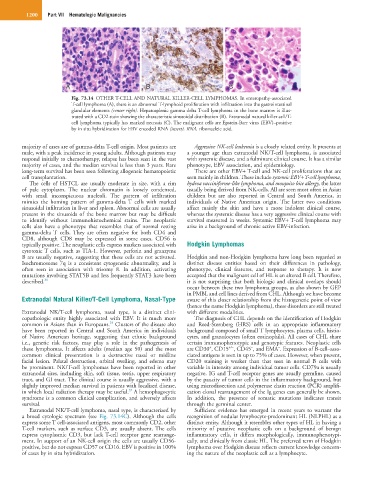
                        Fig. 73.14  OTHER T-CELL AND NATURAL KILLER-CELL LYMPHOMAS. In enteropathy-associated
                        T-cell lymphoma (A), there is an abnormal T-lymphoid proliferation with infiltration into the gastrointestinal
                        glandular elements (center right). Hepatosplenic gamma delta T-cell lymphoma in the bone marrow is illus-
                        trated with a CD2 stain showing the characteristic sinusoidal distribution (B). Extranodal natural killer cell/T-
                        cell lymphoma typically has marked necrosis (C). The malignant cells are Epstein-Barr virus (EBV)–positive
                        by in situ hybridization for EBV encoded RNA (insert). RNA, ribonucleic acid.

        majority of cases are of gamma-delta T-cell origin. Most patients are   Aggressive NK-cell leukemia is a closely related entity. It presents at
        male, with a peak incidence in young adults. Although patients may   a younger age than extranodal NK/T-cell lymphoma, is associated
        respond initially to chemotherapy, relapse has been seen in the vast   with systemic disease, and a fulminant clinical course. It has a similar
        majority of cases, and the median survival is less than 3 years. Rare   phenotype, EBV association, and epidemiology.
        long-term survival has been seen following allogeneic hematopoietic   There are other EBV+ T-cell and NK-cell proliferations that are
        cell transplantation.                                 seen mainly in children. These include systemic EBV+ T-cell lymphoma,
           The  cells  of  HSTCL  are  usually  moderate  in  size,  with  a  rim   hydroa vacciniforme-like lymphoma, and mosquito bite allergy, the latter
        of  pale  cytoplasm.  The  nuclear  chromatin  is  loosely  condensed,   usually being derived from NK-cells. All are seen most often in Asian
        with  small  inconspicuous  nucleoli.  The  pattern  of  infiltration   children  but  are  also  reported  in  Central  and  South  America,  in
        mimics  the  homing  pattern  of  gamma-delta  T  cells  with  marked   individuals  of  Native  American  origin.  The  latter  two  conditions
        sinusoidal infiltration in liver and spleen. Abnormal cells are usually   affect  mainly  the  skin  and  have  a  more  indolent  clinical  course,
        present  in  the  sinusoids  of  the  bone  marrow  but  may  be  difficult   whereas the systemic disease has a very aggressive clinical course with
        to  identify  without  immunohistochemical  stains.  The  neoplastic   survival measured in weeks. Systemic EBV+ T-cell lymphoma may
        cells  also  have  a  phenotype  that  resembles  that  of  normal  resting   arise in a background of chronic active EBV-infection.
        gamma-delta  T  cells.  They  are  often  negative  for  both  CD4  and
        CD8,  although  CD8  may  be  expressed  in  some  cases.  CD56  is
        typically positive. The neoplastic cells express markers associated with   Hodgkin Lymphomas
        cytotoxic T cells, such as TIA-1. However, perforin and granzyme
        B are usually negative, suggesting that these cells are not activated.   Hodgkin and non-Hodgkin lymphoma have long been regarded as
        Isochromosome  7q  is  a  consistent  cytogenetic  abnormality,  and  is   distinct  disease  entities  based  on  their  differences  in  pathology,
        often  seen  in  association  with  trisomy  8.  In  addition,  activating   phenotype,  clinical  features,  and  response  to  therapy.  It  is  now
        mutations involving STAT5B and less frequently STAT3 have been    accepted that the malignant cell of HL is an altered B cell. Therefore,
        described. 36                                         it is not surprising that both biologic and clinical overlaps should
                                                              occur between these two lymphoma groups, as also shown by GEP
                                                              in PMBL and cell lines derived from CHL. Although we have become
        Extranodal Natural Killer/T-Cell Lymphoma, Nasal-Type  aware of this closer relationship from the histogenetic point of view
                                                              (hence the name Hodgkin lymphoma), these disorders are still treated
        Extranodal  NK/T-cell  lymphoma,  nasal  type,  is  a  distinct  clini-  with different modalities.
        copathologic  entity  highly  associated  with  EBV.  It  is  much  more   The diagnosis of CHL depends on the identification of Hodgkin
                                     34
        common in Asians than in Europeans.  Clusters of the disease also   and  Reed-Sternberg  (HRS)  cells  in  an  appropriate  inflammatory
        have  been  reported  in  Central  and  South  America  in  individuals   background composed of small T lymphocytes, plasma cells, histio-
        of  Native  American  heritage,  suggesting  that  ethnic  background   cytes, and granulocytes (often eosinophils). All cases of CHL share
        i.e.,  genetic  risk  factors,  may  play  a  role  in  the  pathogenesis  of   certain immunophenotypic and genotypic features. Neoplastic cells
                                                                                   −
                                                                            +/−
                                                                                            −
                                                                      +
        these  lymphomas.  It  affects  adults  (median  age  50)  and  the  most   are CD30 , CD15 , CD45 , and EMA . Expression of B-cell–asso-
        common  clinical  presentation  is  a  destructive  nasal  or  midline   ciated antigens is seen in up to 75% of cases. However, when present,
        facial  lesion.  Palatal  destruction,  orbital  swelling,  and  edema  may   CD20  staining  is  weaker  than  that  seen  in  normal  B  cells  with
        be prominent. NK/T-cell lymphomas have been reported in other   variable in intensity among individual tumor cells. CD79a is usually
        extranodal sites, including skin, soft tissue, testis, upper respiratory   negative. IG and T-cell receptor genes are usually germline, caused
        tract, and GI tract. The clinical course is usually aggressive, with a   by the paucity of tumor cells in the inflammatory background, but
        slightly improved median survival in patients with localized disease,   using microdissection and polymerase chain reaction (PCR) amplifi-
                                           37
        in which local radiation therapy may be useful.  A hemophagocytic   cation clonal rearrangement of the Ig genes can generally be shown.
        syndrome is a common clinical complication, and adversely affects     In  addition,  the  presence  of  somatic  mutations  indicates  transit
        survival.                                             through the germinal center.
           Extranodal NK/T-cell lymphoma, nasal type, is characterized by   Sufficient  evidence  has  emerged  in  recent  years  to  warrant  the
        a  broad  cytologic  spectrum  (see  Fig.  73.14C).  Although  the  cells   recognition of nodular lymphocyte-predominant HL (NLPHL) as a
        express some T cell-associated antigens, most commonly CD2, other   distinct entity. Although it resembles other types of HL in having a
        T-cell  markers,  such  as  surface  CD3,  are  usually  absent. The  cells   minority  of  putative  neoplastic  cells  on  a  background  of  benign
        express  cytoplasmic  CD3,  but  lack T-cell  receptor  gene  rearrange-  inflammatory  cells,  it  differs  morphologically,  immunophenotypi-
        ment. In support of an NK-cell origin the cells are usually CD56-  cally, and clinically from classic HL. The preferred term of Hodgkin
        positive, but do not express CD57 or CD16. EBV is positive in 100%   lymphoma over Hodgkin disease reflects current knowledge concern-
        of cases by in situ hybridization.                    ing the nature of the neoplastic cell as a lymphocyte.

