


Page 1389 - Hematology_ Basic Principles and Practice ( PDFDrive )
P. 1389
Chapter 76  Origin of Non-Hodgkin Lymphoma  1235


             A                                  E                                  I
            CD10              BCL6             MUM1              CD138            CD30


             B                C                 F                G                 J


             D                                  H                                  K
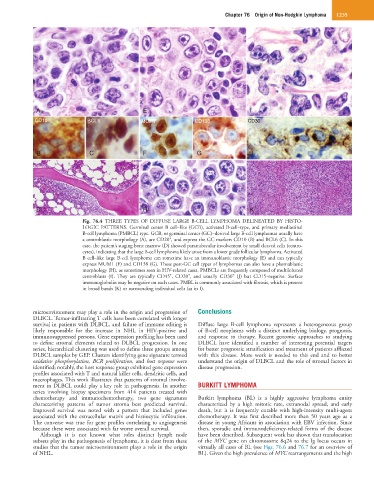
                            Fig.  76.4  THREE TYPES  OF  DIFFUSE  LARGE  B-CELL  LYMPHOMA  DELINEATED  BY  HISTO-
                            LOGIC PATTERNS. Germinal center B cell–like (GCB), activated B-cell–type, and primary mediastinal
                            B-cell lymphoma (PMBCL) type. GCB, or germinal center (GC)–derived large B-cell lymphomas usually have
                                                        +
                            a centroblastic morphology (A), are CD20 , and express the GC markers CD10 (B) and BCL6 (C). In this
                            case, the patient’s staging bone marrow (D) showed paratrabecular involvement by small cleaved cells (centro-
                            cytes), indicating that the large B-cell lymphoma likely arose from a lower grade follicular lymphoma. Activated
                            B cell–like large B-cell lymphoma can sometime have an immunoblastic morphology (E) and can typically
                            express MUM1 (F) and CD138 (G). These post-GC cell types of lymphomas can also have a plasmablastic
                            morphology (H), as sometimes seen in HIV-related cases. PMBCLs are frequently composed of multilobated
                                                         +
                                                               +
                                                                             +
                            centroblasts  (I).  They  are  typically  CD45 ,  CD20 ,  and  usually  CD30   (J)  but  CD15-negative.  Surface
                            immunoglobulin may be negative on such cases. PMBL is commonly associated with fibrosis, which is present
                            in broad bands (K) or surrounding individual cells (as in I).
            microenvironment may play a role in the origin and progression of   Conclusions
            DLBCL. Tumor-infiltrating T cells have been correlated with longer
            survival in patients with DLBCL, and failure of immune editing is   Diffuse  large  B-cell  lymphoma  represents  a  heterogeneous  group
            likely  responsible  for  the  increase  in  NHL  in  HIV-positive  and   of  B-cell  neoplasms  with  a  distinct  underlying  biology,  prognosis,
            immunosuppressed persons. Gene expression profiling has been used   and  response  to  therapy.  Recent  genomic  approaches  to  studying
            to  define  stromal  elements  related  to  DLBCL  progression.  In  one   DLBCL  have  identified  a  number  of  interesting  potential  targets
            series, hierarchical clustering was used to define three groups among   for better prognostic stratification and treatment of patients afflicted
            DLBCL samples by GEP. Clusters identifying gene signature termed   with  this  disease.  More  work  is  needed  to  this  end  and  to  better
            oxidative  phosphorylation,  BCR  proliferation,  and  host  response  were   understand the origin of DLBCL and the role of stromal factors in
            identified; notably, the host response group exhibited gene expression   disease progression.
            profiles associated with T and natural killer cells, dendritic cells, and
            macrophages. This work illustrates that patterns of stromal involve-
            ment in DLBCL could play a key role in pathogenesis. In another   BURKITT LYMPHOMA
            series  involving  biopsy  specimens  from  414  patients  treated  with
            chemotherapy  and  immunochemotherapy,  two  gene  signatures   Burkitt  lymphoma  (BL)  is  a  highly  aggressive  lymphoma  entity
            characterizing  patterns  of  tumor  stroma  best  predicted  survival.   characterized  by  a  high  mitotic  rate,  extranodal  spread,  and  early
            Improved  survival  was  noted  with  a  pattern  that  included  genes   death,  but  it  is  frequently  curable  with  high-intensity  multi-agent
            associated with the extracellular matrix and histiocytic infiltration.   chemotherapy.  It  was  first  described  more  than  50  years  ago  as  a
            The converse was true for gene profiles correlating to angiogenesis   disease in young Africans in association with EBV infection. Since
            because these were associated with far worse overall survival.  then,  sporadic  and  immunodeficiency-related  forms  of  the  disease
              Although  it  is  not  known  what  roles  distinct  lymph  node     have been described. Subsequent work has shown that translocation
            subsets play in the pathogenesis of lymphoma, it is clear from these   of the MYC gene on chromosome 8q24 to the Ig locus occurs in
            studies that the tumor microenvironment plays a role in the origin     virtually all cases of BL (see Figs. 76.6 and 76.7 for an overview of
            of NHL.                                               BL). Given the high prevalence of MYC rearrangements and the high

