


Page 1393 - Hematology_ Basic Principles and Practice ( PDFDrive )
P. 1393
Chapter 76  Origin of Non-Hodgkin Lymphoma  1239


              Although BCL2 is thought to have a critical role in development   evolution or transformation of a putative progenitor FL stem cell.
            of FL, nearly 30% of grade 3A and a majority of grade 3B FLs are   Acquired rearrangement of the MYC oncogene can also occur and
            t(14;18) negative. Alternative rearrangements involving the κ or λ   has  been  associated  with  an  aggressive  plasmablastic  phenotype.
            light chains and BCL2 may occur, but many t(14;18) FLs do not   Stromal  factors  with  FL  tumors  also  likely  play  a  key  role  in  FL
            express BCL2. These entities express a post-GC CD10-IRF4-pheno-  propagation and have been studied as having prognostic consequence
            type with 3q27/BCL6 rearrangements and are associated with lower   in FL as well.
            chemotherapy response rates as well as worse overall survival com-
            pared with t(14;18)-positive FLs. It is not clear how this subset of FL
            evolves from normal B cells, but this immunophenotype suggests a   Tumor Microenvironment and Survival in
            late- or post-GC origin. GEP and analysis of miRNA profiles of FL   Follicular Lymphoma
            confirm this association. Leich et al analyzed gene expression profiles
            of 184 grade I-3A FLs, of which 17 were t(14;18) negative (six of   Just as the lymphoid microenvironment is integral to the formation
            these rearrangement-negative FLs still overexpressed BCL2). Analysis   and function of GCs and immune factors predict survival in DLBCL,
            of this data showed enrichment of signatures associated with activated   FL development appears to depend on stromal factors and the host
            B  cells,  including  NFκB  signaling,  and  those  associated  with  cell   immune response. In the largest study examining this relationship
            cycle,  proliferation,  and  the  tumor  microenvironment.  A  study   Dave et al performed gene expression analysis using whole-genome
            involving a similar cohort showed that a pattern of 17 miRNAs was   microarrays  on  191  FL  specimens  with  the  goal  of  determining
            differentially expressed between translocation positive and negative   genomic predictors of survival. Genes identified were stratified into
            phenotypes. A group of five miRNAs was found to be downregulated   two groups based on correlation of expression with patient outcome
            in  the  t(14;18)  group,  and  this  correlated  with  overexpression  of   (gene sets associated with good prognosis or poor prognosis). Hier-
            genes  related  to  proliferation,  apoptosis,  and  differentiation. Thus   archical clustering then identified five survival gene sets within each
            evidence for a post-GCB origin of t(14;18) translocation–negative   of these groups; analysis revealed that a combination of two gene sets
            FLs exists at the gene expression level. Further work is needed to fully   (immune response-1 and immune response-2) formed the best model
            understand how BCL2-negative FL develops.             for prediction of survival. Interestingly, immune response-1 consists
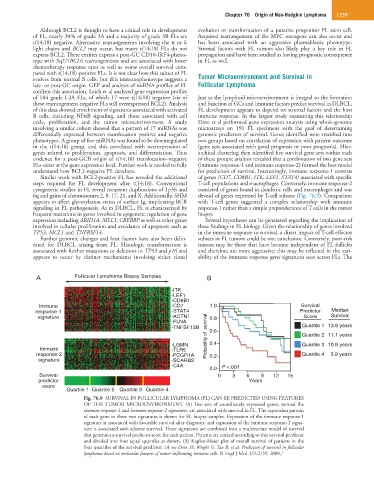
              Similar work with BCL2-positive FL has revealed the additional   of genes (CD7, CD8B1, ITK, LEF1, STAT4) associated with specific
            steps  required  for  FL  development  after  t(14;18).  Conventional   T-cell populations and macrophages. Conversely, immune response-2
            cytogenetic studies in FL reveal recurrent duplications of 1p36 and   consisted of genes found in dendritic cells and macrophages and was
            6q and gains of chromosomes 2, 8, 17, 21, and X. Additionally, SHM   devoid of genes expressed by T-cell subsets (Fig. 76.9). Comparison
            appears to affect glycosylation status of surface Ig, implicating BCR   with  T-cell  genes  suggested  a  complex  relationship  with  immune
            signaling in FL pathogenesis. As in DLBCL, FL is characterized by   response-1 rather than a simple preponderance of T cells in the tumor
            frequent mutations in genes involved in epigenetic regulation of gene   biopsy.
            expression including ARID1A, MLL3, CREBBP as well as other genes   Several hypotheses can be generated regarding the implication of
            involved in cellular proliferation and avoidance of apoptosis such as   these findings in FL biology. Given the relationship of genes involved
            TP53, MCL1 and TNFRSF14.                              in the immune response to survival, a direct impact of T-cell effector
              Further genomic changes and host factors have also been delin-  subsets in FL tumors could be one conclusion. Conversely, poor-risk
            eated  for  DLBCL  arising  from  FL.  Histologic  transformation  is   tumors may be those that have become independent of FL follicles
            associated with further mutations or deletions in TP53 and p16 and   and therefore are more aggressive; this may be reflected in the vari-
            appears  to  occur  by  distinct  mechanisms  involving  either  clonal   ability of the immune response gene signatures seen across FLs. The


             A           Follicular Lymphoma Biopsy Samples          B
                                                         -ITK
                                                         -LEF1
                                                         -CD8B1
              Immune                                     -CD7         1.0                           Survival
             response-1                                  -STAT4                                    Predictor   Median
             signature                                   -ACTN1       0.8                           Score     Survival
                                                         -FLNA
                                                         -TNFSF13B    0.6                           Quartile 1 13.6 years
                                                                                                    Quartile 2 11.1 years
                                                         -LGMN       Probability of  survival  0.4  Quartile 3 10.8 years
              Immune                                     -TLR5
             response-2                                  -FCGR1A      0.2                           Quartile 4  3.9 years
              signature                                  -SCARB2
                                                         -C4A             P <.001
                                                                      0.0
              Survival                                                  0    3    6   9   12   15
              predictor                                                           Years
               score
                       Quartile 1 Quartile 2  Quartile 3 Quartile 4
                            Fig. 76.9  SURVIVAL IN FOLLICULAR LYMPHOMA (FL) CAN BE PREDICTED USING FEATURES
                            OF THE TUMOR MICROENVIRONMENT. (A) Two sets of coordinately expressed genes, termed the
                            immune response-1 and immune response-2 signatures, are associated with survival in FL. The expression pattern
                            of each gene in these two signatures is shown for FL biopsy samples. Expression of the immune response-1
                            signature is associated with favorable survival after diagnosis, and expression of the immune response-2 signa-
                            ture is associated with adverse survival. These signatures are combined into a multivariate model of survival
                            that generates a survival predictor score for each patient. Patients are ranked according to this survival predictor
                            and divided into four equal quartiles as shown. (B) Kaplan-Meier plot of overall survival of patients in the
                            four quartiles of the survival predictor. (A, see Dave SS, Wright G, Tan B, et al: Prediction of survival in follicular
                            lymphoma based on molecular features of tumor-infiltrating immune cells. N Engl J Med 351:2159, 2004.)

