


Page 1390 - Hematology_ Basic Principles and Practice ( PDFDrive )
P. 1390
1236   Part VII  Hematologic Malignancies


                                                           TNFRSF14               cSNVs
                                                                 BCL10 CD58       CNV loss
                                                                          BTG2    CNV gain
                                                                                  CNV high-level gain
                                                                                  LOH
                                  MEF2B
                                 CD70
                              BCL2
                           GNA13
                          STAT3                                                        MYD88
                          CD79B
                           TP53
                           IRF8
                        CREBBP                                                             KLHL6
                                                            BCL2
                          B2M
                                                            IGH


                          FOXO1
                              BTG1
                                MLL2                                                 HIST1H1C
                                                                                   CCND3
                                   ETS1
                                                                                TMEM30A
                                                                              SGK1
                                             FAS                          CARD11
                                                                   EZH2
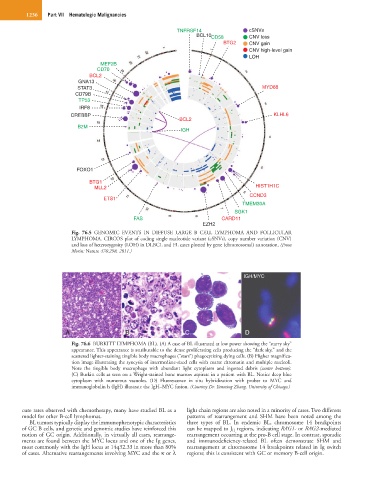
                        Fig.  76.5  GENOMIC  EVENTS  IN  DIFFUSE  LARGE  B  CELL  LYMPHOMA  AND  FOLLICULAR
                        LYMPHOMA. CIRCOS plot of coding single nucleotide variant (cSNVs), copy number variation (CNV)
                        and loss of heterozygosity (LOH) in DLBCL and FL cases plotted by gene (chromosomal) annotation. (From
                        Morin: Nature 476:298, 2011.)


                                                                                 IGH/MYC


                       A                  B                   C                  D

                        Fig. 76.6  BURKITT LYMPHOMA (BL). (A) A case of BL illustrated at low power showing the “starry sky”
                        appearance. This appearance is attributable to the dense proliferating cells producing the “dark sky,” and the
                        scattered lighter-staining tingible body macrophages (“stars”) phagocytizing dying cells. (B) Higher magnifica-
                        tion image illustrating the syncytia of intermediate-sized cells with coarse chromatin and multiple nucleoli.
                        Note  the  tingible  body  macrophage  with  abundant  light  cytoplasm  and  ingested  debris  (center  bottom).
                        (C) Burkitt cells as seen on a Wright-stained bone marrow aspirate in a patient with BL. Notice deep blue
                        cytoplasm  with  numerous  vacuoles.  (D)  Fluorescence  in  situ  hybridization  with  probes  to  MYC  and
                        immunoglobulin h (IgH) illustrate the IgH–MYC fusion. (Courtesy Dr. Yanming Zhang, University of Chicago.)


        cure rates observed with chemotherapy, many have studied BL as a   light chain regions are also noted in a minority of cases. Two different
        model for other B-cell lymphomas.                     patterns  of  rearrangement  and  SHM  have  been  noted  among  the
           BL tumors typically display the immunophenotypic characteristics   three  types  of  BL.  In  endemic  BL,  chromosome  14  breakpoints
        of GC B cells, and genetic and genomic studies have reinforced this   can be mapped to J H regions, indicating RAG1- or RAG2-mediated
        notion of GC origin. Additionally, in virtually all cases, rearrange-  rearrangement occurring at the pro-B cell stage. In contrast, sporadic
        ments are found between the MYC locus and one of the Ig genes,   and  immunodeficiency-related  BL  often  demonstrate  SHM  and
        most commonly with the IgH locus at 14q32.33 in more than 80%   rearrangement at chromosome 14 breakpoints related in Ig switch
        of cases. Alternative rearrangements involving MYC and the κ or λ   regions; this is consistent with GC or memory B-cell origin.

