


Page 1392 - Hematology_ Basic Principles and Practice ( PDFDrive )
P. 1392
1238   Part VII  Hematologic Malignancies


        there was DLBCL–BL overlap, causing disagreement among patholo-  than  16,000  adults  diagnosed  yearly  in  the  United  States.  It  is
        gists. The outcome with CHOP-like chemotherapy in these instances   characterized by significant heterogeneity with regards to histologic
        was associated with poorer survival. Furthermore, classic MYC t(8;14)   grade  and  overall  survival,  with  more  than  10%  of  patients  sur-
        rearrangements  and  intermediate  molecular  phenotypes  were  also   viving  at  least  15  years  after  diagnosis.  A  spectrum  of  histologic
        associated with worse overall survival.               grading  based  on  the  density  of  centroblasts  is  also  characteristic
           The development of a molecular diagnosis for BL aids in distin-  of this disorder, with higher FL grades resembling DLBCL. There
        guishing BL from DLBCL and further illustrates the complexity of   is  no  clear  association  between  grade  and  clinical  outcome  in  the
        MYC rearrangements in NHL. Lymphoma entities containing MYC   disease.  Some  patients  with  FL  experience  an  aggressive  clinical
        rearrangement  in  addition  to  rearrangements  in  BCL2  or  BCL6   course  and  transformation  to  aggressive  lymphomas,  but  others
        (double  hit  lymphomas)  exhibit  clinical  behavior  distant  from  BL   may experience disease progression only after many years with the
        and is often associated with progressive disease, a high International   disease. This review focuses on the classic rearrangements of BCL2
        Prognostic Index score, and poor response to intensive chemotherapy   and  the  additional  molecular  changes  associated  with  FL  develop-
        regimens. More work regarding this subtype of NHL is needed to   ment and with histologic transformation of FL to more aggressive
        understand its pathogenesis.                          subtypes.
           Aside from gene expression patterns related to GC origin, further
        genomic alterations may contribute to BL pathogenesis. As in DLBCL,
        whole genome/exome/transcriptome approaches have deepened our   BCL2 Rearrangements and Other Genomic Alterations
        understanding  of  the  importance  of  genetic  lesions  beyond  MYC   in Follicular Lymphoma
        rearrangement in BL pathogenesis. While MYC mutation (occurring
        in addition to MYC rearrangement) appears to be the most frequent   Follicular lymphoma arises from GC B cells that have been immortal-
        mutation in BL, mutations in the transcription factor TCF3 or its   ized  at  this  stage  of  B-cell  differentiation  (see  E-Slide VM03961).
        negative regulator ID3 occur in the majority of cases of BL and appear   Cytogenetic studies performed in the early 1970s defined a recurrent
        to  lead  to  phosphoinositol-3-kinase  activation  and  other  complex   translocation involving the long arms of chromosomes 14 and 18 in
        transcriptional changes with BL cells. ID3 mutations may also serve   more than 90% of FL cases. Further investigation revealed that this
        as a regulator of MYC and directly influence cell cycle progression,   places  the  gene  encoding  the  important  antiapoptotic  gene  BCL2
        thus fostering BL development. TP53 is frequently also mutated or   downstream  of  the  Ig  heavy  chain  transcriptional  regulators.  The
        deleted in a subset of BL tumors. High throughput genomic tech-  BCL2 protein inhibits the release of cytochrome c from mitochondria
        niques have revealed many other novel BL cancer mutations in genes   in  the  process  of  apoptosis.  In  normal  GCs,  BCL2  is  essentially
        such as SMARCA2 and CCND3 and recurrent copy number abnor-  absent because selection of B-cell clones via apoptosis is an important
        malities including gains of 1q and 18q and deletion of 19p13. Thus   step  in  the  production  of  high-affinity  Ig  idiotypes. The  t(14;18)
        these studies have revealed molecular complexity beyond the dysregu-  (q32.3;q21.3) appears to be mediated by RAG1/RAG2 in pre-GC B
        lation of MYC through cytogenetic rearrangement.      cells because BCL2 is most often found juxtaposed to J chain exons.
           EBV infection is also thought to play a role in the development   Isolated t(14;18) is not sufficient to induce FL because transgenic
        of BL because virtually 100% of cases of endemic BL and 30% to   mice  bearing  this  translocation  develop  lymphoid  hyperplasia  but
        50% of all other BLs are associated with EBV positivity. The exact   require  other  genetic  lesions  to  develop  FL.  Additionally,  B  cells
        role of EBV in BL is unclear. Endemic BL is frequently associated   with  t(14;18)  can  be  isolated  from  apparently  normal  individuals
        with endemic malaria, which further suggests a complex interaction   who never develop lymphoma, and in situ follicular hyperplasia with
        of the host immune response with microorganisms and other factors.   BCL2 overexpression has been noted on examination of otherwise
        Other host factors or genomic changes may further contribute to the   normal lymph nodes. This suggests that other lesions must be acquired
        development of BL.                                    for  development  of  FL;  a  preponderance  of  evidence  suggests  this
           Further work is needed to define what other genomic changes and   occurs in GCs. Histologically, FL is characterized by an abnormal
        host–environmental  interactions  contribute  to  the  pathogenesis  of   follicular architecture containing neoplastic cells. The follicles loosely
        BL. Ongoing studies seeking to define the entire spectrum of molecu-  resemble  GCs  but  usually  lack  an  appreciable  mantle  zone.  The
        lar, immunologic, genomic, and epigenetic changes associated with   follicles generally occur in close proximity to follicular T-helper cells
        BL pathogenesis may further elucidate this process.   expressing CD3, CD4, CD57, PD1, and CXCL13. FL usually exhib-
                                                              its  a  CD10+BCL6+IRF8+  GC-like  phenotype  in  association  with
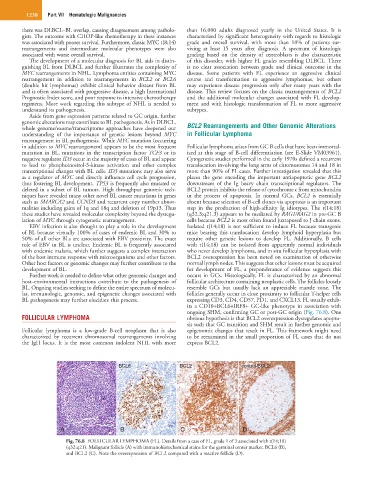
                                                              ongoing SHM, confirming GC or post-GC origin (Fig. 76.8). One
        FOLLICULAR LYMPHOMA                                   obvious hypothesis is that BCL2 overexpression dysregulates apopto-
                                                              sis such that GC transition and SHM result in further genomic and
        Follicular  lymphoma  is  a  low-grade  B-cell  neoplasm  that  is  also   epigenomic changes that result in FL. This framework might need
        characterized  by  recurrent  chromosomal  rearrangements  involving   to be reexamined in the small proportion of FL cases that do not
        the  IgH  locus.  It  is  the  most  common  indolent  NHL  with  more   express BCL2.


                                        BCL6                BCL2                control BCL2


                     A                  B                   C                   D
                       Fig. 76.8  FOLLICULAR LYMPHOMA (FL). Details from a case of FL, grade 1 of 3 associated with t(14;18)
                       (q32;q21). Malignant follicle (A) with immunohistochemical stains for the germinal center marker, BCL6 (B),
                       and BCL2 (C). Note the overexpression of BCL2 compared with a reactive follicle (D).

