


Page 1570 - Hematology_ Basic Principles and Practice ( PDFDrive )
P. 1570
Chapter 86  Plasma Cell Neoplasms  1397


            lesions within the background of generalized involvement of the bone   CR is a good prognostic feature and is being considered as one of the
            marrow. MRI is indicated in all patients with a suspected diagnosis   methods to better define a CR.
            of a solitary plasmacytoma and is indicated in SMM to identify any   CT has been used to evaluate focal lesions in order to perform
            occult bone marrow involvement. Identification of multiple lesions   fine-needle biopsies for cytologic analysis. CT scans provide a better
            not observed on a skeletal survey allows prediction of progression and   picture of the bone component and can also be used to judge the
            early intervention.                                   integrity  of  the  bone.  PET  along  with  CT  can  be  used  to  define
              In symptomatic myeloma, MRI is considered a routine evaluation   extramedullary disease (EMD) as well as medullary lesions, and they
            to detect unsuspected focal lesions, to assess the extent of involvement   complement  MRI  for  follow-up  of  patients  with  nonsecretory
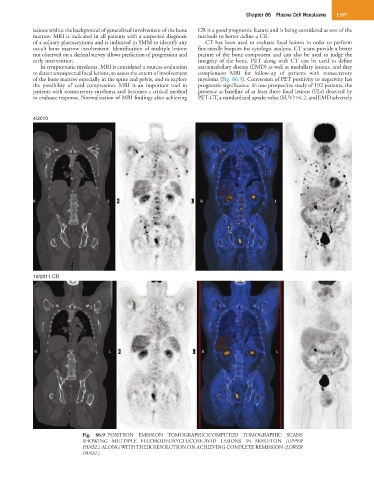
            of the bone marrow especially in the spine and pelvis, and to explore   myeloma (Fig. 86.9). Conversion of PET positivity to negativity has
            the  possibility  of  cord  compression.  MRI  is  an  important  tool  in   prognostic significance. In one prospective study of 192 patients, the
            patients with nonsecretory myeloma and becomes a critical method   presence at baseline of at least three focal lesions (FLs) detected by
            to evaluate response. Normalization of MRI findings after achieving   PET-CT, a standardized uptake value (SUV) >4.2, and EMD adversely


            4/2010


            10/2011 CR


                            Fig.  86.9  POSITRON  EMISSION  TOMOGRAPHIC/COMPUTED  TOMOGRAPHIC  SCANS
                            SHOWING  MULTIPLE  FLUORODEOXYGLUCOSE-AVID  LESIONS  IN  SKELETON  (UPPER
                            PANEL), ALONG WITH THEIR RESOLUTION ON ACHIEVING COMPLETE REMISSION (LOWER
                            PANEL).

