


Page 1571 - Hematology_ Basic Principles and Practice ( PDFDrive )
P. 1571
1398   Part VII  Hematologic Malignancies


        affected  the  4-year  estimate  of  progression-free  survival  (PFS)  (≥3   such as bone marrow MVD, serum soluble syndecan-1 levels, soluble
        FLs, 50%; SUV >4.2, 43%; presence of EMD, 28%). An SUV >4.2   CD16  levels,  and  bone  marrow  pDC  numbers;  patient-related
        and EMD was also correlated with a shorter OS (4-year OS rates   factors, such as age, renal failure, albumin, and performance status;
        77% and 66%, respectively). In this study, posttherapy persistence of   and treatment-related factors, such as achieving a CR or a very good
        PET positivity for lesions predicted a poor outcome as compared with   partial response (VGPR) and the performance of tandem autologous
        those with a negative PET-CT (PFS 66% and OS 89%).    transplants. Among these features, the International Staging System
           A prospective evaluation of MRI and PET-CT at diagnosis and   (ISS) uses serum albumin and β 2-microglobulin levels, cytogenetic/
        before  maintenance  therapy  was  performed  in  a  subgroup  of  134   FISH changes, and newer genomic correlates of outcome that have
        patients with MM in the IFM/DFCI 2009 trial. At diagnosis, MRI   been validated in a number of studies and are considered standard
        was positive in 127 (94.7%) of 134 patients and PET-CT was positive   predictive markers. A short list of investigations to be performed for
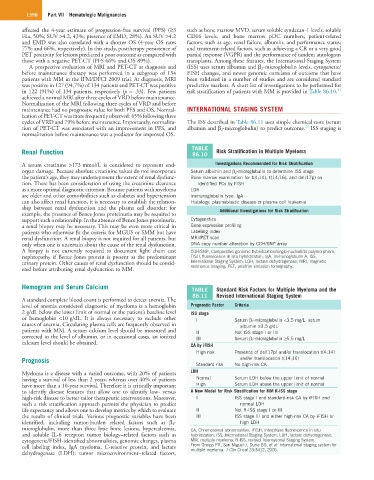
        in 122 (91%) of 134 patients, respectively (p = .33). Few patients   risk stratification of patients with MM is provided in Table 86.10. 21
        achieved a normal MRI after three cycles of VRD before maintenance.
        Normalization of the MRI following three cycles of VRD and before
        maintenance had no prognostic value for both PFS and OS. Normal-  INTERNATIONAL STAGING SYSTEM
        ization of PET-CT was more frequently observed: 45% following three
        cycles of VRD and 79% before maintenance. Importantly, normaliza-  The ISS described in Table 86.11 uses simple chemical tests (serum
                                                                                                     22
        tion of PET-CT was associated with an improvement in PFS, and   albumin and β 2-microglobulin) to predict outcome.  ISS staging is
        normalization before maintenance was a predictor for improved OS.

                                                                TABLE
        Renal Function                                          86.10   Risk Stratification in Multiple Myeloma
        A  serum  creatinine  >173 mmol/L  is  considered  to  represent  end-  Investigations Recommended for Risk Stratification
        organ damage. Because absolute creatinine values do not incorporate   Serum albumin and β 2 -microglobulin to determine ISS stage
        the patient’s age, they may underrepresent the extent of renal dysfunc-  Bone marrow examination for t(4;14), t(14;16), and del(17p) on
        tion. There has been consideration of using the creatinine clearance   identified PCs by FISH
        as a more optimal diagnostic criterion. Because patients with myeloma   LDH
        are older and other comorbidities such as diabetes and hypertension   Immunoglobulin type: IgA
        can also affect renal function, it is necessary to establish the relation-  Histology: plasmablastic disease or plasma cell leukemia
        ship  between  renal  dysfunction  and  the  plasma  cell  disorder;  for   Additional Investigations for Risk Stratification
        example, the presence of Bence Jones proteinuria may be required to
        support such a relationship. In the absence of Bence Jones proteinuria,   Cytogenetics
        a renal biopsy may be necessary. This may be even more critical in   Gene expression profiling
        patients who otherwise fit the criteria for MGUS or SMM but have   Labeling index
        renal dysfunction. A renal biopsy is not required for all patients, but   MRI/PET scan
        only when one is uncertain about the cause of the renal dysfunction.   DNA copy number alteration by CGH/SNP array
        A  biopsy  is  not  currently  required  to  document  light  chain  cast   CGH/SNP, Comparative genomic hybridization/single-nucleotide polymorphism;
        nephropathy if Bence Jones protein is present as the predominant   FISH, fluorescence in situ hybridization; IgA, immunoglobulin A; ISS,
        urinary protein. Other causes of renal dysfunction should be consid-  International Staging System; LDH, lactate dehydrogenase; MRI, magnetic
        ered before attributing renal dysfunction to MM.       resonance imaging; PET, positron emission tomography.


        Hemogram and Serum Calcium                              TABLE   Standard Risk Factors for Multiple Myeloma and the
                                                                86.11   Revised International Staging System
        A standard complete blood count is performed to detect anemia. The
        level of anemia considered diagnostic of myeloma is a hemoglobin   Prognostic Factor  Criteria
        2 g/dL below the lower limit of normal or the patient’s baseline level   ISS stage
        or  hemoglobin  <10 g/dL.  It  is  always  necessary  to  exclude  other     I  Serum β 2 -microglobulin <3.5 mg/L, serum
        causes of anemia. Circulating plasma cells are frequently observed in   albumin ≥3.5 g/dL
        patients with MM. A serum calcium level should be measured and     II  Not ISS stage I or III
        corrected to the level of albumin, or in occasional cases, an ionized     III  Serum β 2 -microglobulin ≥5.5 mg/L
        calcium level should be obtained.
                                                               CA by iFISH
                                                                  High risk   Presence of del(17p) and/or translocation t(4;14)
        Prognosis                                                               and/or translocation t(14;16)
                                                                  Standard risk  No high-risk CA
        Myeloma is a disease with a varied outcome, with 20% of patients   LDH
        having a survival of less than 2 years, whereas over 40% of patients     Normal  Serum LDH below the upper limit of normal
        have more than a 10-year survival. Therefore it is critically important     High  Serum LDH above the upper limit of normal
        to  identify  disease  features  that  allow  one  to  identify  low-  versus   A New Model for Risk Stratification for MM R-ISS stage
        high-risk disease to better tailor therapeutic interventions. Moreover,     I  ISS stage I and standard-risk CA by iFISH and
        such a risk stratification approach permits the physician to predict    normal LDH
        life expectancy and allows one to develop metrics by which to evaluate     II  Not R-ISS stage I or III
        the results of clinical trials. Various prognostic variables have been     III  ISS stage III and either high-risk CA by iFISH or
        identified,  including  tumor-burden  related  factors  such  as  β 2-  high LDH
        microglobulin,  more  than  three  lytic  bone  lesions,  hypercalcemia,   CA, Chromosomal abnormalities; iFISH, interphase fluorescence in situ
        and  soluble  IL-6  receptor;  tumor  biology–related  factors  such  as   hybridization; ISS, International Staging System; LDH, lactate dehydrogenase;
        cytogenetic/FISH-identified abnormalities, genomic changes, plasma   MM, multiple myeloma; R-ISS, revised International Staging System.
        cell  labeling  index,  IgA  myeloma,  C-reactive  protein,  and  lactate   From Greipp PR, San Miguel J, Durie BG, et al: International staging system for
                                                               multiple myeloma. J Clin Oncol 23:3412, 2005.
        dehydrogenase  (LDH);  tumor  microenvironment–related  factors,

