


Page 1582 - Hematology_ Basic Principles and Practice ( PDFDrive )
P. 1582
Chapter 86  Plasma Cell Neoplasms  1409


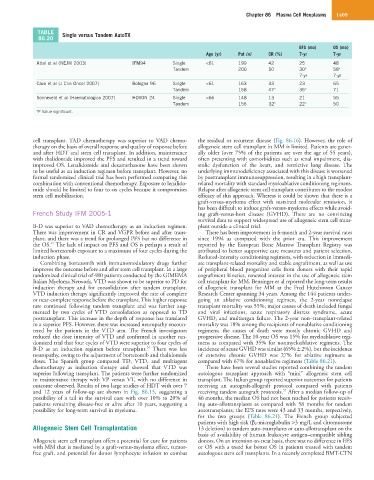
             TABLE   Single versus Tandem AutoTX
              86.20
                                                                                                   EFS (mo)   OS (mo)
                                                                    Age (yr)   Pat (n)   CR (%)    7-yr       7-yr
             Attal et al (NEJM 2003)        IFM94         Single    <61        199       42        25         48
                                                          Tandem               200       50        30 a       58 a
                                                                                                   7-yr       7-yr
             Cavo et al (J Clin Oncol 2007)  Bologna 96   Single    <61        163       33        23         65
                                                          Tandem               158       47 a      35 a       71
             Sonneveld et al (Haematologica 2007)  HOVON 24  Single  <66       148       13        21         55
                                                          Tandem               156       32 a      22 a       50
             a P Value significant.


            cell  transplant. TAD  chemotherapy  was  superior  to  VAD  chemo-  the residual or recurrent disease (Fig. 86.16). However, the role of
            therapy on the basis of overall response and quality of response before   allogeneic stem cell transplant in MM is limited. Patients are gener-
            and after HDT and stem cell transplant. In addition, maintenance   ally older (over 75% of the patients are over the age of 55 years),
            with thalidomide improved the PFS and resulted in a trend toward   often presenting with comorbidities such as renal impairment, dia-
            improved OS. Lenalidomide and dexamethasone have been shown   stolic  dysfunction  of  the  heart,  and  restrictive  lung  disease.  The
            to be useful as an induction regimen before transplant. However, no   underlying immunodeficiency associated with this disease is worsened
            formal randomized clinical trial has been performed comparing this   by posttransplant immunosuppression, resulting in a high transplant-
            combination with conventional chemotherapy. Exposure to lenalido-  related mortality with standard myeloablative conditioning regimens.
            mide should be limited to four to six cycles because it compromises   Relapse after allogeneic stem cell transplant contributes to the modest
            stem cell mobilization.                               efficacy of this approach. Whereas it could be shown that there is a
                                                                  graft-versus-myeloma  effect  with  sustained  molecular  remission,  it
                                                                  has been difficult to induce graft-versus-myeloma effects while avoid-
            French Study IFM 2005-1                               ing  graft-versus-host  disease  (GVHD).  There  are  no  convincing
                                                                  survival data to support widespread use of allogeneic stem cell trans-
            B-D was superior to VAD chemotherapy as an induction regimen.   plant outside a clinical trial.
            There was improvement in CR and VGPR before and after trans-  There has been improvement in 6-month and 2-year survival rates
            plant, and there was a trend for prolonged PFS but no difference in   since  1994  as  compared  with  the  prior  era.  This  improvement
                  27
            the OS.  The lack of impact on PFS and OS is perhaps a result of   reported  by  the  European  Bone  Marrow  Transplant  Registry  was
            limited bortezomib exposure to a maximum of four cycles during the   attributed to better supportive care measures and patient selection.
            induction phase.                                      Reduced-intensity conditioning regimens, with reduction in immedi-
              Combining bortezomib with immunomodulatory drugs further   ate transplant-related mortality and stable engraftment, as well as use
            improves the outcome before and after stem cell transplant. In a large   of  peripheral  blood  progenitor  cells  from  donors  with  their  rapid
            randomized clinical trial of 480 patients conducted by the GIMEMA   engraftment kinetics, renewed interest in the use of allogeneic stem
            Italian Myeloma Network, VTD was shown to be superior to PD for   cell transplant for MM. Bensinger et al reported the long-term results
            induction  therapy  and  for  consolidation  after  tandem  transplant.   of  allogeneic  transplant  for  MM  at  the  Fred  Hutchinson  Cancer
            VTD induction therapy significantly improved the rate of complete   Research Center spanning 34 years. Among the 144 patients under-
            or near-complete response before the transplant. This higher response   going  an  ablative  conditioning  regimen,  the  2-year  nonrelapse
            rate  continued  following  tandem  transplant  and  was  further  aug-  transplant mortality was 55%; major causes of death included fungal
            mented  by  two  cycles  of  VTD  consolidation  as  opposed  to  TD   and  viral  infections,  acute  respiratory  distress  syndrome,  acute
            posttransplant. This increase in the depth of response has translated   GVHD, and multiorgan failure. The 2-year non–transplant-related
            to a superior PFS. However, there was increased neuropathy encoun-  mortality was 18% among the recipients of nonablative conditioning
            tered  by  the  patients  in  the  VTD  arm.  The  French  investigators   regimens;  the  causes  of  death  were  mostly  chronic  GVHD  and
            reduced the dose intensity of VTD and confirmed in another ran-  progressive disease. The 10-year OS was 15% for myeloablative regi-
            domized trial that four cycles of VTD were superior to four cycles of   mens  as  compared  with  35%  for  nonmyeloablative  regimens. The
                                                 34
            B-D  as  an  induction  regimen  before  transplant.   There  was  less   incidence of acute GVHD was similar (65% ± 2%), but the incidence
            neuropathy, owing to the adjustment of bortezomib and thalidomide   of  extensive  chronic  GVHD  was  27%  for  ablative  regimens  as
            doses.  The  Spanish  group  compared  TD,  VTD,  and  multiagent   compared with 67% for nonablative regimens (Table 86.21).
            chemotherapy  as  induction  therapy  and  showed  that  VTD  was   There have been several studies reported combining the tandem
            superior following transplant. The patients were further randomized   autologous  transplant  approach  with  “mini”  allogeneic  stem  cell
            to maintenance therapy with VP versus VT, with no difference in   transplant. The Italian group reported superior outcomes for patients
            outcome observed. Results of two large studies of HDT with over 7   receiving  an  autograft-allograft  protocol  compared  with  patients
                                                                                              35
            and  12  years  of  follow-up  are  shown  in  Fig.  86.15,  suggesting  a   receiving tandem autograft protocols.  After a median follow-up of
            possibility of a tail in the survival cure with over 10% to 20% of   46 months, the median OS had not been reached for patients receiv-
            patients remaining disease-free or alive after 10 years, suggesting a   ing  auto-allotransplants  as  compared  with  58  months  for  tandem
            possibility for long-term survival in myeloma.        autotransplants; the EFS rates were 43 and 33 months, respectively,
                                                                  for  the  two  groups  (Table  86.21).  The  French  group  subjected
                                                                  patients with high risk (β 2-microglobulin >3 mg/L and chromosome
            Allogeneic Stem Cell Transplantation                  13 deletion) to tandem auto-transplants or auto-allotransplant on the
                                                                  basis of availability of human leukocyte antigen–compatible sibling
            Allogeneic stem cell transplant offers a potential for cure for patients   donors. On an intention-to-treat basis, there was no difference in EFS
            with MM that is mediated by a graft-versus-myeloma effect, tumor-  or OS with a trend for better OS in patients treated with tandem
            free graft, and potential for donor lymphocyte infusion to combat   autologous stem cell transplants. In a recently completed BMT-CTN

