


Page 2012 - Hematology_ Basic Principles and Practice ( PDFDrive )
P. 2012
Chapter 118  Hemapheresis  1783


                                                                  substitution  of  a  single  amino  acid.  Although  the  defect  appears
                                                                  simple, the pathophysiology of the vasoocclusive crises is complex,
                                                                  involving  Hb  polymerization,  change  in  cell  shape,  adhesion  to
                                                                  endothelial cells, dysregulated nitric oxide homeostasis, and release
                                                                                               3
                                                                  of free Hb and inflammatory cytokines.  Clinical manifestations vary
                                                                  from patient to patient. The rationale behind exchange transfusion
                                                                  involves  improving  tissue  oxygenation,  reducing  hemolysis,  and
                                                                  preventing microvascular sickling by diluting the patient’s abnormal
                                                                  RBCs,  simultaneously  correcting  anemia  and  favorably  altering
                                                                  whole blood viscosity and rheology. No clinical data support a single
                                                                  optimal  level  of  HbA;  however,  as  few  as  30%  of  transfused  cells
                                                                  markedly  decrease  blood  viscosity.  At  mixtures  of  50%  or  greater,
                                                                  resistance to membrane filterability approaches normal. In nonemer-
                                                                  gency  situations,  such  levels  can  often  be  achieved  with  a  simple
                                                                  transfusion regimen. For simple and exchange transfusions, raising
                                                                  the level of HbA to between 60% and 70% while lowering the level
                                                                  of HbS to 30% is generally efficacious, although even higher levels
                                                                  of  HbA  are  often  used  to  treat  an  ongoing  crisis.  Clinical  indica-
                                                                  tions  for  exchange  transfusion  in  patients  with  sickle  cell  anemia
                                                                  remain  controversial,  with  limited  controlled  study  data  available.
                                                                  Simple transfusion has been shown to improve renal concentrating
                                                                  ability and splenic function in young sickle cell patients; exchange
                                                                  transfusion  improves  exercise  tolerance  and  reverses  the  periodic
                                                                  oscillations  in  cutaneous  blood  flow  associated  with  this  disease.
                                                                  Such observations have encouraged the use of exchange transfusion
                                                                  for  acute  complications  of  sickle  cell  disease  such  as  acute  chest
                                                                  syndrome, priapism, cerebrovascular accident, and hepatic and retinal
                                                                  infarction. Exchange transfusion for sickle cell patients has also been
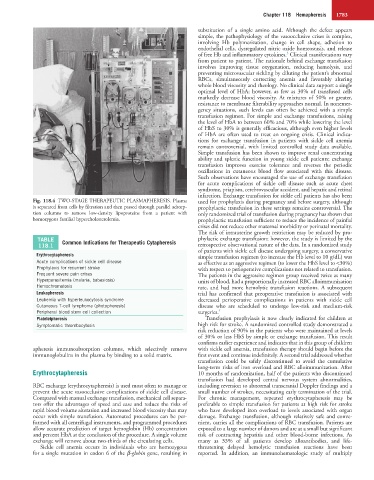
            Fig. 118.4  TWO-STAGE THERAPEUTIC PLASMAPHERESIS. Plasma   used for prophylaxis during pregnancy and before surgery, although
            is separated from cells by filtration and then passed through parallel adsorp-  prophylactic transfusion in these settings remains controversial. The
            tion  columns  to  remove  low-density  lipoproteins  from  a  patient  with   only randomized trial of transfusion during pregnancy has shown that
            homozygous familial hypercholesterolemia.             prophylactic transfusion sufficient to reduce the incidence of painful
                                                                  crises did not reduce other maternal morbidity or perinatal mortality.
                                                                  The risk of intrauterine growth restriction may be reduced by pro-
             TABLE   Common Indications for Therapeutic Cytapheresis  phylactic exchange transfusion; however, the study is limited by the
              118.1                                               retrospective observational nature of the data. In a randomized study
                                                                  of patients with sickle cell disease undergoing surgery, a conservative
             Erythrocytapheresis                                  simple transfusion regimen (to increase the Hb level to 10 g/dL) was
             Acute complications of sickle cell disease           as effective as an aggressive regimen (to lower the HbS level to <30%)
             Prophylaxis for recurrent stroke                     with respect to perioperative complications not related to transfusion.
             Frequent severe pain crises                          The patients in the aggressive regimen group received twice as many
             Hyperparasitemia (malaria, babesiosis)               units of blood, had a proportionally increased RBC alloimmunization
             Hemochromatosis                                      rate,  and  had  more  hemolytic  transfusion  reactions.  A  subsequent
             Leukapheresis                                        trial has confirmed that preoperative transfusion is associated with
             Leukemia with hyperleukocytosis syndrome             decreased  perioperative  complications  in  patients  with  sickle  cell
             Cutaneous T-cell lymphoma (photopheresis)            disease  who  are  scheduled  to  undergo  low-risk  and  medium-risk
             Peripheral blood stem cell collection                surgeries. 4
             Plateletpheresis                                       Transfusion prophylaxis is now clearly indicated for children at
             Symptomatic thrombocytosis                           high risk for stroke. A randomized controlled study demonstrated a
                                                                  risk reduction of 90% in the patients who were maintained at levels
                                                                  of 30% or less HbS by simple or exchange transfusion. This result
                                                                  confirms earlier experience and indicates that in this group of children
            apheresis  immunoabsorption  columns,  which  selectively  remove   with sickle cell anemia, transfusion therapy should begin before the
            immunoglobulins in the plasma by binding to a solid matrix.  first event and continue indefinitely. A second trial addressed whether
                                                                  transfusion  could  be  safely  discontinued  to  avoid  the  cumulative
                                                                  long-term risks of iron overload and RBC alloimmunization. After
            Erythrocytapheresis                                   10 months of randomization, half of the patients who discontinued
                                                                  transfusion  had  developed  central  nervous  system  abnormalities,
            RBC exchange (erythrocytapheresis) is used most often to manage or   including reversion to abnormal transcranial Doppler findings and a
            prevent the acute vasoocclusive complications of sickle cell disease.   small number of strokes, necessitating early termination of the trial.
            Compared with manual exchange transfusion, mechanical cell separa-  For  chronic  management,  repeated  erythrocytapheresis  may  be
            tors offer the advantages of speed and ease and reduce the risks of   preferable to simple transfusion for patients at high risk for stroke
            rapid blood volume alteration and increased blood viscosity that may   who  have  developed  iron  overload  to  levels  associated  with  organ
            occur  with  simple  transfusion.  Automated  procedures  can  be  per-  damage.  Exchange  transfusion,  although  relatively  safe  and  conve-
            formed with all centrifugal instruments, and programmed procedures   nient, carries all the complications of RBC transfusion. Patients are
            allow accurate prediction of target hemoglobin (Hb) concentration   exposed to a large number of donors and are at a small but significant
            and percent HbA at the conclusion of the procedure. A single volume   risk  of  contracting  hepatitis  and  other  blood-borne  infections.  As
            exchange will remove about two-thirds of the circulating cells.  many  as  33%  of  all  patients  develop  alloantibodies,  and  life-
              Sickle  cell  anemia  occurs  in  individuals  who  are  homozygous   threatening  delayed  hemolytic  transfusion  reactions  have  been
            for a single mutation in codon 6 of the β-globin gene, resulting in   reported.  In  addition,  an  immunohematologic  study  of  multiply

