


Page 2015 - Hematology_ Basic Principles and Practice ( PDFDrive )
P. 2015
1786   Part XI  Transfusion Medicine


        been found, and no generally accepted assay of platelet dysfunction   guided by clinical response and continued until the platelet count is
        predicts which patients are at risk. A single cytapheresis procedure   above 150,000/µL and lactate dehydrogenase is near normal for 2–3
        can lower the platelet count by 30% to 50%. Plateletpheresis can   consecutive days. The persistence of schistocytes on the peripheral
        have dramatic effects for selected patients such as those with evolving   blood smear does not preclude weaning or discontinuation of treat-
        digital gangrene. Attempts to maintain thrombocythemic patients at   ment.  Typically,  patients  should  respond  within  2  or  3  days  of
        normal platelet counts by cytapheresis alone have not been successful;   beginning  treatment.  In  desperately  ill  and  deteriorating  patients,
        more practical long-term chemotherapy should be instituted concur-  escalating  the  intensity  of  plasma  exchange  to  twice  daily  may  be
                                                                     18
        rently.  Because  most  patients  with  thrombocytosis  do  not  develop   necessary.   Despite  initial  reports  of  improved  response  rates  in
        symptoms,  including  patients  with  myeloproliferative  disorders,   certain  patients,  recent  experience  suggests  that  the  use  of
        prophylactic  plateletpheresis  seems  unwarranted  regardless  of  the   cryoprecipitate-poor plasma may not be more effective than the use
        platelet  count.  One  possible  exception  involves  pregnant  patients   of standard FFP as a specific replacement fluid for plasma exchange
        with essential thrombocythemia who may be at increased risk of first   in patients with TTP. The effectiveness of plasma exchange in this
        trimester abortion; Periodic plateletpheresis has been used in a limited   setting may derive from removal of antibody to or replacement of the
        series,  with  weekly  procedures  necessary  to  reduce  the  circulating   von Willebrand factor–cleaving zinc metalloprotease, ADAMTS13.
        platelet number until delivery.                       However, patients with clinical features of TTP and only moderate
                                                              ADAMTS13  deficiency  or  even  normal  activity  may  respond  to
                                                              plasma exchange. Plasma exchange for hematopoietic progenitor cell
        THERAPEUTIC PLASMAPHERESIS                            transplant recipients exhibiting clinical features of TTP, now gener-
                                                              ally referred to as transplantation-associated thrombotic microangi-
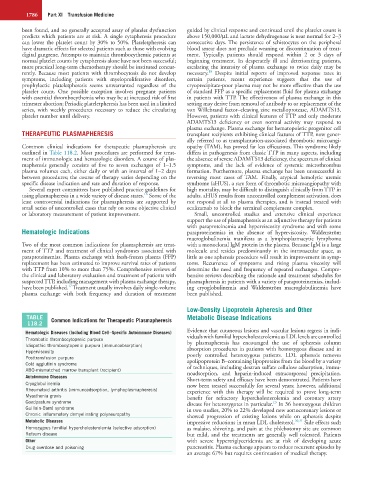
        Common  clinical  indications  for  therapeutic  plasmapheresis  are   opathy (TAM), has proved far less efficacious. This syndrome likely
        outlined in Table 118.2. Most procedures are performed for treat-  differs in pathogenesis from classic TTP in many aspects, including
        ment of immunologic and hematologic disorders. A course of plas-  the absence of severe ADAMTS13 deficiency, the spectrum of clinical
        mapheresis  generally  consists  of  five  to  seven  exchanges  of  1–1.5   symptoms,  and  the  lack  of  evidence  of  systemic  microthrombus
        plasma volumes each, either daily or with an interval of 1–2 days   formation. Furthermore, plasma exchange has been unsuccessful in
        between procedures; the course of therapy varies depending on the   reversing  most  cases  of  TAM.  Finally,  atypical  hemolytic  uremic
        specific disease indication and rate and duration of response.  syndrome (aHUS), a rare form of thrombotic microangiopathy with
           Several expert committees have published practice guidelines for   high mortality, may be difficult to distinguish clinically from TTP in
                                                16
        using plasmapheresis in a wide variety of disease states.  Some of the   adults. aHUS results from uncontrolled complement activation, does
        least  controversial  indications  for  plasmapheresis  are  supported  by   not respond at all to plasma therapies, and is instead treated with
        small series of uncontrolled cases that rely on some objective clinical   eculizamab to block the terminal complement complex.
        or laboratory measurement of patient improvement.        Small,  uncontrolled  studies  and  extensive  clinical  experience
                                                              support the use of plasmapheresis as an adjunctive therapy for patients
                                                              with paraproteinemia and hyperviscosity syndrome and with some
        Hematologic Indications                               paraproteinemias  in  the  absence  of  hyperviscosity.  Waldenström
                                                              macroglobulinemia  manifests  as  a  lymphoplasmacytic  lymphoma
        Two of the most common indications for plasmapheresis are treat-  with a monoclonal IgM protein in the plasma. Because IgM is a large
        ment of TTP and treatment of clinical syndromes associated with   molecule  and  resides  predominantly  in  the  intravascular  space,  as
        paraproteinemias. Plasma exchange with fresh-frozen plasma (FFP)   little as one apheresis procedure will result in improvement in symp-
        replacement has been estimated to improve survival rates of patients   toms.  Recurrence  of  symptoms  and  rising  plasma  viscosity  will
        with TTP from 10% to more than 75%. Comprehensive reviews of   determine the need and frequency of repeated exchanges. Compre-
        the clinical and laboratory evaluation and treatment of patients with   hensive reviews describing the rationale and treatment schedules for
        suspected TTP, including management with plasma exchange therapy,   plasmapheresis in patients with a variety of paraproteinemias, includ-
                       17
        have been published.  Treatment usually involves daily single-volume   ing  cryoglobulinemia  and  Waldenström  macroglobulinemia  have
        plasma  exchange  with  both  frequency  and  duration  of  treatment   been published.
                                                              Low-Density Lipoprotein Apheresis and Other
          TABLE   Common Indications for Therapeutic Plasmapheresis  Metabolic Disease Indications
          118.2
         Hematologic Diseases (Including Blood Cell–Specific Autoimmune Diseases)  Evidence that cutaneous lesions and vascular lesions regress in indi-
         Thrombotic thrombocytopenic purpura                  viduals with familial hypercholesterolemia as LDL levels are controlled
                                                              by  plasmapheresis  has  encouraged  the  use  of  apheresis  column
         Idiopathic thrombocytopenic purpura (immunoabsorption)  absorption procedures in patients with homozygous disease and in
         Hyperviscosity                                       poorly  controlled  heterozygous  patients.  LDL  apheresis  removes
         Posttransfusion purpura                              apolipoprotein B–containing lipoproteins from the blood by a variety
         Cold agglutinin syndrome                             of techniques, including dextran sulfate cellulose adsorption, immu-
         ABO-mismatched marrow transplant (recipient)         noadsorption,  and  heparin-induced  extracorporeal  precipitation.
         Autoimmune Diseases                                  Short-term safety and efficacy have been demonstrated. Patients have
         Cryoglobulinemia                                     now been treated successfully for several years; however, additional
         Rheumatoid arthritis (immunoadsorption, lymphoplasmapheresis)  experience  with  this  therapy  will  be  required  to  prove  long-term
         Myasthenia gravis                                    benefit  for  refractory  hypercholesterolemia  and  coronary  artery
         Goodpasture syndrome                                 disease for heterozygotes in particular.  In 36 homozygous children
                                                                                          19
         Guillain-Barré syndrome                              in two studies, 20% to 22% developed new aortocoronary lesions or
         Chronic inflammatory demyelinating polyneuropathy    showed  progression  of  existing  lesions  while  on  apheresis  despite
         Metabolic Diseases                                   impressive reductions in mean LDL cholesterol. 20,21  Side effects such
         Homozygous familial hypercholesterolemia (selective adsorption)  as malaise, shivering, and pain at the phlebotomy site are common
         Refsum disease                                       but  mild,  and  the  treatments  are  generally  well  tolerated.  Patients
         Other                                                with  severe  hypertriglyceridemia  are  at  risk  of  developing  acute
         Drug overdose and poisoning                          pancreatitis. Plasma exchange appears to reduce recurrent episodes by
                                                              an average 67% but requires continuation of medical therapy.

