


Page 2014 - Hematology_ Basic Principles and Practice ( PDFDrive )
P. 2014
Chapter 118  Hemapheresis  1785


            to  treat  these  chronic,  relapsing,  lifelong  disorders.  Although  IBD
            respond to a variety of drug regimens, leukapheresis may have a role
            as a “steroid-sparing” intervention for patients who develop toxicity          5
            from long-term steroid use. Cellsorba removes leukocytes by extra-
            corporeal  filtration.  Granulocyte-monocyte  apheresis  (Adacolumn)
                                                              9
            selectively adsorbs cells through columns filled with cellulose beads.
            Clinical trials using Adacolumn technology have promising results in
            the treatment of ulcerative colitis, with remission rates in excess of
            70%  compared  with  conventional  medical  therapy.  These  studies
            should be interpreted with caution given their high risk of bias and                          UVA irradiation
            the inclusion of predominantly Japanese patients, which may limit   1
            how  the  results  apply  to  populations  with  different  genetic  and
                            10
            environmental factors.  The optimum course of therapy is yet to be           2
            defined.  Recent  trials  have  investigated  the  safety  and  efficacy  of                4
            procedures varying from weekly to a daily basis. 11     Whole
                                                                    blood
            Extracorporeal Photopheresis                                             Plasma
                                                                                      Erythrocytes
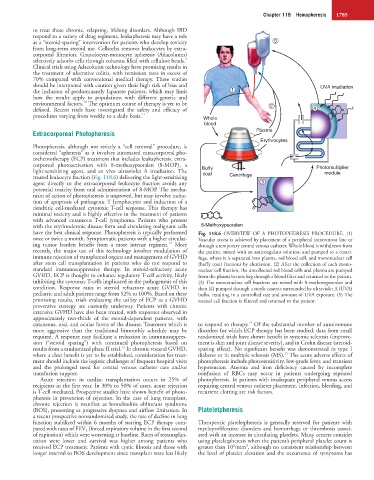
            Photopheresis,  although  not  strictly  a  “cell  removal”  procedure,  is
            considered “apheresis” as it involves automated extracorporeal pho-
            tochemotherapy (ECP) treatment that includes leukapheresis, extra-
            corporeal  photoactivation  with  8-methoxypsoralen  (8-MOP),  a                             Photomultiplier
            light-sensitizing  agent,  and  ex  vivo  ultraviolet  A  irradiation.  The   Buffy            module
                                                                   coat
            treated leukocyte fraction (Fig. 118.6) delivering the light-sensitizing   Centrifuge
            agent  directly  to  the  extracorporeal  leukocyte  fraction  avoids  any   3
            potential toxicity from oral administration of 8-MOP. The mecha-
            nism of action of photopheresis is unproved, but may involve induc-
            tion of apoptosis of pathogenic T lymphocytes and induction of a
            dendritic  cell-mediated  cytotoxic T-cell  response. This  therapy  has
            minimal toxicity and is highly effective in the treatment of patients
            with  advanced  cutaneous  T-cell  lymphoma.  Patients  who  present
            with the erythrodermic disease form and circulating malignant cells   8-Methoxypsoralen
            have the best clinical response. Photopheresis is typically performed   Fig.  118.6  OVERVIEW  OF  A  PHOTOPHERESIS  PROCEDURE.  (1)
            once or twice a month. Symptomatic patients with a higher circulat-  Vascular access is achieved by placement of a peripheral intravenous line or
                                                        12
            ing  tumor  burden  benefit  from  a  more  intense  regimen.   More   through a temporary central venous catheter. Whole blood is withdrawn from
            recently,  the  major  use  of  this  technology  involves  modulation  of   the patient, mixed with an anticoagulant solution, and pumped to a centri-
            immune rejection of transplanted organs and management of GVHD   fuge, where it is separated into plasma, red blood cell, and mononuclear cell
            after  stem  cell  transplantation  in  patients  who  do  not  respond  to   (buffy coat) fractions by elutriation. (2) After the collection of each mono-
            standard  immunosuppressive  therapy.  In  steroid-refractory  acute   nuclear cell fraction, the uncollected red blood cells and plasma are pumped
            GVHD, ECP is thought to enhance regulatory T-cell activity, likely   from the plasma/return bag through a blood filter and returned to the patient.
            inhibiting the cytotoxic T-cells implicated in the pathogenesis of this   (3) The mononuclear cell fractions are mixed with 8-methoxypsoralen and
            condition.  Response  rates  in  steroid  refractory  acute  GVHD  in   then (4) pumped through a sterile cassette surrounded by ultraviolet A (UVA)
            pediatric and adult patients range from 52% to 100%. Based on these   bulbs, resulting in a controlled rate and amount of UVA exposure. (5) The
            promising results, trials evaluating the utility of ECP as a GVHD   treated cell fraction is filtered and returned to the patient.
            preventive  strategy  are  currently  underway.  Patients  with  chronic
            extensive GVHD have also been treated, with responses observed in
            approximately  two-thirds  of  the  steroid-dependent  patients,  with
                                                                                  14
            cutaneous, oral, and ocular forms of the disease. Treatment which is   to respond to therapy.  Of the substantial number of autoimmune
            more  aggressive  than  the  traditional  bimonthly  schedule  may  be   disorders for which ECP therapy has been studied, data from small
            required. A response may facilitate a reduction in immunosuppres-  randomized trials have shown benefit in systemic sclerosis (improve-
            sion  (“steroid  sparing”)  with  continued  photopheresis  based  on   ment is skin and joint disease severity), and in Crohn disease (steroid-
                                         13
            results from a randomized phase II trial.  In chronic visceral GVHD,   sparing  effect).  No  significant  benefit  was  demonstrated  in  type  I
                                                                                              15
            where a clear benefit is yet to be established, consideration for treat-  diabetes or in multiple sclerosis (MS).  The acute adverse effects of
            ment should include the logistic challenges of frequent hospital visits   photopheresis include photosensitivity, low-grade fever, and transient
            and  the  prolonged  need  for  central  venous  catheter  care  and/or   hypotension.  Anemia  and  iron  deficiency  caused  by  incomplete
            transfusion support.                                  reinfusion  of  RBCs  may  occur  in  patients  undergoing  repeated
              Acute  rejection  in  cardiac  transplantation  occurs  in  25%  of   photopheresis. In patients with inadequate peripheral venous access
            recipients in the first year. In 30% to 50% of cases, acute rejection   requiring central venous catheter placement, infection, bleeding, and
            is T-cell mediated. Prospective studies have shown benefit of photo-  recurrent clotting are risk factors.
            pheresis in prevention of rejection. In the case of lung transplant,
            chronic  rejection  is  manifest  as  bronchiolitis  obliterans  syndrome
            (BOS), presenting as progressive dyspnea and airflow limitation. In   Plateletpheresis
            a recent prospective nonrandomized study, the rate of decline in lung
            function stabilized within 6 months of starting ECP therapy com-  Therapeutic  plateletpheresis  is  generally  reserved  for  patients  with
            pared with rates of FEV 1 (forced expiratory volume in the first second   myeloproliferative  disorders  and  hemorrhage  or  thrombosis  associ-
            of expiration) which were worsening at baseline. Rates of retransplan-  ated with an increase in circulating platelets. Many centers consider
            tation  were  lower  and  survival  was  higher  among  patients  who   using plateletpheresis when the patient’s peripheral platelet count is
                                                                             6
                                                                                 3
            received ECP treatment. Patients with cystic fibrosis and those with   greater than 10 /mm , although no consistent relationship between
            longer interval to BOS development since transplant were less likely   the level of platelet elevation and the occurrence of symptoms has

