


Page 2013 - Hematology_ Basic Principles and Practice ( PDFDrive )
P. 2013
1784   Part XI  Transfusion Medicine


        transfused sickle cell patients shows that 85% of heavily transfused   Leukapheresis
        patients  are  alloimmunized  to  human  leukocyte  antigens  (HLAs),
        platelet-specific  antigens,  or  both.  Most  centers  avoid  inducing   Therapeutic leukapheresis has been used most successfully to help
        nonhemolytic transfusion reactions and HLA alloimmunization by   manage  patients  with  acute  leukemia  and  extremely  high  WBC
        using  leukocyte-depleted  RBCs.  Extended  RBC  phenotyping  at   numbers, so-called acute hyperleukocytic leukemia (AHL). When the
        diagnosis  and  provision  of  phenotypically  matched  blood,  when   fractional volume of leukocytes (leukocrit) exceeds 20%, blood vis-
        practical, can reduce the risk of RBC alloimmunization and associ-  cosity  increases  and  leukocytes  can  interfere  with  pulmonary  and
        ated hemolytic transfusion reactions. Despite the removal of RBCs   cerebral  blood  flow  and  compete  with  tissue  for  oxygen  in  the
        during  exchange,  most  patients  remain  in  positive  iron  balance,   microcirculation.  Investigations  of  the  expression  and  function  of
        although iron accumulation is slow and chelation is rarely required   adhesion receptors in leukemic cells and the role of adhesion mol-
        to prevent transfusional hemosiderosis.               ecules in leukocyte-induced acute lung injury in sepsis suggest that
           Other  indications  for  RBC  exchange  are  rare.  The  procedure   the pathophysiology of leukostasis in AHL may also be related to
        has been used for patients with overwhelming RBC parasitic infec-  interactions between leukemic blasts, platelets, and endothelial cells
        tions,  such  as  severe  and  complicated  malaria  and  babesiosis.  In   mediated  by  locally  released  adhesion  molecules.  A  single-volume
        malaria,  exchange  transfusion  may  have  at  least  three  beneficial   leukapheresis procedure generally reduces the WBC count by 20%
        effects. An automated exchange rapidly decreases the concentration   to 50%, depending on the differing sedimentation characteristics of
        of circulating parasites while improving the rheologic properties of   the specific blast cell population. Ordinarily, leukapheresis is initiated
        the blood by replacing the infected RBCs. The exchange may also   in a patient with acute myeloid leukemia (AML) or in the accelerated
        reduce  levels  of  proinflammatory  cytokines  and  may  help  sustain   phases  of  chronic  myeloid  leukemia  (CML)  when  the  blast  count
                                                                              3
        life  until  conventional  therapy  and  natural  immunity  take  effect.   exceeds 100,000/mm  or when rapidly rising blast counts are higher
                                                                           3
        Although  the  efficacy  of  this  therapy  has  not  been  evaluated  by   than 50,000/mm , especially when evidence of central nervous system
        controlled  trials,  prospective  studies  and  review  of  published  cases   or  pulmonary  symptoms  appears.  The  threshold  for  initiation  of
        suggest  the  use  of  erythrocytapheresis  for  parasitemia  greater  than   leukapheresis in patients with acute lymphocytic leukemia (ALL) is
                                                                                                 3
        10%  to  15%  or  even  less  in  selected  patients  such  as  those  with   generally  higher  (WBC  count  >200,000/mm ).  Leukostatic  syn-
        cerebral malaria or pulmonary edema. Case reports document RBC   dromes  do  not  occur  when  concentrations  of  well-differentiated
                                                                                                3
        exchange  in  such  diverse  conditions  as  carbon  monoxide  poison-  lymphocytes exceed even several million/mm .
        ing  and  glucose-6-phosphate  dehydrogenase  (G6PD)–deficient     Although  leukapheresis  is  effective  in  reducing  the  number  of
        hemolysis.                                            circulating blasts, the evidence for clinical benefit is anecdotal. Case
           Automated RBC removal with volume replacement (isovolemic   reports and small series describe dramatic improvement of patients
        hemodilution) can be performed rapidly and safely in polycythemic   with evolving strokes and respiratory insufficiency, but the absence
        subjects. This maneuver should be reserved for polycythemic patients   of a randomized controlled trial necessitates reliance on retrospective
        with  an  urgent  clinical  indication  to  lower  the  hematocrit  (e.g.,   studies. Leukapheresis may reduce early death (ED) rates but does
                                                                                                      6
        evolving thrombotic stroke) for which standard single-unit manual   not improve the overall survival of patients with AML.  Trials report-
        phlebotomy  might  be  inadvisably  slow.  Automated  double  RBC   ing reduction in ED should be interpreted with caution. Because one
        apheresis  technology  has  more  recently  been  used  to  treat  indi-  retrospective  cohort  study  associated  leukapheresis  with  a  poorer
                                                                                                              7
        viduals  with  hereditary  hemochromatosis. This  procedure  removes   outcome  attributed  to  a  delay  in  commencing  chemotherapy,   it
        excess  iron  more  rapidly  than  manual  phlebotomy  and  is  well   seems imprudent to delay other immediate measures for treatment
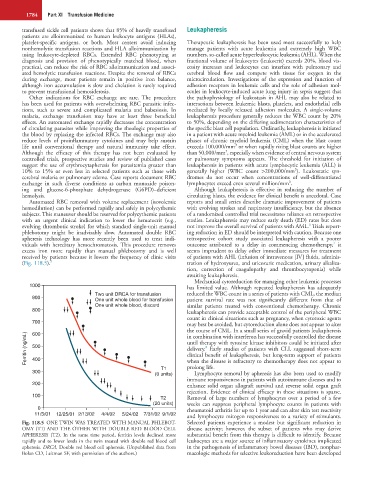
        received by patients because it lowers the frequency of clinic visits     of patients with AHL (infusion of intravenous [IV] fluids, adminis-
        (Fig. 118.5). 5                                       tration of hydroxyurea, and uricosuric medication, urinary alkaliza-
                                                              tion,  correction  of  coagulopathy  and  thrombocytopenia)  while
                                                              awaiting leukapheresis.
                                                                 Mechanical cytoreduction for managing other leukemic processes
           1000                                               has  limited  value.  Although  repeated  leukapheresis  has  adequately
                                Two unit DRCA for transfusion  reduced the WBC count in a series of patients with CML, the median
            900                 One unit whole blood for transfusion  patient  survival  rate  was  not  significantly  different  from  that  of
                                One unit whole blood, discard  similar  patients  treated  with  conventional  chemotherapy.  Chronic
            800                                               leukapheresis can provide acceptable control of the peripheral WBC
                                                              count in clinical situations such as pregnancy, when cytotoxic agents
            700                                               may best be avoided, but cytoreduction alone does not appear to alter
                                                              the course of CML. In a small series of gravid patients leukapheresis
            600
          Ferritin (ng/mL)  500                               until therapy with tyrosine kinase inhibitors could be initiated after
                                                              in combination with interferon has successfully controlled the disease
                                                                    8
                                                              delivery.   Early  studies  of  patients  with  CLL  suggested  short-term
                                                              clinical benefit of leukapheresis, but long-term support of patients
            400
                                                              prolong life.
                                                      T1
            300                                     (0 units)  when the disease is refractory to chemotherapy does not appear to
                                                                 Lymphocyte removal by apheresis has also been used to modify
                                                              immune responsiveness in patients with autoimmune diseases and to
            200                                               enhance solid organ allograft survival and reverse solid organ graft
                                                              rejection. Evidence of clinical efficacy in these situations is sparse.
            100                                       T2      Removal  of  large  numbers  of  lymphocytes  over  a  period  of  a  few
                                                   (20 units)  weeks  can  suppress  peripheral  lymphocyte  counts  in  patients  with
             0                                                rheumatoid arthritis for up to 1 year and can alter skin test reactivity
            11/5/01  12/25/01 2/13/02  4/4/02  5/24/02  7/31/02 9/1/02  and lymphocyte mitogen responsiveness to a variety of stimulants.
        Fig. 118.5  ONE TWIN WAS TREATED WITH MANUAL PHLEBOT-  Selected  patients  experience  a  modest  but  significant  reduction  in
        OMY (T1) AND THE OTHER WITH DOUBLE RED BLOOD CELL     disease  activity;  however,  the  subset  of  patients  who  may  derive
        APHERESIS  (T2).  In  the  same  time  period,  ferritin  levels  declined  more   substantial benefit from this therapy is difficult to identify. Because
        rapidly and to lower levels in the twin treated with double red blood cell   leukocytes are a major source of inflammatory cytokines implicated
        apheresis. DRCA, Double red blood cell apheresis. (Unpublished data from   in the pathogenesis of inflammatory bowel diseases (IBD), nonphar-
        Bolan CD, Leitman SF, with permission of the authors.)   macologic methods for selective leukoreduction have been developed

