


Page 2103 - Hematology_ Basic Principles and Practice ( PDFDrive )
P. 2103
1866   Part XII  Hemostasis and Thrombosis


                                                                                αllb/β3

                                                            (GPlbαβIX) V
                                                                    2
               Plasma
             membrane
                                                   Membrane
             Membrane                               skeleton
              skeleton
                                                                                                       Filamin
                Actin
              skeleton


                                                                                                       F-actin
                                                       Microtubule
                                                        bundle
                                                                    Spectrin   Adducin
             A                               B
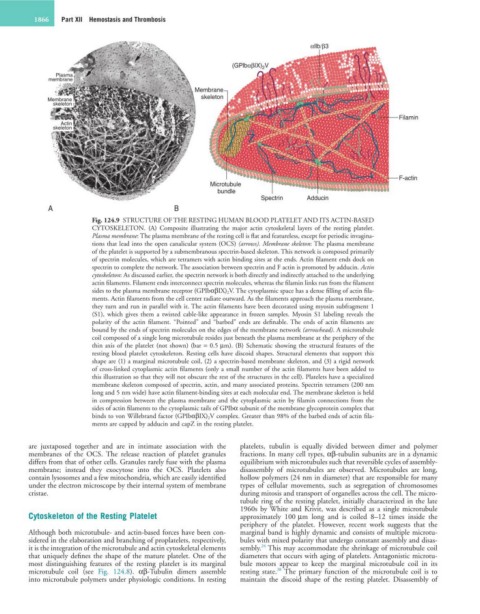
                        Fig. 124.9  STRUCTURE OF THE RESTING HUMAN BLOOD PLATELET AND ITS ACTIN-BASED
                        CYTOSKELETON.  (A)  Composite  illustrating  the  major  actin  cytoskeletal  layers  of  the  resting  platelet.
                        Plasma membrane: The plasma membrane of the resting cell is flat and featureless, except for periodic invagina-
                        tions that lead into the open canalicular system (OCS) (arrows). Membrane skeleton: The plasma membrane
                        of the platelet is supported by a submembranous spectrin-based skeleton. This network is composed primarily
                        of spectrin molecules, which are tetramers with actin binding sites at the ends. Actin filament ends dock on
                        spectrin to complete the network. The association between spectrin and F actin is promoted by adducin. Actin
                        cytoskeleton: As discussed earlier, the spectrin network is both directly and indirectly attached to the underlying
                        actin filaments. Filament ends interconnect spectrin molecules, whereas the filamin links run from the filament
                        sides to the plasma membrane receptor (GPIbαβIX) 2V. The cytoplasmic space has a dense filling of actin fila-
                        ments. Actin filaments from the cell center radiate outward. As the filaments approach the plasma membrane,
                        they turn and run in parallel with it. The actin filaments have been decorated using myosin subfragment 1
                        (S1),  which  gives  them  a  twisted  cable-like  appearance  in  frozen  samples.  Myosin  S1  labeling  reveals  the
                        polarity of the actin filament. “Pointed” and “barbed” ends are definable. The ends of actin filaments are
                        bound by the ends of spectrin molecules on the edges of the membrane network (arrowhead). A microtubule
                        coil composed of a single long microtubule resides just beneath the plasma membrane at the periphery of the
                        thin axis of the platelet (not shown) (bar = 0.5 µm). (B) Schematic showing the structural features of the
                        resting blood platelet cytoskeleton. Resting cells have discoid shapes. Structural elements that support this
                        shape are (1) a marginal microtubule coil, (2) a spectrin-based membrane skeleton, and (3) a rigid network
                        of cross-linked cytoplasmic actin filaments (only a small number of the actin filaments have been added to
                        this illustration so that they will not obscure the rest of the structures in the cell). Platelets have a specialized
                        membrane skeleton composed of spectrin, actin, and many associated proteins. Spectrin tetramers (200 nm
                        long and 5 nm wide) have actin filament-binding sites at each molecular end. The membrane skeleton is held
                        in compression between the plasma membrane and the cytoplasmic actin by filamin connections from the
                        sides of actin filaments to the cytoplasmic tails of GPIbα subunit of the membrane glycoprotein complex that
                        binds to von Willebrand factor (GPIbαβIX) 2V complex. Greater than 98% of the barbed ends of actin fila-
                        ments are capped by adducin and capZ in the resting platelet.

        are  juxtaposed  together  and  are  in  intimate  association  with  the   platelets,  tubulin  is  equally  divided  between  dimer  and  polymer
        membranes  of  the  OCS. The  release  reaction  of  platelet  granules   fractions. In many cell types, αβ-tubulin subunits are in a dynamic
        differs from that of other cells. Granules rarely fuse with the plasma   equilibrium with microtubules such that reversible cycles of assembly-
        membrane;  instead  they  exocytose  into  the  OCS.  Platelets  also   disassembly  of  microtubules  are  observed.  Microtubules  are  long,
        contain lysosomes and a few mitochondria, which are easily identified   hollow polymers (24 nm in diameter) that are responsible for many
        under the electron microscope by their internal system of membrane     types  of  cellular  movements,  such  as  segregation  of  chromosomes
        cristae.                                              during mitosis and transport of organelles across the cell. The micro-
                                                              tubule ring of the resting platelet, initially characterized in the late
                                                              1960s by White and Krivit, was described as a single microtubule
        Cytoskeleton of the Resting Platelet                  approximately  100 µm  long  and  is  coiled  8–12  times  inside  the
                                                              periphery  of  the  platelet.  However,  recent  work  suggests  that  the
        Although both microtubule- and actin-based forces have been con-  marginal band is highly dynamic and consists of multiple microtu-
        sidered in the elaboration and branching of proplatelets, respectively,   bules with mixed polarity that undergo constant assembly and disas-
                                                                    24
        it is the integration of the microtubule and actin cytoskeletal elements   sembly.  This may accommodate the shrinkage of microtubule coil
        that uniquely defines the shape of the mature platelet. One of the   diameters that occurs with aging of platelets. Antagonistic microtu-
        most  distinguishing  features  of  the  resting  platelet  is  its  marginal   bule  motors  appear  to  keep  the  marginal  microtubule  coil  in  its
                                                                        38
        microtubule  coil  (see  Fig.  124.8).  αβ-Tubulin  dimers  assemble   resting state.  The primary function of the microtubule coil is to
        into microtubule polymers under physiologic conditions. In resting   maintain  the  discoid  shape  of  the  resting  platelet.  Disassembly  of

