


Page 2135 - Hematology_ Basic Principles and Practice ( PDFDrive )
P. 2135
1896   Part XII  Hemostasis and Thrombosis


                                                                     GPIb-IX-V
                                                  Factor V
                                                 Fibrinogen
                                                                           vWF
                                                     vWf
                                                     PF4
                                                  Factor XI        “PS”
                                        GPIIb-IIIa
                                                              Thrombin
                                                  Activation    ADP
                                                    and       Collagen
                                                  secretion  Epinephrine
                                                           Thromboxane A 2
                                                              Serotonin                 “PS”
                                 Factor Va


                                                                GPIIb-IIIa

                                                                       vWF
                                        GPIIb-IIIa
                                                                            GPIa-IIa
                                           Fibrinogen
                          Factor Xla


                                                                            Collagen


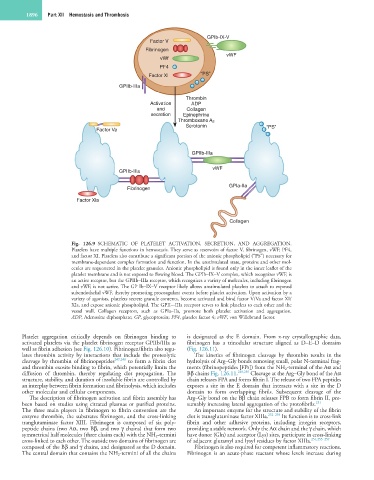
                        Fig.  126.9  SCHEMATIC  OF  PLATELET  ACTIVATION,  SECRETION,  AND  AGGREGATION.
                        Platelets have multiple functions in hemostasis. They serve as reservoirs of factor V, fibrinogen, vWF, PF4,
                        and factor XI. Platelets also contribute a significant portion of the anionic phospholipid (“PS”) necessary for
                        membrane-dependent complex formation and function. In the unstimulated state, proteins and other mol-
                        ecules are sequestered in the platelet granules. Anionic phospholipid is found only in the inner leaflet of the
                        platelet membrane and is not exposed to flowing blood. The GPIb–IX–V complex, which recognizes vWF, is
                        an active receptor, but the GPIIb–IIIa receptor, which recognizes a variety of molecules, including fibrinogen
                        and vWF, is not active. The GP Ib–IX–V receptor likely allows unstimulated platelets to attach to exposed
                        subendothelial vWF, thereby promoting procoagulant events before platelet activation. Upon activation by a
                        variety of agonists, platelets secrete granule contents, become activated and bind factor V/Va and factor XI/
                        XIa, and expose anionic phospholipid. The GPII–-IIIa receptor serves to link platelets to each other and the
                        vessel  wall.  Collagen  receptors,  such  as  GPIa–IIa,  promote  both  platelet  activation  and  aggregation.
                        ADP, Adenosine diphosphate; GP, glycoprotein; PF4, platelet factor 4; vWF, von Willebrand factor.


        Platelet  aggregation  critically  depends  on  fibrinogen  binding  to   is  designated  as  the  E  domain.  From  x-ray  crystallographic  data,
        activated platelets via the platelet fibrinogen receptor GPIIb/IIIa as   fibrinogen  has  a  trinodular  structure  aligned  as  D–E–D  domains
        well as fibrin adhesion (see Fig. 126.10). Fibrinogen/fibrin also regu-  (Fig. 126.11).
        lates thrombin activity by interactions that include the proteolytic   The  kinetics  of  fibrinogen  cleavage  by  thrombin  results  in  the
        cleavage by thrombin of fibrinopeptides 247,248  to form a fibrin clot   hydrolysis of Arg–Gly bonds removing small, polar N-terminal frag-
        and thrombin exosite binding to fibrin, which potentially limits the   ments (fibrinopeptides [FPs]) from the NH 2 -terminal of the Aα and
        diffusion  of  thrombin,  thereby  regulating  clot  propagation.  The   Bβ chains Fig. 126.11. 249,250  Cleavage at the Arg–Gly bond of the Aα
        structure, stability, and duration of insoluble fibrin are controlled by   chain releases FPA and forms fibrin I. The release of two FPA peptides
        an interplay between fibrin formation and fibrinolysis, which includes   exposes a site in the E domain that interacts with a site in the D
        other molecular and cellular components.              domain  to  form  overlapping  fibrils.  Subsequent  cleavage  of  the
           The description of fibrinogen activation and fibrin assembly has   Arg–Gly bond on the Bβ chain releases FPB to form fibrin II, pre-
        been  based  on  studies  using  citrated  plasmas  or  purified  proteins.   sumably increasing lateral aggregation of the protofibrils. 251
        The  three  main  players  in  fibrinogen  to  fibrin  conversion  are  the   An important enzyme for the structure and stability of the fibrin
        enzyme  thrombin,  the  substrates  fibrinogen,  and  the  cross-linking   clot is transglutaminase factor XIIIa. 252–254  Its function is to cross-link
        tranglutaminase  factor  XIII.  Fibrinogen  is  composed  of  six  poly-  fibrin  and  other  adhesive  proteins,  including  integrin  receptors,
        peptide chains (two Aα, two Bβ, and two γ chains) that form two   providing a stable network. Only the Aα chain and the γ chain, which
        symmetrical half molecules (three chains each) with the NH 2-termini   have donor (Gln) and acceptor (Lys) sites, participate in cross-linking
        cross-linked to each other. The outside two domains of fibrinogen are   of adjacent glutamyl and lysyl residues by factor XIIIa. 251,255–257
        composed of the Bβ and γ chains, and designated as the D domain.   Fibrinogen is also required for competent inflammatory reactions.
        The central domain that contains the NH 2 -termini of all the chains   Fibrinogen  is  an  acute-phase  reactant  whose  levels  increase  during

