


Page 2136 - Hematology_ Basic Principles and Practice ( PDFDrive )
P. 2136
Chapter 126  Molecular Basis of Blood Coagulation  1897


                                                              Thrombin

                                            Fibrinogen                            vWF

                                          GPIIb/IIIa
                                                                   PARS(1,4)
                                                                                GPIb-IX-V
                                   ADP                                                     Collagen
                                                 P2Y 12
                                                                                       GPIa/IIa

                                                               Platelet
                             Epinephrine                      activation                   TXA 2 R
                                       α 2 A-AR
                                                                          TX synthase
                                                                PGG 2                  TXA 2
                                               Aspirin
                                                                   COX-1
                                                            Arachidonic acid
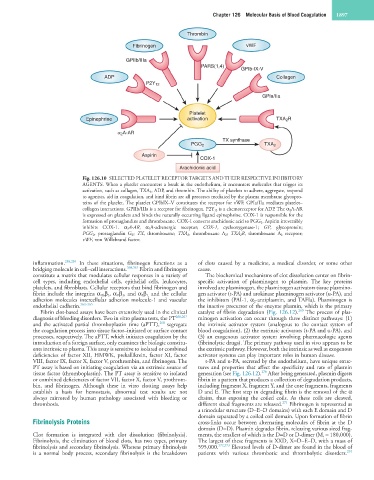
                            Fig. 126.10  SELECTED PLATELET RECEPTOR TARGETS AND THEIR RESPECTIVE INHIBITORY
                            AGENTS. When a platelet encounters a break in the endothelium, it encounters molecules that trigger its
                            activation, such as collagen, TXA 2, ADP, and thrombin. The ability of platelets to adhere, aggregate, respond
                            to agonists, aid in coagulation, and bind fibrin are all processes mediated by the plasma membrane glycopro-
                            teins of the platelet. The platelet GPIbIX–V constitutes the receptor for vWF. GPIa/IIa mediates platelet–
                            collagen interactions. GPIIb/IIIa is a receptor for fibrinogen. P2Y 12 is a chemoreceptor for ADP. The α 2A-AR
                            is expressed on platelets and binds the naturally occurring ligand epinephrine. COX-1 is responsible for the
                            formation of prostaglandins and thromboxane. COX-1 converts arachidonic acid to PGG 2. Aspirin irreversibly
                            inhibits  COX-1.  α 2A-AR,  α 2A-adrenergic  receptor;  COX-1,  cyclooxygenase-1;  GP,  glycoprotein;
                            PGG 2,  prostaglandin  G 2 ;  TX,  thromboxane;  TXA 2,  thromboxane  A 2;  TXA 2R,  thromboxane  A 2  receptor;
                            vWF, von Willebrand factor.


            inflammation. 258,259   In  these  situations,  fibrinogen  functions  as  a   of  clots  caused  by  a  medicine,  a  medical  disorder,  or  some  other
            bridging molecule in cell–cell interactions. 260,261  Fibrin and fibrinogen   cause.
            constitute a matrix that modulates cellular responses in a variety of   The biochemical mechanisms of clot dissolution center on fibrin-
            cell  types,  including  endothelial  cells,  epithelial  cells,  leukocytes,   specific  activation  of  plasminogen  to  plasmin.  The  key  proteins
            platelets, and fibroblasts. Cellular receptors that bind fibrinogen and   involved are plasminogen, the plasminogen activators tissue plasmino-
            fibrin include the integrins α IIb β 3 , α V β 3 , and α 5 β 1,  and the cellular   gen activator (t-PA) and urokinase plasminogen activator (u-PA), and
            adhesion  molecules  intercellular  adhesion  molecule-1  and  vascular   the inhibitors (PAI-1, α 2 -antiplasmin, and TAFIa). Plasminogen is
            endothelial cadherin. 262–265                         the inactive precursor of the enzyme plasmin, which is the primary
                                                                                                   269
              Fibrin clot-based assays have been extensively used in the clinical   catalyst of fibrin degradation (Fig. 126.12).  The process of plas-
            diagnosis of bleeding disorders. Two in vitro plasma tests, the PT 266,267    minogen activation can occur through three distinct pathways: (1)
                                                     268
            and the activated partial thromboplastin time (aPTT),  segregate   the  intrinsic  activator  system  (analogous  to  the  contact  system  of
            the coagulation process into tissue factor–initiated or surface contact   blood coagulation), (2) the extrinsic activators (t-PA and u-PA), and
            processes, respectively. The aPTT, which initiates coagulation by the   (3)  an  exogenous  activator  system  involving  pharmacologic  agents
            introduction of a foreign surface, only examines the biologic constitu-  (fibrinolytic drugs). The primary pathway used in vivo appears to be
            ents intrinsic to plasma. This assay is sensitive to isolated or combined   the extrinsic pathway. However, both the intrinsic as well as exogenous
            deficiencies  of  factor  XII,  HMWK,  prekallikrein,  factor  XI,  factor   activator systems can play important roles in human disease.
            VIII, factor IX, factor X, factor V, prothrombin, and fibrinogen. The   t-PA and u-PA, secreted by the endothelium, have unique struc-
            PT assay is based on initiating coagulation via an extrinsic source of   tures  and  properties  that  affect  the  specificity  and  rate  of  plasmin
                                                                                       270
            tissue factor (thromboplastin). The PT assay is sensitive to isolated   generation (see Fig. 126.12).  After being generated, plasmin digests
            or combined deficiencies of factor VII, factor X, factor V, prothrom-  fibrin in a pattern that produces a collection of degradation products,
            bin,  and  fibrinogen.  Although  these  in  vitro  clotting  assays  help   including fragment X, fragment Y, and the core fragments, fragments
            establish  a  basis  for  hemostasis,  abnormal  test  results  are  not     D and E. The first step in degrading fibrin is the removal of the α
            always  mirrored  by  human  pathology  associated  with  bleeding  or   chains,  thus  exposing  the  coiled  coils.  As  these  coils  are  cleaved,
                                                                                             271
            thrombosis.                                           different sized fragments are released.  Fibrinogen is represented as
                                                                  a trinodular structure (D–E–D domains) with each E domain and D
                                                                  domain separated by a coiled coil domain. Upon formation of fibrin
            Fibrinolysis Proteins                                 cross-links  occur  between  alternating  molecules  of  fibrin  at  the  D
                                                                  domain (D=D). Plasmin degrades fibrin, releasing various sized frag-
            Clot  formation  is  integrated  with  clot  dissolution  (fibrinolysis).   ments, the smallest of which is the D=D or D-dimer (M r  = 180,000).
            Fibrinolysis, the elimination of blood clots, has two types, primary   The largest of these fragments is XXD, X=D–E–D, with a mass of
            fibrinolysis and secondary fibrinolysis. Whereas primary fibrinolysis   595,000. 272,273  Elevated levels of D-dimer are found in the blood of
                                                                                                                  274
            is  a  normal  body  process,  secondary  fibrinolysis  is  the  breakdown   patients  with  various  thrombotic  and  thrombolytic  disorders.

