


Page 2570 - Hematology_ Basic Principles and Practice ( PDFDrive )
P. 2570
Chapter 158  Hematologic Aspects of Parasitic Diseases  2293


                                        Key
                                        T. b. gambiense
                                        T. b. rhodesiense


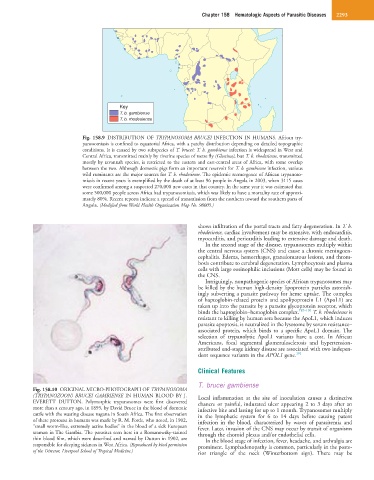
                            Fig.  158.9  DISTRIBUTION OF TRYPANOSOMA BRUCEI INFECTION IN HUMANS. African try-
                            panosomiasis is confined to equatorial Africa, with a patchy distribution depending on detailed topographic
                            conditions. It is caused by two subspecies of T. brucei: T. b. gambiense infection is widespread in West and
                            Central Africa, transmitted mainly by riverine species of tsetse fly (Glossina), but T. b. rhodesiense, transmitted
                            mostly by savannah species, is restricted to the eastern and east-central areas of Africa, with some overlap
                            between the two. Although domestic pigs form an important reservoir for T. b. gambiense infection, various
                            wild ruminants are the major sources for T. b. rhodesiense. The epidemic reemergence of African trypanoso-
                            miasis in recent years is exemplified by the death of at least 96 people in Angola in 2003, when 3115 cases
                            were confirmed among a suspected 270,000 new cases in that country. In the same year it was estimated that
                            some 500,000 people across Africa had trypanosomiasis, which was likely to have a mortality rate of approxi-
                            mately 80%. Recent reports indicate a spread of transmission from the northern toward the southern parts of
                            Angola. (Modified from World Health Organization Map No. 98005.)


                                                                  shows infiltration of the portal tracts and fatty degeneration. In T. b.
                                                                  rhodesiense, cardiac involvement may be extensive, with endocarditis,
                                                                  myocarditis, and pericarditis leading to extensive damage and death.
                                                                    In the second stage of the disease, trypanosomes multiply within
                                                                  the central nervous system (CNS) and cause a chronic meningoen-
                                                                  cephalitis. Edema, hemorrhages, granulomatous lesions, and throm-
                                                                  bosis contribute to cerebral degeneration. Lymphocytosis and plasma
                                                                  cells with large eosinophilic inclusions (Mott cells) may be found in
                                                                  the CNS.
                                                                    Intriguingly, nonpathogenic species of African trypanosomes may
                                                                  be killed by the human high-density lipoprotein particles astonish-
                                                                  ingly subverting a parasite pathway for heme uptake. The complex
                                                                  of haptoglobin-related protein and apolipoprotein L1 (ApoL1) are
                                                                  taken up into the parasite by a parasite glycoprotein receptor, which
                                                                  binds the haptoglobin–hemoglobin complex. 187–190  T. b. rhodesiense is
                                                                  resistant to killing by human sera because the ApoL1, which induces
                                                                  parasite apoptosis, is neutralized in the lysosome by serum resistance–
                                                                  associated  protein,  which  binds  to  a  specific  ApoL1  domain. The
                                                                  selection  of  trypanolytic  ApoL1  variants  have  a  cost.  In  African
                                                                  Americans,  focal  segmental  glomerulosclerosis  and  hypertension-
                                                                  attributed end-stage kidney disease are associated with two indepen-
                                                                  dent sequence variants in the APOL1 gene. 191

                                                                  Clinical Features

                                                                  T. brucei gambiense
            Fig. 158.10  ORIGINAL MICRO-PHOTOGRAPH OF TRYPANOSOMA
            (TRYPANOZOON) BRUCEI GAMBIENSE IN HUMAN BLOOD BY J.   Local  inflammation  at  the  site  of  inoculation  causes  a  distinctive
            EVERETT  DUTTON.  Polymorphic  trypanosomes  were  first  discovered   chancre or painful, indurated ulcer appearing 2 to 3 days after an
            more than a century ago, in 1895, by David Bruce in the blood of domestic   infective bite and lasting for up to 1 month. Trypanosomes multiply
            cattle with the wasting disease nagana in South Africa. The first observation   in  the  lymphatic  system  for  6  to  14  days  before  causing  patent
            of these protozoa in humans was made by R. M. Forde, who noted, in 1902,   infection  in  the  blood,  characterized  by  waves  of  parasitemia  and
            “small worm-like, extremely active bodies” in the blood of a sick European   fever. Later, invasion of the CNS may occur by transit of organisms
            seaman in The Gambia. The parasites seen here in a Romanowsky-stained   through the choroid plexus and/or endothelial cells.
            thin blood film, which were described and named by Dutton in 1902, are   In the blood stage of infection, fever, headache, and arthralgia are
            responsible for sleeping sickness in West Africa. (Reproduced by kind permission   prominent. Lymphadenopathy is common, particularly in the poste-
            of the Director, Liverpool School of Tropical Medicine.)  rior  triangle  of  the  neck  (Winterbottom  sign).  There  may  be

