


Page 2571 - Hematology_ Basic Principles and Practice ( PDFDrive )
P. 2571
2294   Part XIII  Consultative Hematology


        intermittent  rashes  (often  circinate  erythema),  pruritus,  or  edema.   levels may be elevated to four times normal and with raised IgG levels
        Moderate splenomegaly occurs in 10% to 20% of patients. A few   may cause an increased erythrocyte sedimentation rate.
        infected patients are asymptomatic.                      The white blood cell count may be elevated with monocytosis,
           This early stage of infection may last for up to 2 years or more   lymphocytosis,  and  circulating  plasma  cells,  but  eosinophilia  is
        before CNS involvement, although rapidly progressive disease may   absent. Plasma cells with eosinophilic inclusion or Mott morular cells
        occur. The CNS phase of disease is marked by the progressive onset   may occasionally be seen.
        of headache; disinhibited behavior changes; and mood, thought, and   Petechia and purpura may be secondary to vascular injury, throm-
        sleep  disturbances.  Wasting  is  prominent.  Signs  of  diffuse  CNS   bocytopenia,  and  a  complex  but  poorly  defined  coagulopathy.
        damage in the last phases of the disease include dementia, extrapyra-  Abnormal liver function may cause prolonged clotting times. Func-
        midal and cerebellar dysfunction, and hyperesthesia. Tendon reflexes   tionally,  both  thrombosis  and  fibrinolysis  are  increased,  and  fibrin
        are increased, and signs of upper motor neuron lesions are widespread.   degradation products (D-dimers) are raised in acute disease; in T. b.
        Death usually occurs by intercurrent infection.       rhodesiense,  a  frank  disseminated  intravascular  coagulation  may
                                                              become evident. 195
                                                                 Examination of the bone marrow shows hypercellularity. Gelati-
        T. b. rhodesiense                                     nous degeneration may be seen in patients with wasting.
                                                                 Mononuclear  cells  are  present  late  in  the  disease,  and  the  cell
        T. b. rhodesiense is more virulent, causing a more serious acute disease,   count corresponds to the degree of neurologic involvement and may
        with  systemic  features  including  serous  effusions;  hepatocellular   reach more than 300/µL in severely ill patients. The CSF protein
        jaundice; and a mild, normocytic, normochromic anemia. Hepato-  levels are elevated (0.4 to 1.0 g/L).
        splenomegaly and lymphadenopathy are common, but involvement   As  disease  progresses,  the  circulating  parasites  become  scarce.
        of cervical lymph nodes is less typical. Myocarditis is rare but may   However, anemia and endocrine dysfunction, including amenorrhea,
        cause  death  before  CNS  involvement.  Here  CNS  disease  occurs   reduced libido, and impotence becomes apparent.
        sooner and is more rapidly progressive than T. b. gambiense infection
        and is fatal within 1 to 3 months.
           Infection with T. b. gambiense may resolve in the vast majority of   Parasitologic Assays
        cases. Where infection persists, there is typically a long asymptomatic
        phase. Numerous lymph nodes are enlarged to 1 to 2 cm in diameter   Direct detection of the parasite is particularly important in light of
        and are soft, mobile, and painless.                   the  toxicity  of  the  treatment.  Trypanosomes  may  be  detected  in
           The  differential  diagnosis  of  trypanosomiasis  includes  malaria,   lymph  node  aspirates  and  in  wet  and  thick  blood  smears  (Fig.
        typhoid, fever, and viral hepatitis in the acute phase, whereas lymph-  158.11). An aspirate may be taken from enlarged nodes. Aspirated
        adenopathy may suggest infectious mononucleosis or tuberculosis. In   fluid can be examined under a coverslip, and motile trypanosomes
        the cerebral phase of the disease, syphilis, tuberculosis, HIV-associated   are typically seen at the edges of the coverslip.
        cryptococcal  meningitis,  or  chronic  viral  encephalitis  must  be   Trypanosomes can be seen in wet smears, where a drop of blood is
        considered.                                           placed on a slide and examined under a coverslip. Alternatively, thick

        Children

        Those affected in utero may be born with CNS abnormalities. In
        children the disease is more rapidly progressive, and epileptic seizures
        and psychomotor retardation are the principal features of the disease.

        HIV

        The frequency of HIV seropositivity has been reported to show no
        significant differences between those presenting with trypanosomiasis
        and age-matched control subjects. 192,193  These results do not exclude
        the  possibility  that  coinfections  may  modulate  the  course  of  the
        disease or the effectiveness of treatment.

        Hematologic and Laboratory Features

        The  main  hematologic  features  are  a  normocytic,  normochromic
                                       194
        anemia and moderate thrombocytopenia.  The anemia of trypano-
        somiasis is multifactorial. Hemodilution, hemolysis, and dyserythro-
        poiesis or ineffective erythropoiesis all contribute to the pathogenesis.
        Hemolysis may be caused directly by lytic factors released by trypano-
        somes or indirectly by deposition of immune complexes and subse-
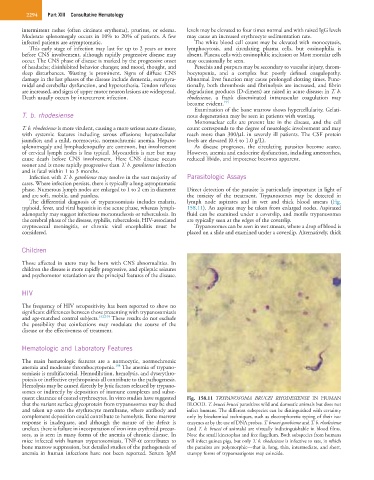
        quent clearance of coated erythrocytes. In vitro studies have suggested   Fig.  158.11  TRYPANOSOMA  BRUCEI  RHODESIENSE  IN  HUMAN
        that the variant surface glycoprotein from trypanosomes may be shed   BLOOD. T. brucei brucei parasitizes wild and domestic animals but does not
        and taken up onto the erythrocyte membrane, where antibody and   infect humans. The different subspecies can be distinguished with certainty
        complement deposition could contribute to hemolysis. Bone marrow   only by biochemical techniques, such as electrophoretic typing of their iso-
        response  is  inadequate,  and  although  the  nature  of  the  defect  is   enzymes or by the use of DNA probes. T. brucei gambiense and T. b. rhodesiense
        unclear, there is failure in incorporation of iron into erythroid precur-  (and T. b. brucei of animals) are virtually indistinguishable in blood films.
        sors, as is seen in many forms of the anemia of chronic disease. In   Note the small kinetoplast and free flagellum. Both subspecies from humans
        mice infected with human trypanosomiasis, TNF-α contributes to   will infect guinea pigs, but only T. b. rhodesiense is infective to rats, in which
        bone marrow suppression, but detailed studies of the pathogenesis of   the parasites are polymorphic—that is, long, thin, intermediate, and short,
        anemia  in  human  infections  have  not  been  reported.  Serum  IgM   stumpy forms of trypomastigotes may coincide.

