


Page 2635 - Hematology_ Basic Principles and Practice ( PDFDrive )
P. 2635
e16    Part XIII  Consultative Hematology


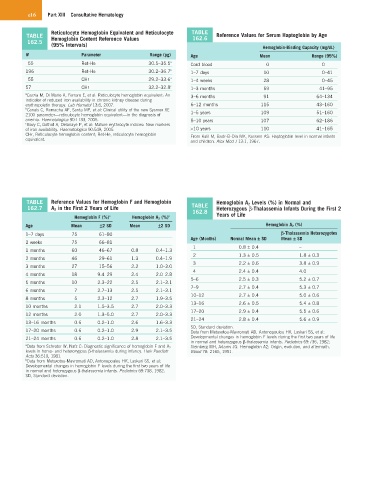
                  Reticulocyte Hemoglobin Equivalent and Reticulocyte   TABLE
          TABLE   Hemoglobin Content Reference Values           162.6   Reference Values for Serum Haptoglobin by Age
          162.5   (95% Intervals)
                                                                                       Hemoglobin-Binding Capacity (mg/dL)
         N                  Parameter             Range (pg)   Age                    Mean             Range (95%)
           55               Ret-He                30.5–35.5 a  Cord blood               0                 0
         196                Ret-He                30.2–36.7 b  1–7 days                10                 0–41
           55               CHr                   29.2–33.6 a  1–4 weeks               28                 0–45
         57                 CHr                   32.2–32.8 c  1–3 months              59                41–95
         a Garzia M, Di Mario A, Ferraro E, et al: Reticulocyte hemoglobin equivalent: An   3–6 months  91  64–134
         indicator of reduced iron availability in chronic kidney disease during
         erythropoietin therapy. Lab Hematol 13:6, 2007.       6–12 months            115                43–160
         b Canals C, Remacha AF, Sarda MP, et al: Clinical utility of the new Sysmex XE
         2100 parameter—reticulocyte hemoglobin equivalent—in the diagnosis of   1–5 years  109          51–160
         anemia. Haematologica 90:1133, 2005.                  5–10 years             107                62–186
         c Bovy C, Gothot A, Delanaye P, et al: Mature erythrocyte indices: New markers
         of iron availability. Haematologica 90:549, 2005.     >10 years              110                41–165
         CHr, Reticulocyte hemoglobin content; Ret-He, reticulocyte hemoglobin   From Kalil M, Badr-El-Din MK, Kassem AS: Haptoglobin level in normal infants
         equivalent.                                           and children. Alex Med J 13:1, 1967.


          TABLE   Reference Values for Hemoglobin F and Hemoglobin      Hemoglobin A 2  Levels (%) in Normal and
          162.7   A 2  in the First 2 Years of Life             TABLE   Heterozygous β-Thalassemia Infants During the First 2
                                                                162.8
                         Hemoglobin F (%) a  Hemoglobin A 2  (%) b      Years of Life
         Age            Mean      ±2 SD    Mean      ±2 SD                              Hemoglobin A 2  (%)
         1–7 days       75       61–80                                                       β-Thalassemia Heterozygotes
                                                               Age (Months)  Normal Mean ± SD  Mean ± SD
         2 weeks        75       66–81
                                                                 1             0.8 ± 0.4           –
         1 months       60       46–67      0.8     0.4–1.3
                                                                 2             1.3 ± 0.5           1.8 ± 0.3
         2 months       46       29–61      1.3     0.4–1.9
                                                                 3             2.2 ± 0.6           3.8 ± 0.9
         3 months       27       15–56      2.2     1.0–3.0
                                                                 4             2.4 ± 0.4           4.0
         4 months       18       9.4–29     2.4     2.0–2.8
                                                               5–6             2.5 ± 0.3           5.2 ± 0.7
         5 months       10       2.3–22     2.5     2.1–3.1
                                                               7–9             2.7 ± 0.4           5.3 ± 0.7
         6 months        7       2.7–13     2.5     2.1–3.1
                                                               10–12           2.7 ± 0.4           5.0 ± 0.6
         8 months        5       2.3–12     2.7     1.9–3.5
                                                               13–16           2.6 ± 0.5           5.4 ± 0.8
         10 months       2.1     1.5–3.5    2.7     2.0–3.3
                                                               17–20           2.9 ± 0.4           5.5 ± 0.6
         12 months       2.0     1.3–5.0    2.7     2.0–3.3
                                                               21–24           2.8 ± 0.4           5.6 ± 0.9
         13–16 months    0.6     0.2–1.0    2.6     1.6–3.3
                                                               SD, Standard deviation.
         17–20 months    0.6     0.2–1.0    2.9     2.1–3.5    Data from Metaxotou-Mavromati AD, Antonopoulou HK, Laskari SS, et al:
         21–24 months    0.6     0.2–1.0    2.8     2.1–3.5    Developmental changes in hemoglobin F levels during the first two years of life
                                                               in normal and heterozygous β-thalassemia infants. Pediatrics 69:736, 1982;
         a Data from Schroter W, Nafz C: Diagnostic significance of hemoglobin F and A 2    Steinberg MH, Adams JG: Hemoglobin A2: Origin, evolution, and aftermath.
         levels in homo- and heterozygous β-thalassemia during infancy. Helv Paediatr   Blood 78: 2165, 1991.
         Acta 36:519, 1981.
         b Data from Metaxotou-Mavromati AD, Antonopoulou HK, Laskari SS, et al:
         Developmental changes in hemoglobin F levels during the first two years of life
         in normal and heterozygous β-thalassemia infants. Pediatrics 69:738, 1982.
         SD, Standard deviation.

