


Page 2636 - Hematology_ Basic Principles and Practice ( PDFDrive )
P. 2636
Chapter 162  Resources for the Hematologist  e17


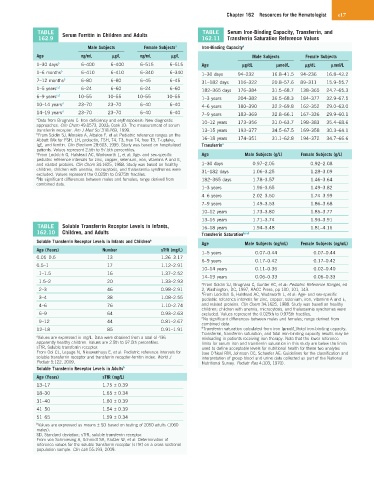
             TABLE   Serum Ferritin in Children and Adults         TABLE   Serum Iron-Binding Capacity, Transferrin, and
              162.9                                                162.11  Transferrin Saturation Reference Values
                              Male Subjects     Female Subjects a  Iron-Binding Capacity a
             Age            ng/mL     µg/L     ng/mL     µg/L                       Male Subjects    Female Subjects
             1–30 days b    6–400    6–400     6–515     6–515     Age          µg/dL      µmol/L    µg/dL   µmol/L
             1–6 months b   6–410    6–410     6–340     6–340     1–30 days   94–232     16.8–41.5  94–236  16.8–42.2
             7–12 months b  6–80     6–80      6–45      6–45      31–182 days  116–322   20.8–57.6  89–311  15.9–55.7
             1–5 years c,d  6–24     6–60      6–24      6–60      182–365 days  176–384  31.5–68.7  138–365  24.7–65.3
             6–9 years c,d  10–55   10–55     10–55     10–55      1–3 years   204–382    36.5–68.3  184–377  32.9–67.5
             10–14 years d  23–70   23–70      6–40      6–40      4–6 years   180–390    32.2–69.8  162–352  29.0–63.0
             14–19 years d  23–70   23–70      6–40      6–40      7–9 years   183–369    32.8–66.1  167–336  29.9–60.1
             a Data from Brugnara C: Iron deficiency and erythropoiesis: New diagnostic   10–12 years  173–356  31.0–63.7  198–383  35.4–68.6
             approaches. Clin Chem 49:1573, 2003; Cook JD: The measurement of serum
             transferrin receptor. Am J Med Sci 318:269, 1999.     13–15 years  193–377   34.5–67.5  169–358  30.3–64.1
             b From Soldin SJ, Morales A, Albalos F, et al: Pediatric reference ranges on the
             Abbott IMx for FSH, LH, prolactin, TSH, T4, T3, free T4, free T3, T-uptake,    16–18 years  174–351  31.1–62.8  194–372  34.7–66.6
             IgE, and ferritin. Clin Biochem 28:603, 1995. Study was based on hospitalized   Transferrin a
             patients. Values represent 2.5th to 97.5th percentiles.
             c From Lockitch G, Halstead AC, Wadsworth L, et al: Age- and sex-specific   Age  Male Subjects (g/L)  Female Subjects (g/L)
             pediatric reference intervals for zinc, copper, selenium, iron, vitamins A and E,
             and related proteins. Clin Chem 34:1625, 1988. Study was based on healthy   1–30 days  0.97–2.05  0.92–2.08
             children; children with anemia, microcytosis, and thalassemia syndromes were   31–182 days  1.06–3.25  1.28–3.09
             excluded. Values represent the 0.025th to 0.975th fractiles.
             d No significant differences between males and females; range derived from   182–365 days  1.78–3.57  1.46–3.64
             combined data.
                                                                   1–3 years        1.96–3.65          1.49–3.82
                                                                   4–6 years        2.02–3.50          1.74–3.99
                                                                   7–9 years        1.49–3.53          1.86–3.68
                                                                   10–12 years      1.73–3.80          1.85–3.77
                                                                   13–15 years      1.71–3.74          1.93–3.91
             TABLE   Soluble Transferrin Receptor Levels in Infants,   16–18 years  1.94–3.48          1.81–4.16
             162.10  Children, and Adults                          Transferrin Saturation b,c,d
             Soluble Transferrin Receptor Levels in Infants and Children a  Age  Male Subjects (ng/mL)  Female Subjects (ng/mL)
             Age (Years)           Number             sTfR (mg/L)
                                                                   1–5 years         0.07–0.44          0.07–0.44
             0.05–0.5               13                1.26–3.17
                                                                   6–9 years         0.17–0.42          0.17–0.42
             0.5–1                  17                1.12–2.91
                                                                   10–14 years       0.11–0.36          0.02–0.40
               1–1.5                16                1.37–2.52
                                                                   14–19 years       0.06–0.33          0.06–0.33
               1.5–2                20                1.33–2.93    a From Soldin SJ, Brugnara C, Gunter KC, et al: Pediatric Reference Ranges, ed
               2–3                  46                0.98–2.91    2, Washington, DC, 1997, AACC Press, pp 100, 101, 143.
                                                                   b From Lockitch G, Halstead AC, Wadsworth L, et al: Age- and sex-specific
               3–4                  38                1.08–2.55    pediatric reference intervals for zinc, copper, selenium, iron, vitamins A and E,
               4–6                  76                1.10–2.74    and related proteins. Clin Chem 34:1625, 1988. Study was based on healthy
                                                                   children; children with anemia, microcytosis, and thalassemia syndromes were
               6–9                  64                0.93–2.63    excluded. Values represent the 0.025th to 0.975th fractiles.
                                                                   c No significant differences between males and females; range derived from
               9–12                 44                0.81–2.67
                                                                   combined data.
             12–18                  85                0.91–1.91    d Transferrin saturation calculated from iron (µmol/L)/total iron-binding capacity.
                                                                   Transferrin, transferrin saturation, and total iron-binding capacity results may be
             a Values are expressed in mg/L. Data were obtained from a total of 436   misleading in patients receiving iron therapy. Note that the lower reference
             apparently healthy children. Values are 2.5th to 97.5th percentiles.  limits for serum iron and transferrin saturation in this study are below the limits
             sTfR, Soluble transferrin receptor.                   used to define acceptable levels for nutritional health for these two analytes
             From Ooi CL, Lepage N, Nieuwenhuys E, et al: Pediatric reference intervals for   (see O’Neal RM, Johnson OC, Schaefer AE: Guidelines for the classification and
             soluble transferrin receptor and transferrin receptor-ferritin index. World J   interpretation of group blood and urine data collected as part of the National
             Pediatr 5:122, 2009.                                  Nutritional Survey. Pediatr Res 4:103, 1970).
             Soluble Transferrin Receptor Levels in Adults b
             Age (Years)           sTfR (mg/L)
             13–17                 1.75 ± 0.39
             18–30                 1.65 ± 0.34
             31–40                 1.60 ± 0.39
             41–50                 1.54 ± 0.39
             51–65                 1.59 ± 0.34
             b Values are expressed as means ± SD based on testing of 2050 adults (1060
             males).
             SD, Standard deviation; sTfR, soluble transferrin receptor.
             From von Schmiesing A, Schmidt SA, Kratzer W, et al: Determination of
             reference values for the soluble transferrin receptor (sTfR) on a cross sectional
             population sample. Clin Lab 55:193, 2009.

