


Page 2638 - Hematology_ Basic Principles and Practice ( PDFDrive )
P. 2638
Chapter 162  Resources for the Hematologist  e19


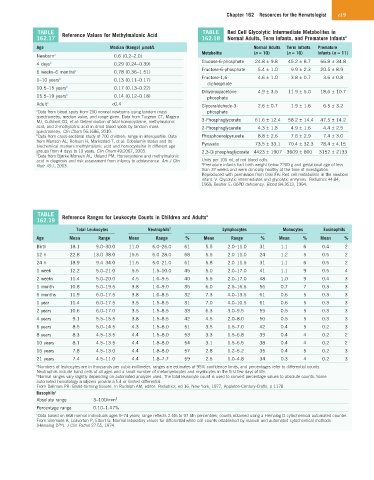
             TABLE                                                 TABLE   Red Cell Glycolytic Intermediate Metabolites in
             162.17  Reference Values for Methylmalonic Acid       162.18  Normal Adults, Term Infants, and Premature Infants a
             Age                     Median (Range) µmol/L                          Normal Adults   Term Infants   Premature
                                                                   Metabolite       (n = 10)   (n = 10)  Infants (n = 11)
             Newborn a                0.6 (0.2–2.0)
                                                                   Glucose-6-phosphate  24.8 ± 9.8  45.2 ± 8.7  66.8 ± 34.8
             4 days b                 0.29 (0.24–0.39)
                                                                   Fructose-6-phosphate  5.4 ± 1.0  9.9 ± 2.3  20.5 ± 8.9
             6 weeks–6 months b       0.78 (0.36–1.51)
                                                                   Fructose-1,6-     4.6 ± 1.0  3.8 ± 0.7  3.6 ± 0.8
             1–10 years b             0.13 (0.11–0.17)
                                                                     diphosphate
             10.5–15 years b          0.17 (0.13–0.22)
                                                                   Dihydroxyacetone   4.9 ± 3.5  11.9 ± 5.0  18.6 ± 10.7
             15.5–19 years b          0.14 (0.12–0.18)               phosphate
             Adult c                  <0.4                         Glyceraldehyde-3-  2.6 ± 0.7  1.9 ± 1.6  6.5 ± 3.2
             a Data from blood spots from 200 normal newborns using tandem mass   phosphate
             spectrometry, median value, and range given. Data from Turgeon CT, Magera
             MJ, Cuthbert CD, et al: Determination of total homocysteine, methylmalonic   3-Phosphoglycerate  61.6 ± 12.4  58.2 ± 14.4  47.5 ± 14.2
             acid, and 2-methylcitric acid in dried blood spots by tandem mass   2-Phosphoglycerate  4.3 ± 1.8  4.9 ± 1.6  4.4 ± 2.5
             spectrometry. Clin Chem 56:1686, 2010.
             b Data from cross-sectional study of 700 children; range in interquartile. Data   Phosphoenolpyruvate  8.8 ± 2.6  7.6 ± 2.9  7.4 ± 3.0
             from Monsen AL, Refsum H, Markestad T, et al: Cobalamin status and its   Pyruvate  73.5 ± 33.1  70.4 ± 32.3  78.4 ± 4.15
             biochemical markers methylmalonic acid and homocysteine in different age
             groups from 4 days to 19 years. Clin Chem 49:2067, 2003.  2,3-Diphosphoglycerate 4423 ± 1907  3609 ± 800  3152 ± 2133
             c Data from Bjørke Monsen AL, Ueland PM: Homocysteine and methylmalonic
             acid in diagnosis and risk assessment from infancy to adolescence. Am J Clin   Units per 100 mL of red blood cells.
                                                                   a
             Nutr 78:7, 2003.                                      Premature infants had birth weight below 2200 g and gestational age of less
                                                                   than 37 weeks and were clinically healthy at the time of investigation.
                                                                   Reproduced with permission from Oski FA: Red cell metabolism in the newborn
                                                                   infant. V. Glycolytic intermediates and glycolytic enzymes. Pediatrics 44:84,
                                                                   1969; Beutler E: G6PD deficiency. Blood 84:3613, 1994.


             TABLE                                                   a
             162.19  Reference Ranges for Leukocyte Counts in Children and Adults
                          Total Leukocytes       Neutrophils b            Lymphocytes         Monocytes    Eosinophils
             Age        Mean     Range     Mean     Range     %     Mean     Range    %     Mean    %     Mean    %
             Birth      18.1    9.0–30.0   11.0    6.0–26.0  61     5.5    2.0–11.0   31     1.1    6     0.4     2
             12 h       22.8    13.0–38.0  15.5    6.0–28.0  68     5.5    2.0–11.0   24     1.2    5     0.5     2
             24 h       18.9    9.4–34.0   11.5    5.0–21.0  61     5.8    2.0–11.5   31     1.1    6     0.5     2
             1 week     12.2    5.0–21.0    5.5    1.5–10.0  45     5.0    2.0–17.0   41     1.1    9     0.5     4
             2 weeks    11.4    5.0–20.0    4.5    1.0–9.5   40     5.5    2.0–17.0   48     1.0    9     0.4     3
             1 month    10.8    5.0–19.5    3.8    1.0–9.0   35     6.0    2.5–16.5   56     0.7    7     0.3     3
             6 months   11.9    6.0–17.5    3.8    1.0–8.5   32     7.3    4.0–13.5   61     0.6    5     0.3     3
             1 year     11.4    6.0–17.5    3.5    1.5–8.5   31     7.0    4.0–10.5   61     0.6    5     0.3     3
             2 years    10.6    6.0–17.0    3.5    1.5–8.5   33     6.3    3.0–9.5    59     0.5    5     0.3     3
             4 years     9.1    5.5–15.5    3.8    1.5–8.5   42     4.5    2.0–8.0    50     0.5    5     0.3     3
             6 years     8.5    5.0–14.5    4.3    1.5–8.0   51     3.5    1.5–7.0    42     0.4    5     0.2     3
             8 years     8.3    4.5–13.5    4.4    1.5–8.0   53     3.3    1.5–6.8    39     0.4    4     0.2     2
             10 years    8.1    4.5–13.5    4.4    1.8–8.0   54     3.1    1.5–6.5    38     0.4    4     0.2     2
             16 years    7.8    4.5–13.0    4.4    1.8–8.0   57     2.8    1.2–5.2    35     0.4    5     0.2     3
             21 years    7.4    4.5–11.0    4.4    1.8–7.7   59     2.5    1.0–4.8    34     0.3    4     0.2     3
             a Numbers of leukocytes are in thousands per cubic millimeter, ranges are estimates of 95% confidence limits, and percentages refer to differential counts.
             Neutrophils include band cells at all ages and a small number of metamyelocytes and myelocytes in the first few days of life.
             b Normal ranges vary slightly depending on automated analyzer used. The total leukocyte count is used to convert percentage values to absolute counts. Some
             automated hematology analyzers provide a full or limited differential.
             From Dallman PR: Blood-forming tissues. In Rudolph AM, editor: Pediatrics, ed 16, New York, 1977, Appleton-Century-Crofts, p 1178.
             Basophils c
             Absolute range     3–100/mm 3
             Percentage range   0.10–1.47%
             c Data based on 668 normal individuals ages 5–74 years; range reflects 2.5th to 97.5th percentiles; counts obtained using a Hemalog D cytochemical automated counter.
             From Simmons A, Leaverton P, Elbert G: Normal laboratory values for differential white cell counts established by manual and automated cytochemical methods
             (Hemalog D™). J Clin Pathol 27:55, 1974.

