


Page 551 - Hematology_ Basic Principles and Practice ( PDFDrive )
P. 551
466    Part V  Red Blood Cells


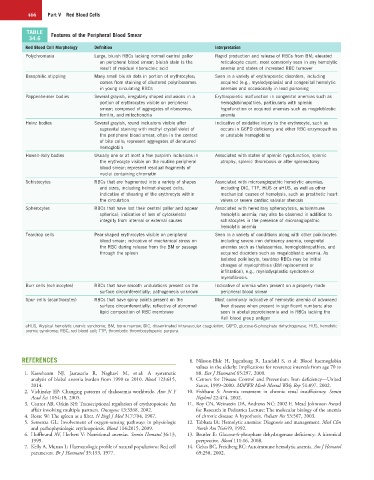
          TABLE   Features of the Peripheral Blood Smear
          34.6
         Red Blood Cell Morphology  Definition                         Interpretation
         Polychromasia          Large, bluish RBCs lacking normal central pallor   Rapid production and release of RBCs from BM; elevated
                                  on peripheral blood smear; bluish stain is the   reticulocyte count; most commonly seen in any hemolytic
                                  result of residual ribonucleic acid    anemia and states of increased RBC turnover
         Basophilic stippling   Many small bluish dots in portion of erythrocytes;   Seen in a variety of erythropoietic disorders, including
                                  comes from staining of clustered polyribosomes   acquired (e.g., myelodysplasia) and congenital hemolytic
                                  in young circulating RBCs              anemias and occasionally in lead poisoning
         Pappenheimer bodies    Several grayish, irregularly shaped inclusions in a   Erythropoietic malfunction in congenital anemias such as
                                  portion of erythrocytes visible on peripheral   hemoglobinopathies, particularly with splenic
                                  smear; composed of aggregates of ribosomes,   hypofunction or acquired anemias such as megaloblastic
                                  ferritin, and mitochondria             anemia
         Heinz bodies           Several grayish, round inclusions visible after   Indicative of oxidative injury to the erythrocyte, such as
                                  supravital staining with methyl crystal violet of   occurs in G6PD deficiency and other RBC enzymopathies
                                  the peripheral blood smear, often in the context   or unstable hemoglobins
                                  of bite cells; represent aggregates of denatured
                                  hemoglobin
         Howell-Jolly bodies    Usually one or at most a few purplish inclusions in   Associated with states of splenic hypofunction, splenic
                                  the erythrocyte visible on the routine peripheral   atrophy, splenic thrombosis or after splenectomy
                                  blood smear; represent residual fragments of
                                  nuclei containing chromatin
         Schistocytes           RBCs that are fragmented into a variety of shapes   Associated with microangiopathic hemolytic anemias,
                                  and sizes, including helmet-shaped cells;   including DIC, TTP, HUS or aHUS, as well as other
                                  indicative of shearing of the erythrocyte within   mechanical causes of hemolysis, such as prosthetic heart
                                  the circulation                        valves or severe cardiac valvular stenosis
         Spherocytes            RBCs that have lost their central pallor and appear   Associated with hereditary spherocytosis, autoimmune
                                  spherical; indicative of loss of cytoskeletal   hemolytic anemia; may also be observed in addition to
                                  integrity from internal or external causes  schistocytes in the presence of microangiopathic
                                                                         hemolytic anemia
         Teardrop cells         Pear-shaped erythrocytes visible on peripheral   Seen in a variety of conditions along with other poikilocytes
                                  blood smear; indicative of mechanical stress on   including severe iron deficiency anemia, congenital
                                  the RBC during release from the BM or passage   anemias such as thalassemias, hemoglobinopathies, and
                                  through the spleen                     acquired disorders such as megaloblastic anemia. As
                                                                         isolated poikilocyte, teardrop RBCs may be initial
                                                                         changes of myelophthisis (BM replacement or
                                                                         infiltration), e.g., myelodysplastic syndrome or
                                                                         myelofibrosis.
         Burr cells (echinocytes)  RBCs that have smooth undulations present on the   Indicative of uremia when present on a properly made
                                  surface circumferentially; pathogenesis unknown  peripheral blood smear
         Spur cells (acanthocytes)  RBCs that have spiny points present on the   Most commonly indicative of hemolytic anemia of advanced
                                  surface circumferentially; reflective of abnormal   liver disease when present in significant numbers; also
                                  lipid composition of RBC membrane      seen in abetalipoproteinemia and in RBCs lacking the
                                                                         Kell blood group antigen
         aHUS, Atypical hemolytic uremic syndrome; BM, bone marrow; DIC, disseminated intravascular coagulation; G6PD, glucose-6-phosphate dehydrogenase; HUS, hemolytic
         uremic syndrome; RBC, red blood cell; TTP, thrombotic thrombocytopenic purpura.


        REFERENCES                                             8.  Nilsson-Ehle  H,  Jagenburg  R,  Landahl  S,  et al:  Blood  haemoglobin
                                                                 values in the elderly: Implications for reverence intervals from age 70 to
         1.  Kassebaum  NJ,  Jasrasaria  R,  Naghavi  M,  et al:  A  systematic   88. Eur J Haematol 65:297, 2000.
           analysis of blobal anemia burden from 1990 to 2010. Blood 123:615,   9.  Centers  for  Disease  Control  and  Prevention:  Iron  deficiency—United
           2014.                                                 States, 1999–2000. MMWR Morb Mortal Wkly Rep 51:897, 2002.
         2.  Vichinsky EP: Changing patterns of thalassemia worldwide. Ann N Y   10.  Fishbane  S:  Anemia  treatment  in  chronic  renal  insufficiency.  Semin
           Acad Sci 1054:18, 2005.                               Nephrol 22:474, 2002.
         3.  Cantor AB, Orkin SH: Transcriptional regulation of erythropoiesis: An   11.  Roy CN, Weinstein DA, Andrews NC: 2002 E. Mead Johnnson Award
           affair involving multiple partners. Oncogene 13:3368, 2002.  for Research in Pediatrics Lecture: The molecular biology of the anemia
         4.  Rosse W: The spleen as a filter. N Engl J Med 317:704, 1987.  of chronic disease: A hypothesis. Pediatr Res 53:507, 2003.
         5.  Semenza  GL:  Involvement  of  oxygen-sensing  pathways  in  physiologic   12.  Tabbara IA: Hemolytic anemias: Diagnosis and management. Med Clin
           and pathophysiologic erythropoiesis. Blood 114:2015, 2009.  North Am 76:649, 1992.
         6.  Hoffbrand AV, Herbert V: Nutritional anemias. Semin Hematol 36:13,   13.  Beutler E: Glucose-6-phosphate dehydrogenase deficiency: A historical
           1999.                                                 perspective. Blood 111:16, 2008.
         7.  Kelly A, Munan L: Haematologic profile of natural populations: Red cell   14.  Gehrs BC, Freidberg RC: Autoimmune hemolytic anemia. Am J Hematol
           parameters. Br J Haematol 35:153, 1977.               69:258, 2002.

