


Page 894 - Hematology_ Basic Principles and Practice ( PDFDrive )
P. 894
Chapter 56  Conventional and Molecular Cytogenomic Basis of Hematologic Malignancies  777


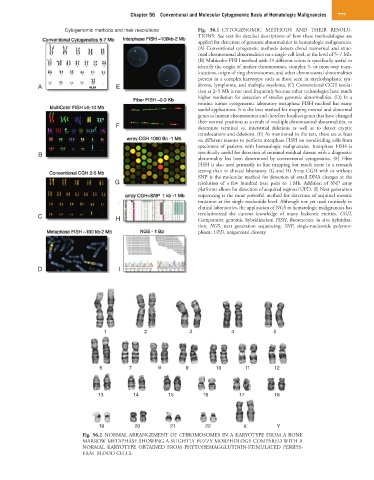
                      Cytogenomic methods and their resolutions   Fig.  56.1  CYTOGENOMIC  METHODS  AND  THEIR  RESOLU-
                                                                  TIONS. See text for detailed descriptions of how these methodologies are
                                                                  applied for detection of genomic abnormalities in hematologic malignancies.
                                                                  (A) Conventional cytogenetic methods detects clonal numerical and struc-
                                                                  tural chromosomal abnormalities on a single-cell level, at the level of 5–7 Mb.
                                                                  (B) Multicolor FISH method with 24 different colors is specifically useful to
                                                                  identify the origin of marker chromosomes, complex 3- or more-way trans-
                                                                  locations, origin of ring chromosomes, and other chromosomal abnormalities
                                                                  present in a complex karyotype such as those seen in myelodysplastic syn-
             A                         E                          drome, lymphoma, and multiple myeloma. (C) Conventional CGH resolu-
                                                                  tion at 2–5 Mb is not used frequently because other technologies have much
                                                                  higher resolution for detection of smaller genomic abnormalities. (D) In a
                                                                  routine tumor cytogenomic laboratory metaphase FISH method has many
                                                                  useful applications. It is the best method for mapping normal and abnormal
                                                                  genes to human chromosomes and therefore localizes genes that have changed
                                                                  their normal positions as a result of multiple chromosomal abnormalities, to
                                       F                          determine  terminal  vs.  interstitial  deletions  as  well  as  to  detect  cryptic
                                                                  translocations and deletions. (E) As mentioned in the text, there are at least
                                                                  six different reasons to perform interphase FISH on nondividing cells from
                                                                  specimens  of  patients  with  hematologic  malignancies.  Interphase  FISH  is
              B                                                   specifically useful for detection of minimal-residual disease with a diagnostic
                                                                  abnormality  has  been  determined  by  conventional  cytogenetics.  (F)  Fiber
                                                                  FISH is also used primarily in fine mapping but much more in a research
                                                                  setting than in clinical laboratory. (G and H) Array CGH with or without
                                                                  SNP is the molecular method for detection of small DNA changes at the
                                       G                          resolution  of  a  few  hundred  base  pairs  to  1 Mb.  Addition  of  SNP  array
                                                                  platforms allows for detection of acquired regional UPD. (I) Next generation
                                                                  sequencing is the most powerful method for detection of acquired somatic
                                                                  mutation at the single nucleotide level. Although not yet used routinely in
                                                                  clinical laboratories, the application of NGS to hematologic malignancies has
             C                         H                          revolutionized  the  current  knowledge  of  many  leukemic  entities.  CGH,
                                                                  Comparative  genomic  hybridization;  FISH,  fluorescence  in  situ  hybridiza-
                                                                  tion;  NGS,  next  generation  sequencing;  SNP,  single-nucleotide  polymor-
                                                                  phism; UPD, uniparental disomy.


             D                          I


                                   1            2              3             4             5


                                  6        7         8        9         10       11        12


                                 13          14         15         16          17          18


                                 19          20          21         22           X          Y
                            Fig. 56.2  NORMAL ARRANGEMENT OF CHROMOSOMES IN A KARYOTYPE FROM A BONE
                            MARROW METAPHASE SHOWING A SLIGHTLY FUZZY MORPHOLOGY COMPARED WITH A
                            NORMAL  KARYOTYPE  OBTAINED  FROM  PHYTOHEMAGGLUTININ-STIMULATED  PERIPH-
                            ERAL BLOOD CELLS.

