


Page 895 - Hematology_ Basic Principles and Practice ( PDFDrive )
P. 895
778    Part VII  Hematologic Malignancies


                                                              abnormalities  in  nondividing,  interphase  nuclei  (Fig.  56.5).  Six
                                                              aspects  of  interphase  FISH  are  particularly  useful:  (1)  Interphase
                                                              cytogenetics allows screening of a large number of cells. This permits
                                                              investigation of hematologic malignancies with a low mitotic yield,
                                                              such as chronic lymphocytic leukemia (CLL) or multiple myeloma
                                                              (MM). (2) Interphase FISH permits detection of chromosomal rear-
                                                              rangements in peripheral blood samples, thus obviating the need for
                                                              marrow aspiration. For instance, in CML, which rarely yields a large
                                                              number of dividing cells in peripheral blood, conventional cytogenet-
                  A                                           ics  usually  is  uninformative.  However,  detection  of  BCR-ABL1,  a
                                                              molecular  equivalent  of  the  Philadelphia  chromosome  (Ph),  in
                                                              peripheral blood using interphase FISH provides reliable, fast, quan-
                                                              titative results (see the section on Chronic Myelogenous Leukemia
                                                              later in this chapter). (3) Interphase FISH offers a quantitative assay
                                                              for monitoring disease progression or detection of minimal residual
                                                              disease  after  ablative  chemotherapy  or  hematopoietic  stem  cell
                                                              transplantation.  (4)  Use  of  specific  probe  sets  allows  detection  of
                                                              specific  disease-associated  abnormalities  such  as  t(8;21),  which
                  B                                           denotes  the  M2  subtype  of  acute  myeloid  leukemia  (AML),  or
                                                              t(15;17),  which  is  associated  with  acute  promyelocytic  leukemia
                                                              (APL), within 4 hours, allowing for timely and appropriate therapy.
                                                              (5) Abnormalities can be detected accurately in archival specimens
                                                              stored for up to 15 years. (6) Simultaneous use of interphase FISH
                                                              and  immunophenotyping  is  a  powerful  tool  for  investigation  of
                                                              lineage involvement in diseases such as myelodysplasia and to deter-
                                                              mine which cell population carries the specific chromosome abnor-
                  C                                           mality. FISH nomenclature is described in the International System
                                                              for Human Cytogenetic Nomenclature.
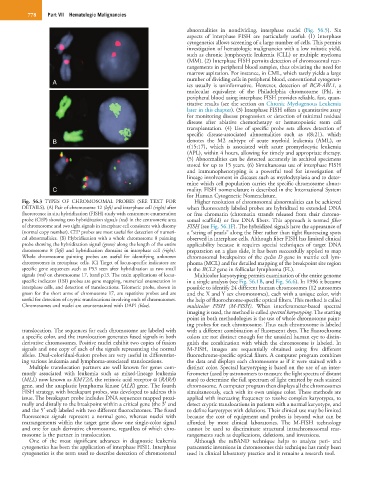
        Fig.  56.3  TYPES  OF  CHROMOSOMAL  PROBES  (SEE  TEXT  FOR   Higher resolution of chromosomal abnormalities can be achieved
        DETAILS). (A) Pair of chromosome 12 (left) and interphase cell (right) after   when fluorescently labeled probes are hybridized to extended DNA
        fluorescence in situ hybridization (FISH) study with centromere enumeration   or  free  chromatin  (chromatin  strands  released  from  their  chromo-
        probe (CEP) showing two hybridization signals (red) in the centromeric area   somal  scaffold)  or  free  DNA  fibers. This  approach  is  termed  fiber
        of chromosome and two tight signals in interphase cell consistent with disomy   FISH (see Fig. 56.1F). The hybridized signals have the appearance of
        (normal copy number). CEP probes are most useful for detection of numeri-  a “string of pearls” along the fiber rather than tight fluorescing spots
        cal abnormalities. (B) Hybridization with a whole chromosome 8 painting   observed in interphase cells. Although fiber FISH has limited clinical
        probe showing the hybridization signal (green) along the length of the entire   applicability  because  it  requires  special  techniques  of  target  DNA
        chromosome  8  (left)  and  hybridization  domains  in  interphase  cell  (right).   preparation on a glass slide, it has been successfully applied to map
        Whole  chromosome  painting  probes  are  useful  for  identifying  unknown   chromosomal breakpoints of the cyclin D gene in mantle cell lym-
        chromosomes in metaphase cells. (C) Target of locus-specific indicators are   phoma (MCL) and for detailed mapping of the breakpoint site region
        specific  gene  sequences  such  as  P53  seen  after  hybridization  as  two  small   in the BCL2 gene in follicular lymphoma (FL).
        signals (red) on chromosome 17, band p13. The main applications of locus-  Multicolor karyotyping permits examination of the entire genome
        specific indicator (LSI) probes are gene mapping, numerical enumeration in   in a single analysis (see Fig. 56.1B, and Fig. 56.6). In 1996 it became
        interphase cells, and detection of translocations. Telomeric probe, shown in   possible to identify 24 different human chromosomes (12 autosomes
        green for the short arms of chromosome 17, are repetitive probes and are   and the X and Y sex chromosomes), each with a unique color, with
        useful for detection of cryptic translocations involving ends of chromosomes.   the help of fluorochrome-specific optical filters. This method is called
        Chromosomes and nuclei are counterstained with DAPI (blue).   multicolor  FISH  (M-FISH).  When  interferometer-based  spectral
                                                              imaging is used, the method is called spectral karyotyping. The starting
                                                              point in both methodologies is the use of whole chromosome paint-
                                                              ing probes for each chromosome. Thus each chromosome is labeled
        translocation. The sequences for each chromosome are labeled with   with a different combination of fluorescent dyes. The fluorochrome
        a specific color, and the translocation generates fused signals in both   colors are not distinct enough for the unaided human eye to distin-
        derivative chromosomes. Positive nuclei exhibit two copies of fusion   guish  the  combination  with  which  the  chromosome  is  labeled.  In
        signals and one copy of each of the signals representing the normal   M-FISH,  images  are  sequentially  obtained  using  five  different
        alleles. Dual-color/dual-fusion probes are very useful in differentiat-  fluorochrome-specific optical filters. A computer program combines
        ing various leukemia and lymphoma-associated translocations.  the data and displays each chromosome as if it were stained with a
           Multiple  translocation  partners  are  well  known  for  genes  com-  distinct color. Spectral karyotyping is based on the use of an inter-
        monly  associated  with  leukemia  such  as  mixed-lineage  leukemia   ferometer (used by astronomers to measure the light spectra of distant
        (MLL) now known as KMT2A, the retinoic acid receptor α (RARA)   stars) to determine the full spectrum of light emitted by each stained
        gene, and the anaplastic lymphoma kinase (ALK) gene. The fourth   chromosome. A computer program then displays all the chromosomes
        FISH strategy, with breakapart probes, was developed to address this   simultaneously, each with its own unique color. These methods are
        issue. The breakapart probe includes DNA sequences mapped proxi-  applied with increasing frequency to resolve complex karyotypes, to
        mally and distally to the breakpoint within a critical gene (the 3′ end   detect cryptic translocations in patients with a normal karyotype, and
        and the 5′ end) labeled with two different fluorochromes. The fused   to define karyotypes with deletions. Their clinical use may be limited
        fluorescence  signals  represent  a  normal  gene,  whereas  nuclei  with   because the cost of equipment and probes is beyond what can be
        rearrangements within the target gene show one single-color signal   afforded  by  most  clinical  laboratories.  The  M-FISH  technology
        and one for each derivative chromosome, regardless of which chro-  cannot  be  used  to  discriminate  structural  intrachromosomal  rear-
        mosome is the partner in translocation.               rangements such as duplications, deletions, and inversions.
           One  of  the  most  significant  advances  in  diagnostic  leukemia   Although  the  mBAND  technique  helps  to  analyze  peri-  and
        cytogenetics has been the application of interphase FISH. Interphase   paracentric inversions in chromosomes this technique has rarely been
        cytogenetics is the term used to describe detection of chromosomal   used in clinical laboratory practice and it remains a research tool.

