


Page 897 - Hematology_ Basic Principles and Practice ( PDFDrive )
P. 897
780    Part VII  Hematologic Malignancies


                           Interphase


                                         Early Prophase


                                                     Late Prophase

             Interphase
               FISH
                                                                 Prometaphase


                                                                             Metaphase


                                         Conventional
                                         Cytogenetics
                                                                                         Anaphase


                                                                                                  Late Anaphase


                                                                                                   Telophase
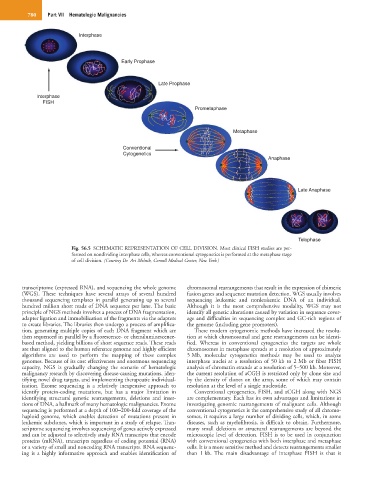
                        Fig. 56.5  SCHEMATIC REPRESENTATION OF CELL DIVISION. Most clinical FISH studies are per-
                        formed on nondividing interphase cells, whereas conventional cytogenetics is performed at the metaphase stage
                        of cell division. (Courtesy Dr. Ari Melnik, Cornell Medical Center, New York.)


        transcriptome (expressed RNA), and sequencing the whole genome   chromosomal rearrangements that result in the expression of chimeric
        (WGS).  These  techniques  have  several  arrays  of  several  hundred   fusion genes and sequence mutation detection. WGS usually involves
        thousand sequencing templates in parallel generating up to several   sequencing  leukemic  and  nonleukemic  DNA  of  an  individual.
        hundred million short reads of DNA sequence per lane. The basic   Although  it  is  the  most  comprehensive  modality,  WGS  may  not
        principle of NGS methods involves a process of DNA fragmentation,   identify all genetic alterations caused by variation in sequence cover-
        adapter ligation and immobilization of the fragments via the adapters   age and difficulties in sequencing complex and GC-rich regions of
        to create libraries. The libraries then undergo a process of amplifica-  the genome (including gene promoters).
        tion, generating multiple copies of each DNA fragment which are   These modern cytogenomic methods have increased the resolu-
        then sequenced in parallel by a fluorescence- or chemiluminescence-  tion at which chromosomal and gene rearrangements can be identi-
        based method, yielding billions of short sequence reads. These reads   fied.  Whereas  in  conventional  cytogenetics  the  targets  are  whole
        are then aligned to the human reference genome and highly efficient   chromosomes in metaphase spreads at a resolution of approximately
        algorithms  are  used  to  perform  the  mapping  of  these  complex   5 Mb,  molecular  cytogenetics  methods  may  be  used  to  analyze
        genomes. Because of its cost effectiveness and enormous sequencing   interphase  nuclei  at  a  resolution  of  50 kb  to  2 Mb  or  fiber  FISH
        capacity,  NGS  is  gradually  changing  the  scenario  of  hematologic   analysis of chromatin strands at a resolution of 5–500 kb. Moreover,
        malignancy research by discovering disease-causing mutations, iden-  the current resolution of aCGH is restricted only by clone size and
        tifying novel drug targets, and implementing therapeutic individual-  by the density of clones on the array, some of which may contain
        ization.  Exome  sequencing  is  a  relatively  inexpensive  approach  to   resolution at the level of a single nucleotide.
        identify  protein-coding  mutations,  but  has  a  major  limitation  in   Conventional cytogenetics, FISH, and aCGH along with NGS
        identifying  structural  genetic  rearrangements,  deletions  and  inser-  are complementary. Each has its own advantages and limitations in
        tions of DNA, a hallmark of many hematologic malignancies. Exome   investigating genomic rearrangements of malignant cells. Although
        sequencing is performed at a depth of 100–200-fold coverage of the   conventional cytogenetics is the comprehensive study of all chromo-
        haploid  genome,  which  enables  detection  of  mutations  present  in   somes, it requires a large number of dividing cells, which, in some
        leukemic subclones, which is important in a study of relapse. Tran-  diseases,  such  as  myelofibrosis,  is  difficult  to  obtain.  Furthermore,
        scriptome sequencing involves sequencing of genes actively expressed   many  small  deletions  or  structural  rearrangements  are  beyond  the
        and can be adjusted to selectively study RNA transcripts that encode   microscopic level of detection. FISH is to be used in conjunction
        proteins (mRNA), transcripts regardless of coding potential (RNA)   with conventional cytogenetics with both interphase and metaphase
        or a variety of small and noncoding RNA transcripts. RNA sequenc-  cells. It is a more sensitive method and detects rearrangements smaller
        ing  is  a  highly  informative  approach  and  enables  identification  of   than  1 kb.  The  main  disadvantage  of  interphase  FISH  is  that  it

