


Page 896 - Hematology_ Basic Principles and Practice ( PDFDrive )
P. 896
Chapter 56  Conventional and Molecular Cytogenomic Basis of Hematologic Malignancies  779


                         A                           B                            C


                         D                           E                            F

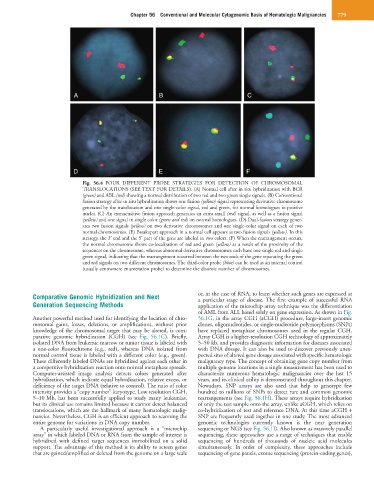
                            Fig.  56.4  FOUR  DIFFERENT  PROBE  STRATEGIES  FOR  DETECTION  OF  CHROMOSOMAL
                            TRANSLOCATIONS (SEE TEXT FOR DETAILS). (A) Normal cell after in situ hybridization with BCR
                            (green) and ABL (red) showing a normal distribution of two red and two green single signals. (B) Conventional
                            fusion strategy after in situ hybridization shows one fusion (yellow) signal representing derivative chromosome
                            generated by the translocation and one single-color signal, red and green, for normal homologues in positive
                            nuclei. (C) An extrasensitive fusion approach generates an extra small (red) signal, as well as a fusion signal
                            (yellow) and one signal in single color (green and red) on normal homologues. (D) Dual-fusion strategy gener-
                            ates two fusion signals (yellow) on two derivative chromosomes and one single-color signal on each of two
                            normal chromosomes. (E) Breakapart approach in a normal cell appears as two fusion signals (yellow). In this
                            strategy, the 3′ end and the 5′ part of the gene are labeled in two colors. (F) When the rearrangement occurs,
                            the normal chromosome shows co-localization of red and green (yellow) as a result of the proximity of the
                            sequences on the chromosome, whereas abnormal derivative chromosomes each have one single red and single
                            green signal, indicating that the rearrangement occurred between the two ends of the gene separating the green
                            and red signals on two different chromosomes. The third-color probe (blue) can be used as an internal control
                            (usually centromere enumeration probe) to determine the disomic number of chromosomes.


            Comparative Genomic Hybridization and Next            or, in the case of RNA, to learn whether such genes are expressed at
                                                                  a  particular  stage  of  disease. The  first  example  of  successful  RNA
            Generation Sequencing Methods                         application of the microchip array technique was the differentiation
                                                                  of AML from ALL based solely on gene expression. As shown in Fig.
            Another powerful method used for identifying the location of chro-  56.1G, in the array CGH (aCGH) procedure, large-insert genomic
            mosomal  gains,  losses,  deletions,  or  amplifications,  without  prior   clones, oligonucleotides, or single-nucleotide polymorphisms (SNPs)
            knowledge of the chromosomal target that may be altered, is com-  have  replaced  metaphase  chromosomes  used  in  the  regular  CGH.
            parative  genomic  hybridization  (CGH)  (see  Fig.  56.1C).  Briefly,   Array CGH is a higher-resolution CGH technology of approximately
            isolated DNA from leukemic marrow or tumor tissue is labeled with   5–50 kb, and provides diagnostic information for diseases associated
            a  one-color  fluorochrome  (e.g.,  red),  whereas  DNA  isolated  from   with DNA dosage. It can also be used to discover previously unex-
            normal control tissue is labeled with a different color (e.g., green).   pected sites of altered gene dosage associated with specific hematologic
            These differently labeled DNAs are hybridized against each other in   malignancy type. The concept of obtaining gene copy number from
            a competitive hybridization reaction onto normal metaphase spreads.   multiple genome locations in a single measurement has been used to
            Computer-assisted  image  analysis  detects  colors  generated  after   characterize  numerous  hematologic  malignancies  over  the  last  15
            hybridization, which indicate equal hybridization, relative excess, or   years, and its clinical utility is demonstrated throughout this chapter.
            deficiency of the target DNA (relative to control). The ratio of color   Nowadays,  SNP  arrays  are  also  used  that  help  to  genotype  few
            intensity provides a “copy number” karyotype. Low resolution CGH,   hundred to millions of SNPs to detect rare and common genomic
            5–10 Mb, has been successfully applied to study many leukemias,   rearrangements (see Fig. 56.1H). These arrays require hybridization
            but its clinical use remains limited because it cannot detect balanced   of only the test sample onto the array, unlike aCGH, which relies on
            translocations, which are the hallmark of many hematologic malig-  co-hybridization of test and reference DNA. At this time aCGH +
            nancies. Nevertheless, CGH is an efficient approach to scanning the   SNP are frequently used together in one study. The most advanced
            entire genome for variations in DNA copy number.      genomic  technologies  currently  known  is  the  next  generation
              A  particularly  useful  investigational  approach  is  a  “microchip   sequencing or NGS (see Fig. 56.1I). Also known as massively parallel
            array” in which labeled DNA or RNA from the sample of interest is   sequencing, these approaches use a range of techniques that enable
            hybridized  with  defined  target  sequences  immobilized  on  a  solid   sequencing  of  hundreds  of  thousands  of  nucleic  acid  molecules
            support. The advantage of this method is its ability to screen genes   simultaneously.  In  order  of  complexity,  these  approaches  include
            that are gained/amplified or deleted from the genome on a large scale   sequencing of gene panels, exome sequencing (protein-coding genes),

