


Page 898 - Hematology_ Basic Principles and Practice ( PDFDrive )
P. 898
Chapter 56  Conventional and Molecular Cytogenomic Basis of Hematologic Malignancies  781


                     1                    2                     3                     4                    5


                  6              7              8               9             10              11             12


                  13                14                15                16                17                18


                  19                20                21               22                X                  Y


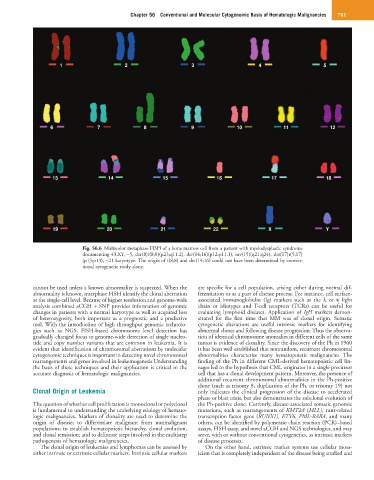
                            Fig. 56.6  Multicolor metaphase FISH of a bone marrow cell from a patient with myelodysplastic syndrome
                            documenting 43,XY, −5, der(8)t(8;8)(p23;q11.2), der(14;16)(p12;p11.1), inv(15)(q21;q24), der(17)t(5;17)
                            (p13;p13), −21 karyotype. The origin of t(8;8) and der(14;16) could not have been determined by conven-
                            tional cytogenetic study alone.


            cannot be used unless a known abnormality is suspected. When the   are specific for a cell population, arising either during normal dif-
            abnormality is known, interphase FISH identify the clonal aberration   ferentiation or as a part of disease process. For instance, cell surface-
            at the single-cell level. Because of higher resolution and genome-wide   associated  immunoglobulin  (Ig)  markers  such  as  the  λ  or  κ  light
            analysis combined aCGH + SNP provides information of genomic   chain  or  idiotypes  and  T-cell  receptors  (TCRs)  can  be  useful  for
            changes in patients with a normal karyotype as well as acquired loss   evaluating  lymphoid  diseases.  Application  of  IgH  markers  demon-
            of heterozygosity, both important as a prognostic and a predictive   strated  for  the  first  time  that  MM  was  of  clonal  origin.  Somatic
            tool. With the introduction of high throughput genomic technolo-  cytogenetic  alterations  are  useful  intrinsic  markers  for  identifying
            gies  such  as  NGS,  FISH-based  chromosome  level  detection  has   abnormal clones and following disease progression. Thus the observa-
            gradually changed focus to genome-wide detection of single nucleo-  tion of identical chromosome anomalies in different cells of the same
            tide and copy number variants that are common in leukemia. It is   tumor is evidence of clonality. Since the discovery of the Ph in 1960
            evident that identification of chromosomal aberrations by molecular   it has been well established that nonrandom, recurrent chromosomal
            cytogenomic techniques is important in detecting novel chromosomal   abnormalities  characterize  many  hematopoietic  malignancies.  The
            rearrangements and genes involved in leukemogenesis Understanding   finding of the Ph in different CML-derived hematopoietic cell lin-
            the basis of these techniques and their application is critical in the   eages led to the hypothesis that CML originates in a single precursor
            accurate diagnosis of hematologic malignancies.       cell that has a clonal development pattern. Moreover, the presence of
                                                                  additional recurrent chromosomal abnormalities in the Ph-positive
                                                                  clone (such as trisomy 8, duplication of the Ph, or trisomy 19) not
            Clonal Origin of Leukemia                             only indicates the clinical progression of the disease to accelerated
                                                                  phase or blast crisis, but also demonstrates the subclonal evolution of
            The question of whether cell proliferation is monoclonal or polyclonal   the Ph-positive clone. Currently, disease-associated somatic genomic
            is fundamental to understanding the underlying etiology of hemato-  mutations, such as rearrangements of KMT2A (MLL), runt-related
            logic malignancies. Markers of clonality are used to determine the   transcription factor gene (RUNX1), ETV6, PML-RARA, and many
            origin  of  disease;  to  differentiate  malignant  from  nonmalignant   others, can be identified by polymerase chain reaction (PCR)–based
            populations; to establish hematopoietic hierarchy, clonal evolution,   assays, FISH assay, and novel aCGH and NGS technologies, and may
            and clonal remission; and to delineate steps involved in the multistep   serve, with or without conventional cytogenetics, as intrinsic markers
            pathogenesis of hematologic malignancies.             of disease processes.
              The clonal origin of leukemias and lymphomas can be assessed by   On the other hand, extrinsic marker systems use cellular mosa-
            either intrinsic or extrinsic cellular markers. Intrinsic cellular markers   icism that is completely independent of the disease being studied and

